U.S. and EU signal "converging" views on China

Add Axios as your preferred source to
see more of our stories on Google.
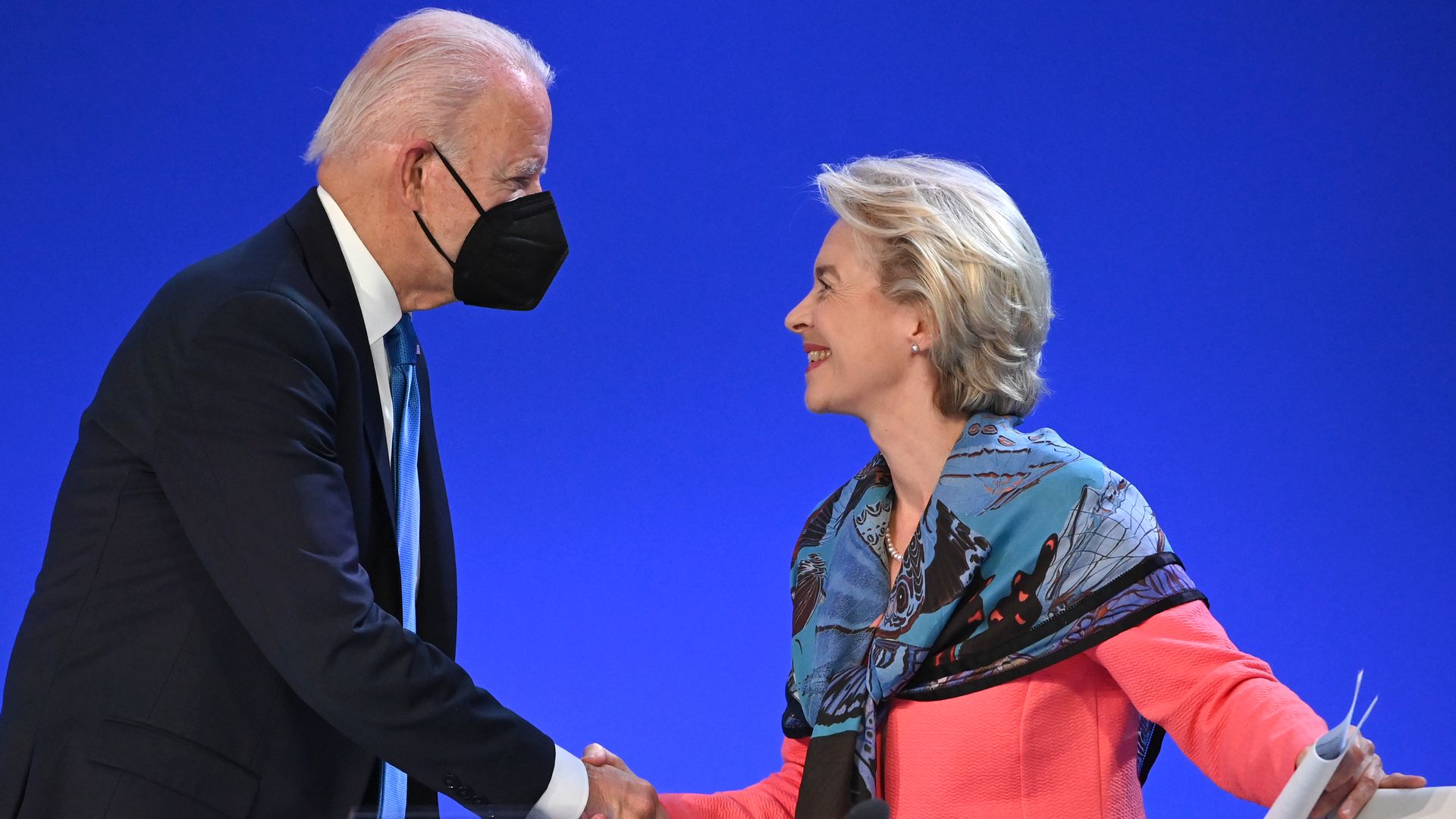
President Biden and European Commission President Ursula von der Leyen. Photo: Jeff J Mitchell - Pool/Getty Images
The U.S. and the European Union are adopting "increasingly convergent" views on the threat posed by the Chinese government, according to senior Biden administration officials, deepening a trend that could tilt the scales in an era of great power competition.
Why it matters: European leaders were initially wary of President Biden's campaign to rally a coalition of U.S. allies to challenge China, hoping to duck a confrontation between the bloc's two largest trading partners. But the winds in Europe seem to be shifting, in part due to Beijing's growing belligerence.
Driving the news: The U.S. and EU released a lengthy joint statement on Thursday pledging "continuous and close contacts" to "manage our competition and systemic rivalry with China responsibly."
- The statement followed the second high-level U.S.-EU Dialogue on China, led by Deputy Secretary of State Wendy Sherman — who has been tipped as State's point person on China — and EU diplomat Stefano Sannino.
- A day earlier, the European Commission unveiled a €300 billion ($339 billion) "Global Gateway" development program designed to counter China's Belt and Road Initiative. The premise is similar to Biden's "Build Back Better World" initiative.
Meanwhile the incoming German government — which mentioned Taiwan for the first time ever in its coalition agreement — is expected to move away from Chancellor Angela Merkel's pro-business, "dialogue-first" approach, says Noah Barkin, an EU-China analyst with Rhodium Group.
- "We Europeans shouldn't make ourselves smaller than we are," Germany's incoming foreign minister, Annalena Baerbock, told a German newspaper this week. "China has massive interests on EU market. We should use leverage of common market much more strongly."
Flashback: A year ago, Merkel was pushing to finalize a major EU-China investment deal over objections from the incoming Biden administration.
- That deal was torpedoed when — in response to relatively modest human rights sanctions from the EU on Chinese officials — Beijing blacklisted several EU lawmakers.
- China hawks in the EU were emboldened by the response, and relations have been slowly degrading ever since.
Between the lines: "The mood is shifting in Europe, but slowly and not at the same pace in every member state," Raphaël Glucksman, a lawmaker who chaired the European Parliament's first-ever official delegation to Taiwan, told Axios in a recent interview.
- Some EU countries are happy to embrace the hardline U.S. approach China — or, in the case of Lithuania, go even further. Beijing downgraded its diplomatic ties with Lithuania this week after the Baltic nation allowed Taiwan to open a de facto embassy in Vilnius.
- Other member states like Hungary, which has built close ties with China, may continue to act as a spoiler in the EU's consensus-driven foreign policy.
