Team Hillary blames Obama more than Putin - Axios
Featured

Team Hillary blames Obama more than Putin

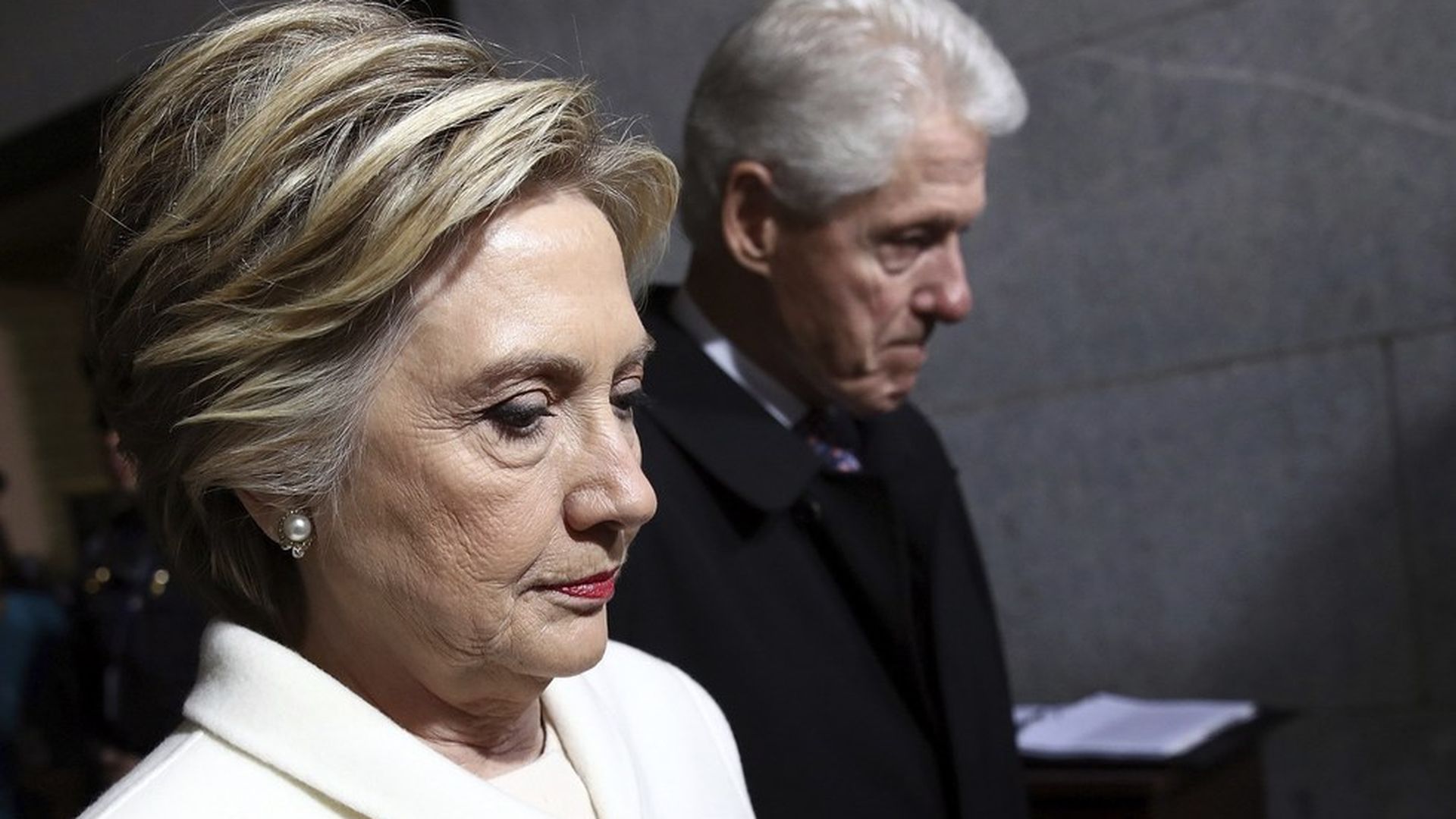
Win McNamee / AP

The worst-kept secret inside Democratic circles is how bitter Hillary Clinton's team is at President Obama over her election loss. We have heard from numerous, anguished people in Clinton-land blaming Obama -- more than Putin, FBI Director James Comey or, um, Hillary herself -- for the defeat.

The reason: Clintonites feel that if Obama had come out early and forcefully with evidence of Russian interference in the campaign, and perhaps quicker sanctions, she might be president today. His caution, they argue, allowed the public to have a foggy sense of clear, calculated, consistent Russian meddling in the campaign. We can't stress enough how upset some Democrats are. It's testing relationships between Clinton and Obama loyalists. It's making efforts to form a new Trump opposition coalition harder.

A Clinton campaign official told us: "The White House was like everyone else: They thought she'd win anyway. ... If he had done more, it might have lessened a lot of aggrieved feelings, although I don't think it would have altered the outcome. The Russia thing was like a spy novel, and anything he had said or done would have helped get people to believe it was real."

On the flip side: Obama has let it be known that he remains befuddled on how she missed what to him was an easy layup of a win, given his own popularity on Election Day and Trump's vulgarity:

  • A top Obama aide told us the White House was very deliberate about not being seen as politicizing the hacks. The aide said the first priority was making sure that the actual voting was untainted, and coordination with Republican state officials would have collapsed if Obama was seen as grandstanding.
  • Obama acknowledged the issue at his year-end news conference: "I know that there is been folks out there who suggested that somehow if we went out there and made big announcements and thumped our chests about a bunch of stuff, that somehow that would potentially spook the Russians ... [T]he idea that somehow public shaming is going to be effective, I think doesn't read the thought process in Russia very well."
Featured

U.S. condemns North Korean "escalation"

Cliff Owen / AP

Secretary of State Rex Tillerson confirms the U.S. believes North Korea launched an intercontinental ballistic missile. "Testing an ICBM represents a new escalation of the threat to the United States, our allies and partners, the region, and the world." He calls for the world to act against this "global threat" and says the U.S. will bring this latest act before the UN Security Council.

Featured

Biggest threat to Trump’s America

This image, from a news bulletin aired today by North Korea's KRT, is said to show North Korea leader Kim Jong-un applauding after the launch of a Hwasong-14 (KRT via AP Video)

In their final conversations during the transition, Barack Obama issued a stark warning to Donald Trump: North Korea presents the most urgent, alarming, and bedeviling threat you will confront as head of the free world.

  • Today, North Korea showed why: The regime claims to have successfully tested a missile that could carry a nuclear bomb and hit Alaska (Update: U.S. officials now believe it may have been that type of missile; Secretary of State Tillerson condemns launch as "escalation.")
  • Trump's tweets: "North Korea has just launched another missile. Does this guy have anything better to do with his life? Hard to believe that South Korea ... and Japan will put up with this much longer. Perhaps China will put a heavy move on North Korea and end this nonsense once and for all!"
  • What North Korea said, via AP: "[T]he test of an ICBM — the Hwasong-14 — marked the 'final step' in creating a 'confident and powerful nuclear state that can strike anywhere on Earth.'"

This doesn't mean the United States faces an imminent threat, because intelligence suggests the regime is a ways from getting the technology right to shoot a missile with sufficient distance and nuclear capacity. But this is a huge deal and here's why, from the N.Y. Times:

"The missile looked like the longest-range missile that North Korea had ever tested, and its long flight time was 'more consistent with an ICBM that can target Alaska and perhaps Hawaii,' said Jeffrey Lewis, director of the East Asia Nonproliferation Program at the Middlebury Institute of International Studies."
"'Even if this is a 7,000-km-range missile, a 10,000-km-range missile that can hit New York isn't far off.'"

The path of the rocket, via an AP graphic:

AP

Go deeper: Axios Expert Voices charts five courses of action for the U.S. confrontation with North Korea.

Featured

Happy Independence Day

Still great after 241 years. Axios thanks all those who work to keep it that way.

Featured

Indiana GOP request for health care "horror stories" backfires

Indiana GOP Facebook page

The Indiana Republican Party's quest for Affordable Care Act "horror stories" didn't really go according to plan, the Indianapolis Star reports. When the party in Vice President Mike Pence's home state put out a Facebook request for stories about bad things — rising premiums, fleeing insurers, burdensome regulations — it instead got flooded with stories about good things, like people getting health insurance.

Why it matters: The outcome was predictable, given how the Internet works — you're never, ever just reaching like-minded people. But it's also a good measure of where the energy is in the ACA debate right now. Sure, the Indiana GOP will find people who suffered premium hikes or lost their insurers, because that is part of what's happening. But there are also a lot of people who were personally helped by the ACA — and that's the side that is now fighting back.

Featured

U.S. believes North Korea tested an ICBM

This photo distributed by the North Korean government shows what was said to be the launch of a Hwasong-14 intercontinental ballistic missile, ICBM, in North Korea's northwest, Tuesday, July 4, 2017. Independent journalists were not given access to cover the event depicted in this photo. (Korean Central News Agency/Korea News Service via AP)

The missile test carried out by North Korea was of an intercontinental ballistic missile that could possibly reach Alaska, unidentified U.S. officials are telling Fox News, CNN and NBC News. CNN reported earlier that should it be determined to have been an ICBM test, any response to would be "measured" and could include sending more troops or aircraft to the region or imposing more sanctions.

Why this matters: A missile that could travel as many as 4,000 miles and hit Alaska represents continued progress by the North Koreans on their missile program and the achievement of a goal that President Trump had said in January "won't happen."

Go deeper: Axios Expert Voices on dealing with North Korea

Featured

The future is live

Data: Magid; Chart: Chris Canipe / Axios

Live boom: Facebook launched its live platform last year and now says 1 in 5 videos on its platform are live and daily time spent watching Facebook Live broadcasts has grown by more than 4x.

Why it matters: The video duopoly of Facebook and YouTube is killing it in the arms race for live-streaming dominance, which should have traditional TV companies worried. Nearly half of online users watch live-streaming every week and nearly a quarter say they watch live-streaming every day, per Magid's latest social broadcasting study.

Facebook also announced earlier this year it's finally matching YouTube in giving publishers a 55 percent cut of ad dollars to seed its real-time offerings.

Both platforms have launched a ton of live-streaming partnerships around sports in particular. Why? Look at the type of programming watched live versus on DVR, via comScore:

  • Sports: 90% - 10%
  • News: 90% - 10%
  • Comedy: 85% - 15%
  • Movies: 85% - 15%
  • Reality: 75% - 25%
  • Drama: 71% - 29%
Featured

Trump reins in tariff temptation

Carolyn Kaster / AP

President Trump, who has expressed enthusiasm behind closed doors for harsh trade tariffs aimed at China, is headed — for now — toward a more moderate course.

  • Trump originally favored a hard line, but was told in a heated meeting that most of his staff and Cabinet were opposed. Economic adviser Gary Cohn and Treasury Secretary Steve Mnuchin argued privately that tough tariffs were bad economics at a time when the market and job rates are strong.
  • Trump left staff with the impression he would proceed with tariffs, but has tempered his views amid the internal pressure.
  • Before heading off to Europe tomorrow on the second international trip of his presidency, Trump tweeted: "Really great numbers on jobs & the economy! Things are starting to kick in now, and we have just begun! Don't like steel & aluminum dumping!"

The backstory: Indeed, steel and aluminum have been on Trump's mind for months. But it turns out that the U.S. imports little steel from China, and most of the steel we import isn't dumped (sold below cost).

The players: The most muscular internal enthusiasm for across-the-board tariffs comes from Steve Bannon and trade-policy director Peter Navarro. Commerce Secretary Wilbur Ross, a longtime friend of the president's, is seen as sharing Bannon's view but is cooler to outright tariffs.

The likely solution: With the caveat that Trump can always make unexpected decisions, the administration is headed toward a more tailored approach that targets China and countries through which it trans-ships steel — Vietnam, for example. That could include possible tariffs, based on unfair trade practices, like dumping.

What's next: The U.S. will need help from other countries to deal with China. A White House readout of a Trump call yesterday with German Chancellor Angela Merkel, ahead of this week's G-20 summit in Hamburg, said they discussed "global steel overcapacity" — a.k.a., the problem of Chinese dumping on the worldwide market.

Be smart: Read that as a signal that Trump plans a G-20 discussion of more collective action.

Featured

Exclusive: Astonishing poll about Trump and media

A stark poll by Survey Monkey finds that 89% of Republicans view President Trump as more trustworthy than CNN, and 91% of Democrats think the opposite. Among all adults, trust for CNN is 7 points ahead of Trump. Among independents, CNN wins by 15 points.

Why it matters, from SurveyMonkey's Jon Cohen: "The fight ... between the White House and major media outlets has made the question of truthfulness just as partisan-tinged as health care or other policies."

Data: SurveyMonkey; Chart: Lazaro Gamio / Axios

Asked whether they trust Trump or the WashPost/NYT more, the newspapers won by 9 points among all adults. Asked about Trump vs. ABC/CBS/NBC, the networks were judged more trustworthy by an 11-point margin. Republicans had a similar disproportionate trust in Trump.

The online poll of 4,965 adults, taken June 29 to July 3 (error estimate: +/- 2.5 points), found:

  • 33% of Republicans say they get their news only from Fox.
  • 64% of all adults disapprove of Trump's use of Twitter (89% Dems, 38% Republicans).
  • Describing his tweets (all adults): undignified 47% ... mean 34% ... entertaining 26% ... presidential 7%.

Jon Cohen, Survey Monkey's SVP, survey research, emails me his takeaways:

  • "A red flag for Democrats continues to be a perception that Trump is isolating himself from the GOP base with his tweets. Not only do most Republicans approve of his use of Twitter, but asked to describe those tweets, the No. 1 mention among the GOP is 'truthful,' with 'entertaining' in second place."
  • "[T]he biggest danger for Republicans is that they grow content with firing up the base: Fully three-quarters of pure independents (those that don't lean one way or the other) disapprove of Trump's tweeting, and their top three descriptors for it are 'undignified,' 'mean,' and 'dishonest.'"
Featured

A media wake-up call

AP Photo/Mark Schiefelbein, File

Forget President Trump's Twitter terrorism against big media companies. The real and urgent web-world threats that could truly bring down a New York Times or CNN are the escalating cyberattacks targeting media and the companies they rely on.

Why it matters: The entire digital ecosystem is far more vulnerable to cyberattacks -and far more ill-prepared to respond - than we realize. "A large part of this too comes from the fact that media companies are not at all prepared for these threats and the impact isn't always obvious until it's too late," says Asaf Cidon, CEO of cybersecurity firm Barracuda networks.

  • Last week, WPP, the global ad agency, and its subsidiary agencies were forced to shut down after a ransomware attack made their systems completely inoperable.
  • The day after the attack, Fastly, a content distribution network that acts as a backup for several mainstream media sites, like Reddit, The New York Times and Axios, went down due to an unrelated technical malfunction, leaving client websites vulnerable as a global ransomware attack was in motion.
  • In April, Google and Facebook, the two biggest tech giants globally, announced that they were the subject of a phishing scam worth over $100 million. And they have way better tech and security than conventional media companies.
  • Last October, a DDOS (bot-based) attack shut down half of the internet, including major media companies, like the Guardian, CNN and Twitter.

Even more pressing: As media organizations become more centralized through consolidation, security experts and safeguards get moved up the chain from the local level to far-flung city headquarters, leaving local outlets more vulnerable.

Be smart: Bone up on phishing attacks (a common and effective cyber-scam used to gain access to sensitive data through harmless click-here emails). Google sent journalists precautionary warnings of state-sponsored phishing attacks earlier this year.

Featured

Where veterans live in the United States

This map shows which counties in the United States have the highest concentration of veterans as a rate per 10 thousand people. Veteran population densities are higher in the Northwest, along the east coast from Florida up into the Chesapeake Bay and in counties near military installations.

Data: U.S. Department of Veterans Affairs, U.S. Census Bureau; Map: Lazaro Gamio / Axios

The data: The veteran population data used in the map are 2015 estimates published the Department of Veteran Affairs, which we compared to 2015 census population estimates to calculate the rate.

A caveat: You'll notice that many cities on this map show a very low rate, but that doesn't mean that they have low veteran populations. For example, Los Angeles is home to over 300 thousand veterans but has a population of over 10 million, bringing its rate to about 303 per 10 thousand. Another thing you'll notice is that rural counties show very high rates, but that's because things get tricky when populations are small.

Top 5 counties in veterans per 10 thousand people:

  1. Liberty County, Georgia — 2,007 per 10k (12,536 vets, 62,467 people)
  2. Okaloosa County, Florida — 1,792 per 10k (35,609 vets, 198,664 people)
  3. Geary County, Kansas — 1,754 per 10k (6,495 vets, 37,030 people)
  4. Cumberland County, North Carolina — 1,752 per 10k (5,6746 vets, 323,838 people)
  5. Sierra County, New Mexico — 1,706 per 10k (1,950 vets, 11,282 people)

Top 5 counties in total veteran population:

  1. Los Angeles County, California — 304 per 10k (308,834 vets, 10,170,282 people)
  2. Maricopa County (Phoenix), Arizona — 661 per 10k (275,494 vets, 4,167,947 people)
  3. San Diego County, California — 749 per 10k (246,972 vets, 3,299,521 people)
  4. Cook County (Chicago), Illinois — 364 per 10k (190,873 vets, 5,238,216 people)
  5. Harris County (Houston), Texas — 408 per 10k (185,085 vets, 4,538,028 people)