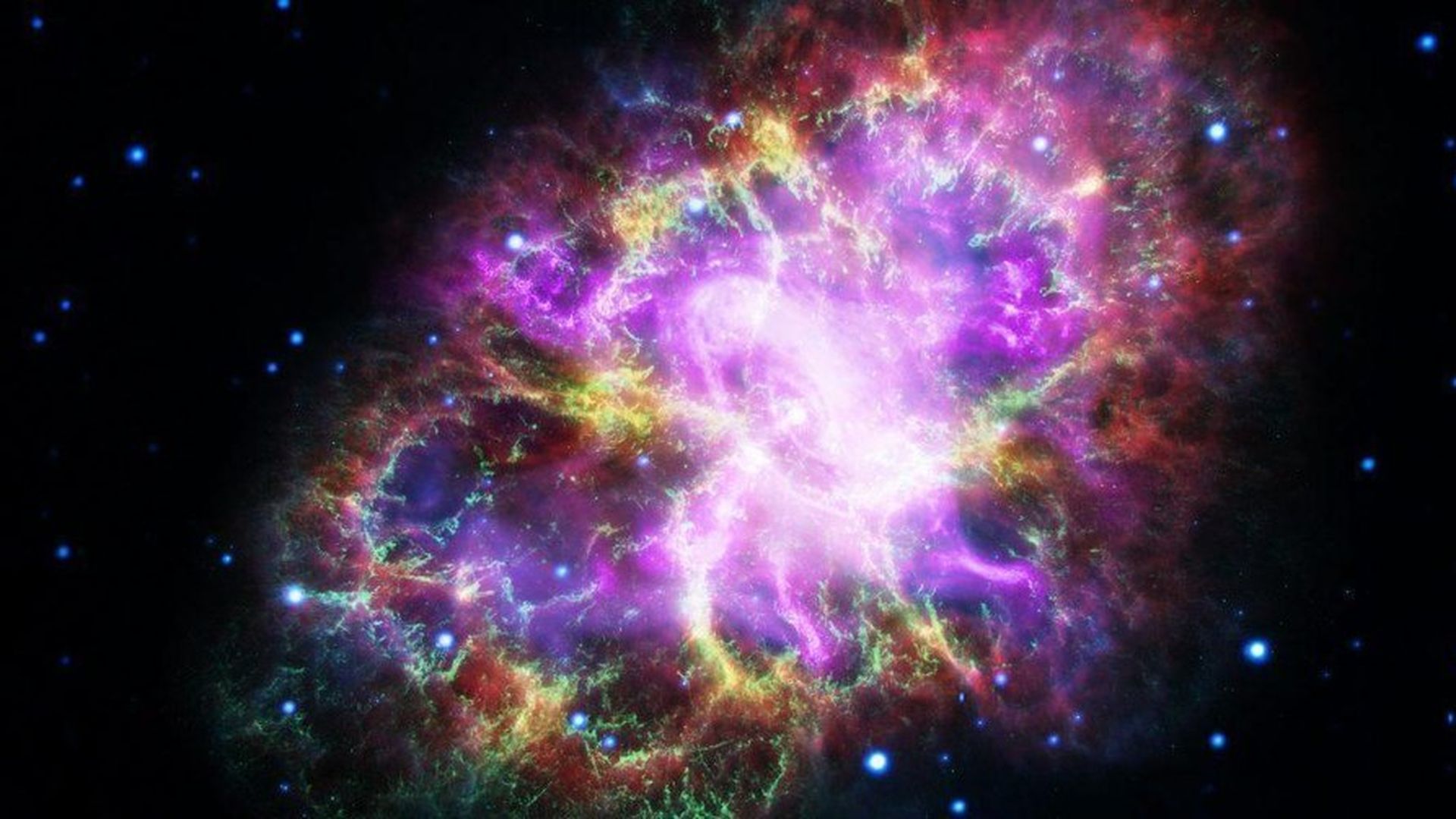
An amazing new image of the Crab Nebula, which is made up of the remnants of a bright supernova explosion that Chinese and other astronomers originally observed as a star in 1054, has been created by combining data from telescopes around the world.
Distance matters: The Crab Nebula is 6,500 light-years away from Earth — but NASA reports if it were 50 light-years away it would have irradiated Earth and killed off life at the time.
Why it looks the way it does: Neutrons at the center of the mass (called a pulsar), fast-moving particles coming from the pulsar, and the surrounding material that came from the original supernova explosion itself give the nebula it's unique shape.
To understand how seven tightly-packed Earth-sized planets orbit around their star (Trappist-1) without colliding or falling into space, scientists turned their orbits into musical notes.
How: Astronomers found that the planets are in a resonant orbit and can continue as such for billions of years. The rhythmic pattern inspired astrophysicist and musician Matt Russo to assign each of them a musical note based on their orbital period, and the result was something similar to a drum progression.
What's next? Though Trappist-1 is the only known planetary system whose planets orbit in resonance, this research could lead to a better understanding of how planets form and exist around other dwarf stars.