
April 10, 2025
It's Thursday. We made it!
- We'll send out newsletters on Tuesdays and Thursdays at 1:30pm ET during recess, plus any breaking news you need to know.
1 big thing: Axios Pro tracker: Tech policy bills to watch in 2025
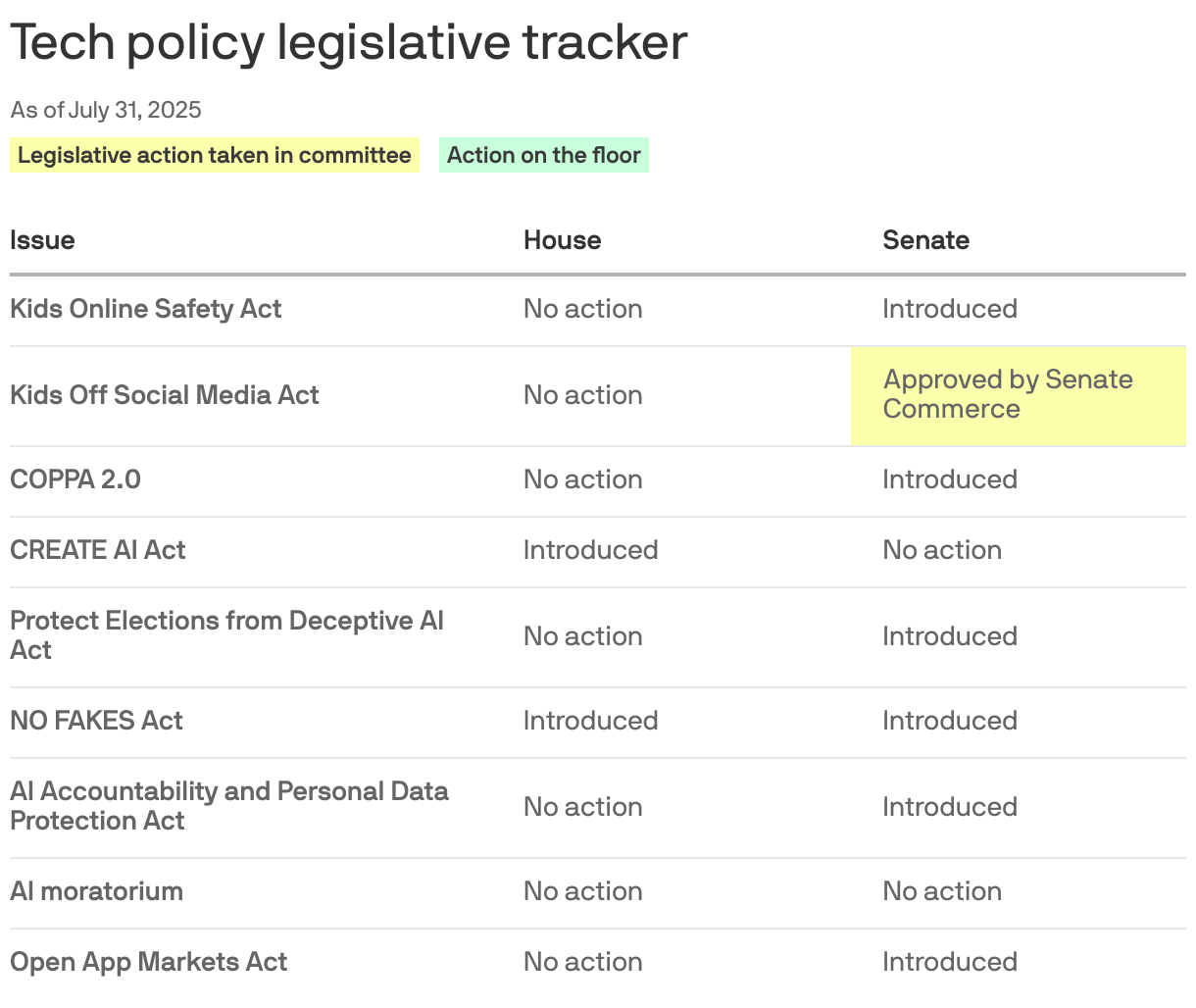
With lawmakers heading out for recess, here's our cheat sheet to keep tabs on the most consequential tech bills in play so far this year.
The big picture: A handful of bills that had real momentum last Congress around AI and kids' safety online have been reintroduced this session.
- But the prospects for bipartisan legislation are tough in an even more divided political climate under the new Trump administration.
Here's a rundown of what we're watching:
TAKE IT DOWN Act
The issue: The TAKE IT DOWN Act aims to tackle AI's supercharging of child sexual abuse material (CSAM) and non-consensual intimate images (NCII).
- The bill would require platforms to take down such content within 48 hours of being notified by the victim and criminalize posting it.
Status: The Senate unanimously passed the bill and the House Energy and Commerce Committee has advanced it.
What's next: A full House vote. The bill is a priority for House Speaker Mike Johnson and Majority Leader Steve Scalise.
Kids' online safety bills
The issue: The Kids Online Safety Act and COPPA 2.0 were not included in a recent E&C markup as sticking points remain among Republicans, particularly for KOSA. E&C Chair Brett Guthrie has said repeatedly he's committed to advancing the bill.
- The Kids Off Social Media Act would set a minimum age of 13 to use social media platforms.
Status: COPPA 2.0 has been reintroduced in the Senate. KOSA has not been reintroduced yet in either chamber. The Senate Commerce Committee has advanced KOSMA.
What's next: House Republicans are gaming out how they want to handle data privacy as a whole, soliciting comments from the public about a more comprehensive plan.
- Individual kids' safety bills are likely on the back burner.
CREATE AI Act
The issue: This bill would build out a national infrastructure for AI research, compute power and data, authorizing the development of the National Artificial Intelligence Research Resource (NAIRR).
Status: Last Congress, authorizing NAIRR was seen as an easy, bipartisan win for AI legislation, but it didn't make it over the finish line. Reps. Jay Obernolte and Don Beyer reintroduced it last month, but it has not yet been reintroduced in the Senate.
What's next: The bill is meant to expand participation in AI development beyond the largest tech companies. In an era where those companies have more sway than under the Biden administration, getting this bill to the president's desk may be a heavier lift.
Protect Elections from Deceptive AI Act
The issue: This bill would ban the use of AI to generate "materially deceptive content falsely depicting federal candidates" in election ads.
- Sen. Amy Klobuchar led the charge on AI and elections bills last Congress. Legislation advanced out of the Senate Rules Committee, but the efforts ultimately stalled out.
Status: Klobuchar reintroduced the bipartisan bill, shared exclusively with Axios, today. Co-sponsors include Sens. Josh Hawley, Chris Coons, Michael Bennet and Susan Collins.
What's next: Klobuchar will have to restart her challenge of getting an elections-related bill to the Senate floor. Her main challenge before was Sen. Mitch McConnell, who was vehemently opposed to any election-related bills.
- Klobuchar may have better luck now that Sen. John Thune leads the Republicans.
NO FAKES Act
The issue: Artists and musicians say they're struggling with their voices and likeness being used without their consent.
- The NO FAKES Act would hold people and companies liable for distributing or knowingly hosting unauthorized digital replicas while excluding certain content protected by the First Amendment.
Status: Sens. Marsha Blackburn, Chris Coons, Thom Tillis and Amy Klobuchar and Reps. Maria Salazar and Madeleine Dean introduced the legislation in their respective chambers today.
What's next: Blackburn and Klobuchar said at an event today they intend to hold a hearing in the Senate Judiciary Privacy, Technology, and the Law Subcommittee soon.
- Blackburn also said she's spoken with OSTP director Michael Kratsios about ensuring such protections are included in the administration's forthcoming AI "action plan."
2. Bills of the week: AI in elections and quantum research

Members of Congress today are rolling out tech policy legislation focused on quantum research and AI in elections.
Here's a look at the two bills, both shared first with Ashley:
Protect Elections from Deceptive AI Act: As we reported above, this bill is back today after last year's version of the bill made it past the Senate Rules Committee.
- "Voters deserve transparency and it's clear we need rules of the road in place to stop the use of fraudulent AI-generated content in campaign ads," sponsor Klobuchar said in a statement.
- "This commonsense, bipartisan legislation would update our laws to prohibit these deceptive ads from being used to mislead voters no matter what party they belong to," she added.
International Quantum Research Exchange Act: Sens. Jeanne Shaheen and Todd Young lead this bipartisan bill, which would create "international research exchanges with like-minded allies and partners" for quantum.
- The legislation would authorize the State Department to fund programs with other countries that have signed quantum agreements with the U.S.
- In FY26, $20 million would be authorized for the programs.
- "Quantum innovation is crucial to our national security priorities, including protecting our supply chains and ensuring we don't rely on China for critical technologies," Young said in a statement.
3. 1 fun thing: Grammys on the Hill
Musicians flocked to D.C. this week to advocate for protections against AI, Maria reports.
Why it matters: Flanked by artists on Capitol Hill, lawmakers reintroduced the NO FAKES Act, which would hold people and companies liable for distributing or knowingly hosting unauthorized digital replicas.
- YouTube and OpenAI endorsed the bill.
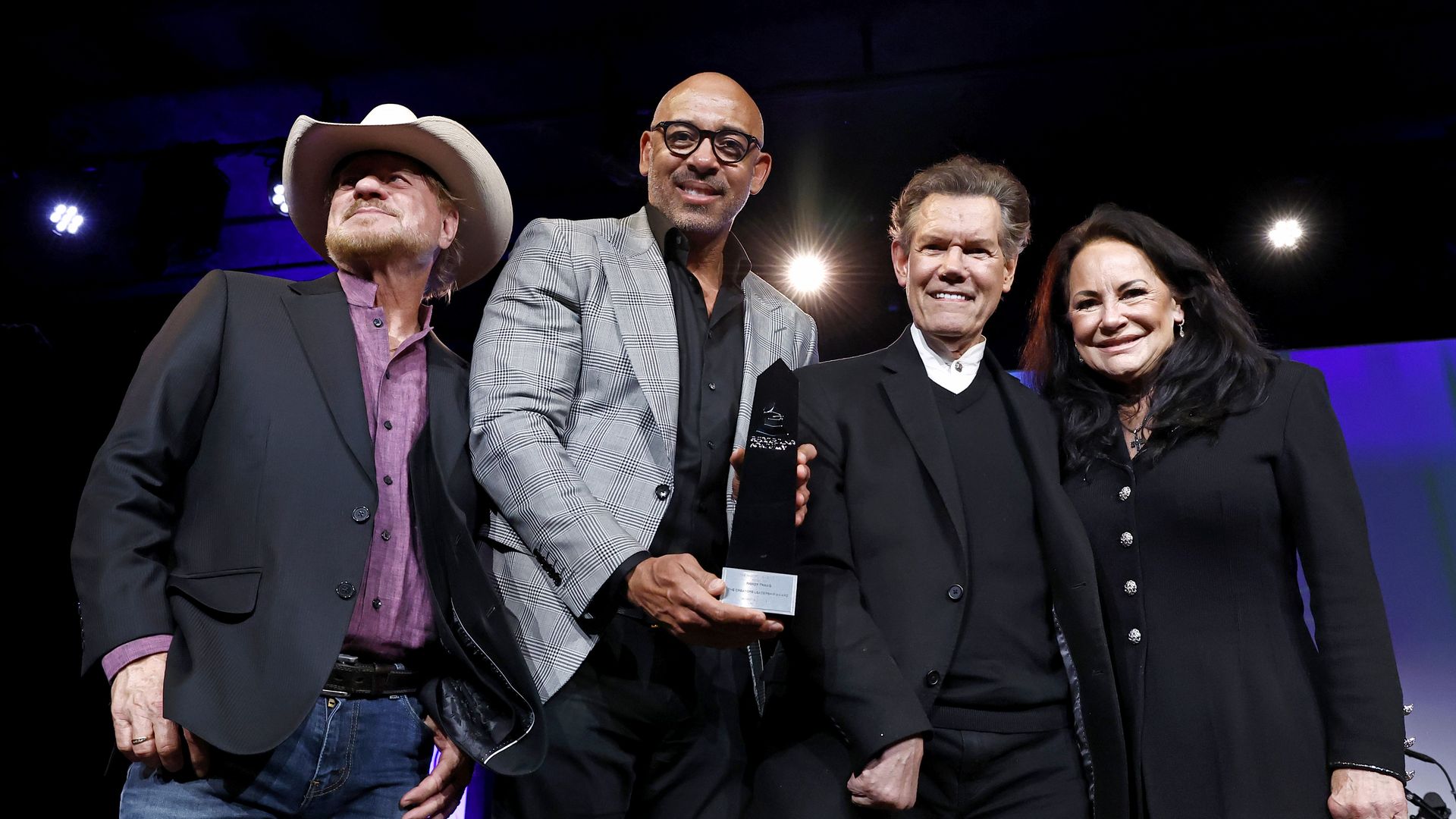
Driving the news: The Recording Academy also hosted a red carpet event in D.C. to honor seven-time GRAMMY winner Randy Travis, who used AI to sing again after suffering a stroke, and Reps. Linda Sánchez and Ron Estes for their HITS Act.
- That bill, introduced earlier this year, would allow independent artists, songwriters and labels to deduct up to $150,000 in music production expenses from their taxes.
What they're saying: Musicians agree they want protections, but their feelings about AI in music vary widely. Here's what they told us on the red carpet:
- DJ Dani Deahl: "Anyone who says that AI is not going to be a common part of the music making process in the future has their head in the sand. It's here to stay. It's not going away, and frankly, most people have been using it, whether they know it or not."
- Jazz vocalist Sara Gazarek: "I'm using AI in my music to send emails that I don't want to send, but otherwise I'm not using AI. I really try to stick to analog in like reading poetry, going to see art, talking to people, reflecting, journaling."
- Latin music producer Tony Succar: "I try to avoid using AI just because I'm a producer that I truly believe in the human element, human touch. Can an AI even win a Grammy?"
- Blues singer Shemekia Copeland: "I'm so old school, AI scares the hell out of me. That's one of the reasons why I want to be here, because we definitely need to make sure that we are in control of our own fates. We don't want computers."
The bottom line: AI is upending how people work, and the music industry is no exception.
4. Catch me up: AI, biotech and more
🔎 AI inquiry: Sens. Elizabeth Warren and Ron Wyden announced they've launched an investigation into Google and Microsoft over whether their respective relationships with Anthropic and OpenAI violate antitrust laws.
📒 Biotech report: The National Security Commission on Emerging Biotechnology, chaired by Sen. Todd Young, delivered its report and action plan to Congress this week, complete with 49 recommendations to keep the U.S. from falling behind China.
🇪🇺 EU AI: The European Commission yesterday presented its "AI Continent Action Plan" to "transform Europe's strong traditional industries and its exceptional talent pool into powerful engines of AI innovation and acceleration."
🔍 TSMC probe: "Exclusive: TSMC could face $1 billion or more fine from US probe, sources say," per Reuters.
🗣️ DOGE at the FTC: Fired Democratic commissioners Rebecca Slaughter and Alvaro Bedoya have responded to the news Ashley broke that DOGE staffers have arrived at the FTC, saying "this threatens the basic functions of the FTC and the markets it protects."
- "The FTC collects and retains extremely sensitive and confidential business data. This data can move markets. It can certainly change the competitive dynamics in any industry."
- "Under no circumstances should DOGE be able to access this data. We are deeply concerned that they may do it anyway," they said in a statement.
✅ Thank you for reading Axios Pro Policy, and thanks to editors Mackenzie Weinger and David Nather and copy editor Bryan McBournie.
- Do you know someone who needs this newsletter? Have them sign up here.
View archive