Axios Pro tracker: Tech policy bills to watch in 2025


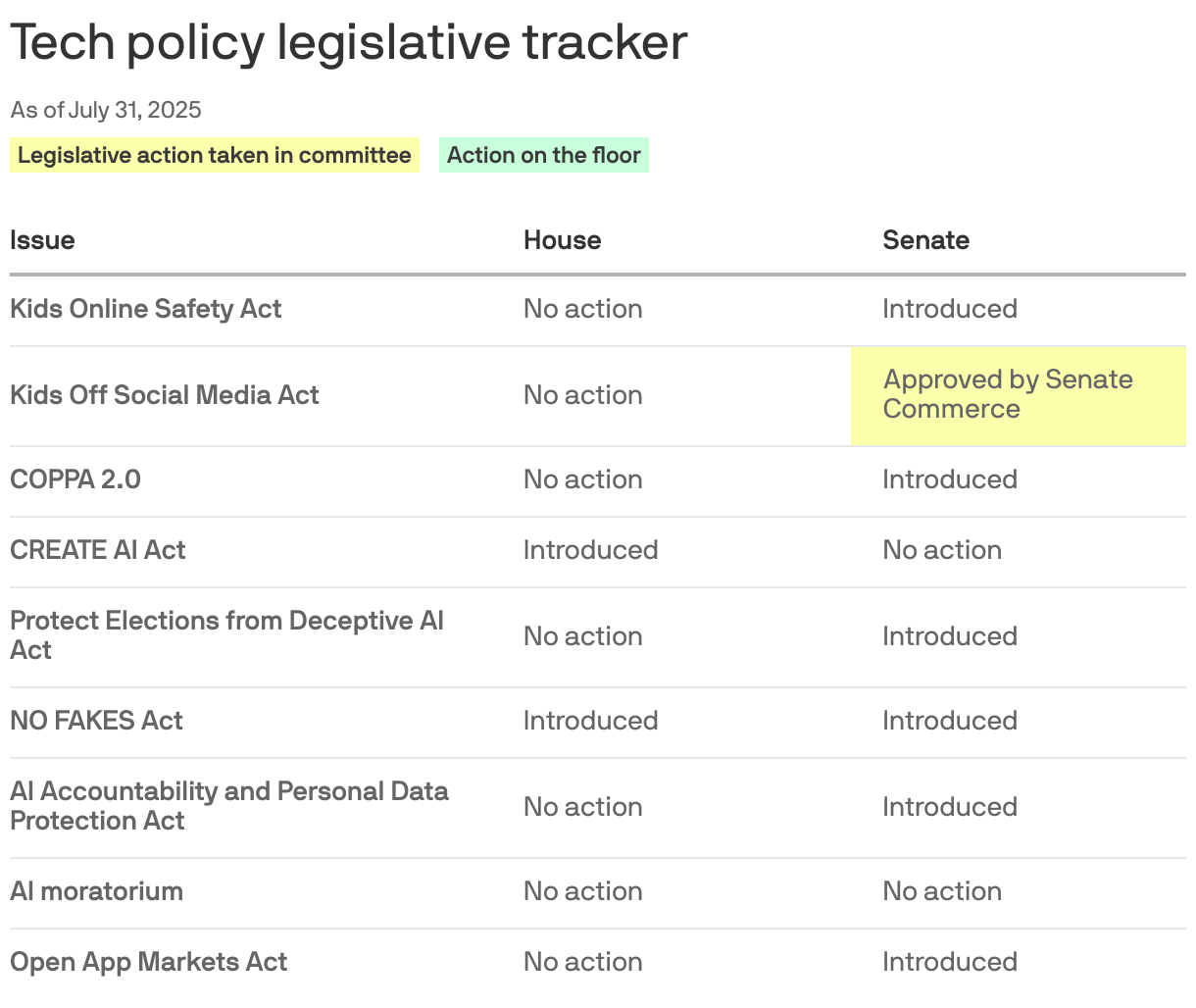
With lawmakers heading out for recess, here's our cheat sheet to keep tabs on the most consequential tech bills in play so far this year.
The big picture: A handful of bills that had real momentum last Congress around AI and kids' safety online have been reintroduced this session.
- But the prospects for bipartisan legislation are tough in an even more divided political climate under the new Trump administration.
Here's a rundown of what we're watching:
TAKE IT DOWN Act
The issue: The TAKE IT DOWN Act aims to tackle AI's supercharging of child sexual abuse material (CSAM) and non-consensual intimate images (NCII).
- The bill would require platforms to take down such content within 48 hours of being notified by the victim and criminalize posting it.
Status: The Senate unanimously passed the bill and the House Energy and Commerce Committee has advanced it.
What's next: A full House vote. The bill is a priority for House Speaker Mike Johnson and Majority Leader Steve Scalise.
Kids' online safety bills
The issue: The Kids Online Safety Act and COPPA 2.0 were not included in a recent E&C markup as sticking points remain among Republicans, particularly for KOSA. E&C Chair Brett Guthrie has said repeatedly he's committed to advancing the bill.
- The Kids Off Social Media Act would set a minimum age of 13 to use social media platforms.
Status: COPPA 2.0 has been reintroduced in the Senate. KOSA has not been reintroduced yet in either chamber. The Senate Commerce Committee has advanced KOSMA.
What's next: House Republicans are gaming out how they want to handle data privacy as a whole, soliciting comments from the public about a more comprehensive plan.
- Individual kids' safety bills are likely on the back burner.
CREATE AI Act
The issue: This bill would build out a national infrastructure for AI research, compute power and data, authorizing the development of the National Artificial Intelligence Research Resource (NAIRR).
Status: Last Congress, authorizing NAIRR was seen as an easy, bipartisan win for AI legislation, but it didn't make it over the finish line. Reps. Jay Obernolte and Don Beyer reintroduced it last month, but it has not yet been reintroduced in the Senate.
What's next: The bill is meant to expand participation in AI development beyond the largest tech companies. In an era where those companies have more sway than under the Biden administration, getting this bill to the president's desk may be a heavier lift.
Protect Elections from Deceptive AI Act
The issue: This bill would ban the use of AI to generate "materially deceptive content falsely depicting federal candidates" in election ads.
- Sen. Amy Klobuchar led the charge on AI and elections bills last Congress. Legislation advanced out of the Senate Rules Committee, but the efforts ultimately stalled out.
Status: Klobuchar reintroduced the bipartisan bill, shared exclusively with Axios, on Thursday. Co-sponsors include Sens. Josh Hawley, Chris Coons, Michael Bennet and Susan Collins.
What's next: Klobuchar will have to restart her challenge of getting an elections-related bill to the Senate floor. Her main challenge before was Sen. Mitch McConnell, who was vehemently opposed to any election-related bills.
- Klobuchar may have better luck now that Sen. John Thune leads the Republicans.
NO FAKES Act
The issue: Artists and musicians say they're struggling with their voices and likeness being used without their consent.
- The NO FAKES Act would hold people and companies liable for distributing or knowingly hosting unauthorized digital replicas while excluding certain content protected by the First Amendment.
Status: Sens. Marsha Blackburn, Chris Coons, Thom Tillis and Amy Klobuchar and Reps. Maria Salazar and Madeleine Dean introduced the legislation in their respective chambers on Thursday.
What's next: Blackburn and Klobuchar said at an event on Thursday they intend to hold a hearing in the Senate Judiciary Privacy, Technology, and the Law Subcommittee soon.
- Blackburn also said she's spoken with OSTP director Michael Kratsios about ensuring such protections are included in the administration's forthcoming AI "action plan."
