
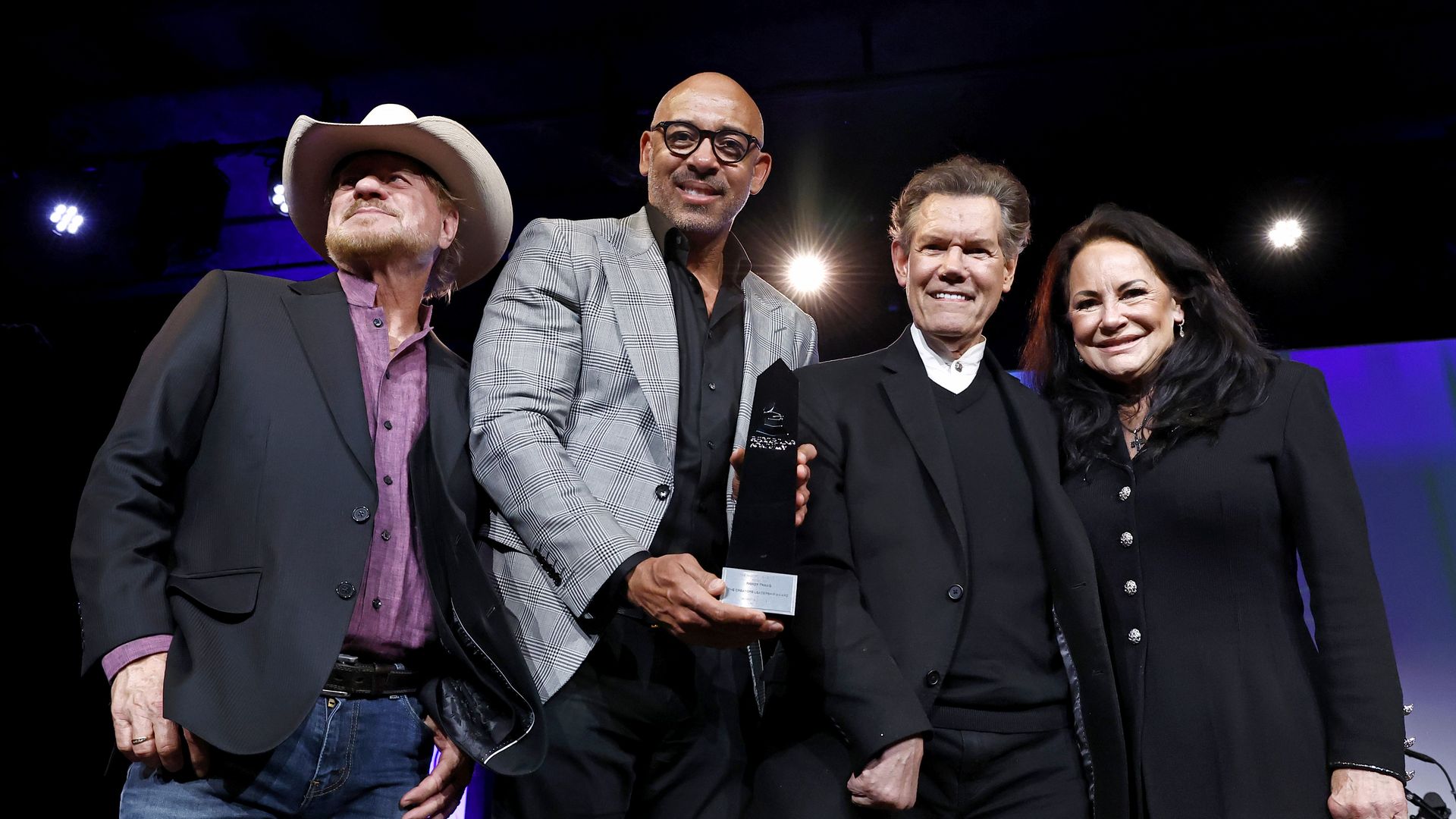
Paul Overstreet, Harvey Mason, Honoree Randy Travis, and Mary Travis attend the Grammys on the Hill Advocacy Day Awards Dinner in Washington, D.C., on April 8. Photo: Paul Morigi/Getty Images for The Recording Academy
Musicians flocked to D.C. this week to advocate for protections against AI.
Why it matters: Flanked by artists on Capitol Hill, lawmakers reintroduced the NO FAKES Act, which would hold people and companies liable for distributing or knowingly hosting unauthorized digital replicas.
- YouTube and OpenAI endorsed the bill.
Driving the news: The Recording Academy also hosted a red carpet event in D.C. to honor seven-time Grammy winner Randy Travis, who used AI to sing again after suffering a stroke, and Reps. Linda Sánchez and Ron Estes for their HITS Act.
- That bill, introduced earlier this year, would allow independent artists, songwriters and labels to deduct up to $150,000 in music production expenses from their taxes.
What they're saying: Musicians agree they want protections, but their feelings about AI in music vary widely. Here's what they told us on the red carpet:
- DJ Dani Deahl: "Anyone who says that AI is not going to be a common part of the music making process in the future has their head in the sand. It's here to stay. It's not going away, and frankly, most people have been using it, whether they know it or not."
- Jazz vocalist Sara Gazarek: "I'm using AI in my music to send emails that I don't want to send, but otherwise I'm not using AI. I really try to stick to analog in like reading poetry, going to see art, talking to people, reflecting, journaling."
- Latin music producer Tony Succar: "I try to avoid using AI just because I'm a producer that I truly believe in the human element, human touch. Can an AI even win a Grammy?"
- Blues singer Shemekia Copeland: "I'm so old school, AI scares the hell out of me. That's one of the reasons why I want to be here, because we definitely need to make sure that we are in control of our own fates. We don't want computers."
The bottom line: AI is upending how people work, and the music industry is no exception.
