May 13, 2024

It's Monday! Changed jobs recently? Let us know here.
✈️ ICYMI: The Senate passed the FAA reauthorization bill last week, but no tech amendments were allowed to hitch a ride.
1 big thing: Klobuchar wants to ban deceptive AI in elections
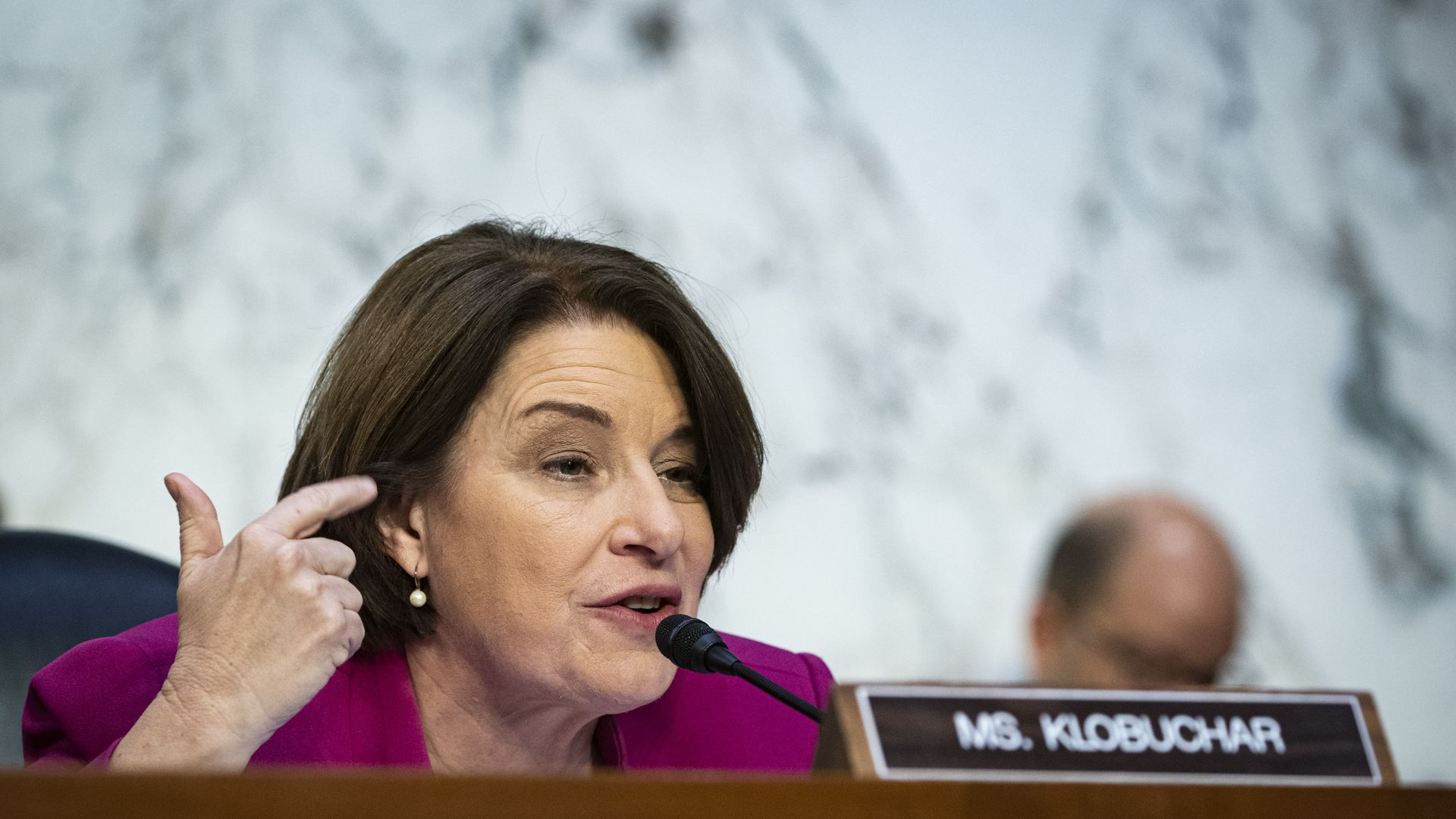
Klobuchar in 2023. Photo: Al Drago/Bloomberg via Getty Images
Sen. Amy Klobuchar says it's time to establish clear-cut rules for the use of artificial intelligence in political advertising, she told Ashley in an interview.
The big picture: The Senate Rules Committee will mark up three bipartisan, Klobuchar-sponsored AI and elections bills Wednesday at 10am ET.
- As Ashley first reported, the meeting will include the Protect Elections From Deceptive AI Act, the AI Transparency in Elections Act and the Preparing Election Administrators for AI Act.
- This is the first markup for AI and election-related bills before this fall's presidential race.
Why it matters: Klobuchar isn't waiting for an official green light from the bipartisan AI working group led by Senate Majority Leader Chuck Schumer to get moving on AI bills.
- That report, which is meant to guide committees on AI topics and bills to take up, is expected to be released soon.
What they're saying: Klobuchar said the rise of deepfakes and manipulated media in political ads means Congress needs to act fast, and it's her goal to get legislation passed before the 2024 presidential election.
- "This is what I like to call a 'hair on fire' issue.
- "With the election approaching … I anticipate democracy and election-related AI will be a major part of [the report]. We just have to get moving on these."
- Schumer and Klobuchar have discussed her AI and elections bills, she said: "I've had extensive conversations with [Schumer] about the bills, and with [Senate Minority Leader] Mitch McConnell about them too. This is the only committee in the Senate they both serve on — what could go wrong?"
Flashback: This isn't Klobuchar's first foray into updating election law for the digital age. Starting before the 2020 election, Klobuchar and the late Sen. John McCain tried to pass the Honest Ads Act, giving online political ads the same disclosure rules as TV, radio and print.
- Tech companies pushed back hard and rolled out their own political advertising databases instead. Some stopped accepting political advertising altogether.
- Klobuchar rolled out a new version of the bill this year.
State of play: Klobuchar said there's more support for bills to regulate AI and elections from companies and members of Congress this time around.
- "This one has been different because a lot of the companies from the beginning have said we need regulation in general, and that's not a normal situation," she said.
What's next: There will be bipartisan House companion legislation for the bill that bans materially deceptive AI-generated content in election ads, Klobuchar said.
- "I think we all know the biggest abuse of this would occur in the fall, which is why we want to get this done immediately."
What we're watching: Klobuchar said the bills could go along with any legislative package that comes out of the AI working group framework, or be grouped with other tech bills on topics like privacy.
2. Scoop: Senate Commerce to take up AI bills next week
Illustration: Shoshana Gordon/Axios
The Senate Commerce Committee will mark up several AI bills May 22, sources told Maria and Ashley.
Why it matters: Lawmakers are racing against the clock to pass tech bills as the election nears and legislative work winds down.
- An AI report from a bipartisan group of senators tapped by Schumer is expected to drop soon and spur committee action.
Senators will likely vote on:
- The CREATE AI Act, which would authorize the National Artificial Intelligence Research Resource.
- Chair Maria Cantwell's and Sen. Todd Young's Future of AI Innovation Act to authorize NIST's U.S. AI Safety Institute.
- The Artificial Intelligence Research, Innovation, and Accountability Act.
- The Promoting United States Leadership in Standards Act.
Some bills have not yet been introduced but could be ready for a vote, including:
- Cantwell's long-anticipated AI workforce bill, which sources said she's working on with Sen. Jerry Moran.
- A proposal from Sen. John Hickenlooper for AI auditing standards, which a source told Axios that Sen. John Thune is likely to join.
One industry source said movement on National Quantum Initiative reauthorization remains a priority.
- But it's expected that the final movement of the bill on the House floor will be during the lame duck period, so it's unlikely that it will be marked up this month by Senate Commerce.
- There's broad support for the AI bills among industry, but companies also believe this could be an ambitious undertaking for the Commerce Committee, the source added.
What they're saying: Beacon Global Strategies' Divyansh Kaushik told Axios the markup "sends a strong signal to our adversaries that Congress views these technologies as critical to our economic and national security."
3. E&C leaders propose deadline to sunset Section 230

Illustration: Sarah Grillo/Axios
House Energy and Commerce Committee leaders yesterday released a draft bill to force big tech to help revamp their liability shield or face its elimination, Maria reports.
Why it matters: Lawmakers for years have tried to get rid of or overhaul Section 230 of the Communications Decency Act, contending that tech companies should be held responsible for the activity that takes place on their platforms.
- Members from both sides of the aisle are concerned about how social media is impacting the mental health and safety of minors online.
Driving the news: The latest attempt from Chair Cathy McMorris Rodgers and Ranking Member Frank Pallone would end Section 230 on Dec. 31, 2025, leaving 18 months to hash out a new legal framework for platforms.
What they're saying: In a Wall Street Journal op-ed, CMR and Pallone said that "Section 230 is now poisoning the healthy online ecosystem it once fostered."
The other side: The proposal prompted the usual arguments from industry and free speech advocates, including that getting rid of Section 230 would lead to censorship and a flood of litigation to the benefit of trial lawyers.
The big picture: Recent Supreme Court cases have left Section 230 untouched, punting the issue back to Congress where many proposals have hit a dead end.
- Differences among Democrats and Republicans regarding what is responsible content moderation versus alleged censorship of conservative views threaten to continue stymieing the debate.
What's next: E&C spokesperson Sean Kelly said the committee will follow regular order on the bill, including a legislative hearing, subcommittee markup and full committee markup.
4. Hill hearing watch

Illustration: Tiffany Herring/Axios
It's a busy week in tech policy beyond Wednesday's Senate Rules meeting.
1. Tech & telecoms markup: Senate Commerce gathers Thursday at 10am ET to mark up several tech and telecom-focused bills the committee originally had planned to take up earlier this month.
- Lawmakers are set to consider the Rural Broadband Protection Act, the NET Act and the Spectrum and National Security Act to reauthorize the FCC's spectrum auction authority.
- Sen. Brian Schatz's The Kids Off Social Media Act is also on the docket.
2. Export controls markup: At the same time, the House Foreign Affairs Committee marks up legislation including the ENFORCE Act, which would give Commerce's Bureau of Industry and Security authority to use export controls on AI and other emerging tech.
3. Budget season, House edition: The House Appropriations Committee examines the FY25 FTC request Wednesday at 10am ET and the FCC's request Thursday at 10am ET.
- House Energy and Commerce hears from NTIA administrator Alan Davidson on the agency's FY25 budget Wednesday at 10:30am ET.
4. Budget season, Senate edition: On Wednesday at 2:30pm ET, Commerce Secretary Gina Raimondo testifies before the Senate Appropriations commerce, justice and science panel about the department's FY25 request.
- The state, foreign operations and related programs subcommittee also meets Wednesday, at 2pm ET, to examine the roles of the DFC, the EXIM Bank and Millennium Challenge Corp. in strengthening U.S. competitiveness.
5. Election threats: On Wednesday at 2:30pm ET, Senate Intel holds an open hearing on foreign threats to this year's elections.
6. China watch: The House China Select Committee, now chaired by Rep. John Moolenaar, convenes a hearing Thursday at 9:30am ET titled "All Roads Leading to Beijing? The CCP's Global Development Offensive."
7. NSF priorities: House Science's research and technology panel meets Thursday at 10am ET for an oversight hearing on NSF's "priorities for 2025 and beyond."
- NSF director Sethuraman Panchanathan and former National Science Board chair Dan Reed testify before lawmakers.
8. Tech procurement: The Senate Homeland Security & Governmental Affairs Committee on Wednesday at 10:30am ET takes up legislation including the FIT Procurement Act, which would streamline the procurement process for emerging tech.
✅ Thank you for reading Axios Pro Policy, and thanks to editors Mackenzie Weinger and David Nather and copy editor Brad Bonhall.
- Do you know someone who needs this newsletter? Have them sign up here.
View archive