March 07, 2024
It's Thursday. Get ready for tonight's SOTU with our tech policy preview here.
⏳ Last call: Our 2nd annual subscriber survey closes tomorrow at 11:59pm ET! Please take five minutes to share your feedback and help us improve Axios Pro.
1 big thing: Congress stuffs NIST's budget with earmarks


Lawmakers requested $303 million in the National Institute for Standards and Technology's budget for projects in their districts, per an Axios analysis of the spending bill.
Why it matters: NIST's funding is coming up short even as the agency gets tasked with more work from both the CHIPS and Science Act and President Biden's AI executive order.
By the numbers: The spending package provides NIST with just $1.46 billion, a cut from $1.6 billion last year.
- NIST requested $1.63 billion in funding for fiscal year 2024, and the CHIPS Act had authorized $1.65 billion.
- Senators alone set aside $218 million in congressionally directed spending in NIST's budget accounts.
How it works: With earmarks, or "community project funding" requests, lawmakers direct funding within an appropriations program or account — like NIST's construction of research facilities account — to local projects.
- Senate aides told Axios that the earmarked projects are for professional and academic research centers, new STEM equipment for universities, biopharmaceutical equipment and other programs.
Our thought bubble: These projects are external to NIST. Although some are tangential to the goals of the CHIPS and Science Act and the AI executive order, the agency that's helping spearhead federal efforts remains underfunded.
Context: NIST has a nearly $900 million deferred maintenance backlog, according to its FY24 budget submission to Congress.
- Sources told Axios this week that it will be tough for NIST to carry out all of its assignments and congressional mandates with this budget cut, pointing to the "earmarked reductions" as especially hurtful across all of NIST's operations.
Axios' Tory Lysik contributed to this report.
2. What's next for the TikTok sale bill
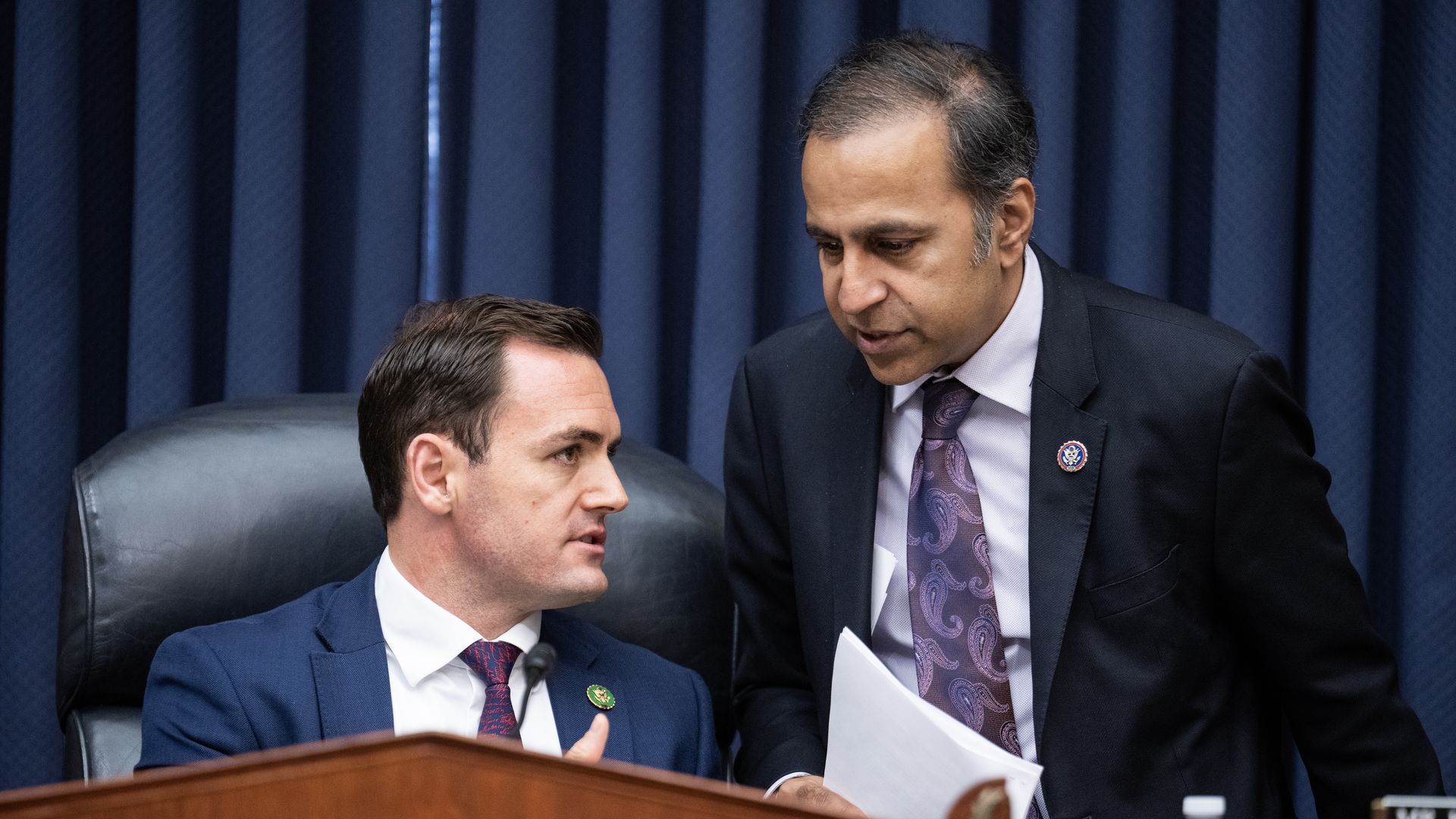
Gallagher and Krishnamoorthi in May 2023. Photo: Tom Williams/CQ-Roll Call via Getty Images
The House Energy and Commerce Committee today advanced a bill to force Beijing-headquartered ByteDance to sell TikTok, Maria reports.
State of play: Lawmakers unanimously voted 50-0 in favor of the Protecting Americans from Foreign Adversary Controlled Applications Act, sponsored by China Select Committee Chair Mike Gallagher and Ranking Member Raja Krishnamoorthi.
- Officials from DOJ, the FBI and Office of the Director of National Intelligence met with E&C members in a classified hearing ahead of the markup.
- The committee also voted unanimously, 50-0, to advance Chair Cathy McMorris Rodgers' and Ranking Member Frank Pallone's Protecting Americans' Data from Foreign Adversaries Act, which would stop data brokers from selling sensitive personal information to foreign adversaries.
What's next: The bill, introduced Tuesday, is moving along quickly. Gallagher told reporters today he wants a floor vote as soon as possible.
- House Speaker Mike Johnson said he supports the bill being marked up; Minority Leader Hakeem Jeffries' office did not respond to a request for comment.
Catch up quick: Lawmakers have been trying to ban or limit TikTok for years over concerns that its alleged ties to the Chinese government pose unique surveillance and disinformation threats.
- Lawmakers, with the help of administration officials, are trying to avoid the constitutional objections to outright bans by making their legislation about broader types of technology that are considered controlled by a foreign adversary.
- Sens. Mark Warner and John Thune's RESTRICT Act would prohibit certain U.S. tech product or service transactions with foreign adversaries.
What we're watching: Gallagher and Krishnamoorthi's search for a Senate sponsor.
- There's "a lot of interest and eagerness" to get companion legislation, Gallagher said, adding "we go through Senate Commerce, I've had discussions with a lot of the members, and we welcome that and hope they could act swiftly."
- Commerce Committee Chair Maria Cantwell has been working on her own TikTok bill, the GUARD Act, for months, spokesperson Tricia Enright said.
Threat level: CMR said lawmakers have internal recordings in which TikTok says "everything is seen by China."
- She added: "We know that they've surveilled on American journalists. We also know from private, classified briefings that there's other examples and action needs to be taken."
- "We have not been asked to share data with China and would not comply if asked," a TikTok spokesperson said.
Yes, but: Warner said he's worried that directly naming ByteDance and TikTok will be problematic, but that he's going to look carefully at the bill and is willing to work with anyone "who takes this threat seriously."
- Gallagher said of First Amendment concerns: "It's not about shutting down speech. As long as the ownership structure has changed, TikTok can continue and Americans can say whatever the heck they want on the platform."
The other side: TikTok is calling the House bill an "outright ban" even though the bill would allow the app to continue to exist under different ownership.
- Ahead of the markup, TikTok launched a pop-up campaign urging users to call E&C members to vote no on the bill.
- "They're getting a lot of calls in their offices. And they were saying that their phones were ringing off the hook last night," Gallagher told reporters today.
The big picture: Efforts to address concerns with TikTok are overshadowed by the fact that Congress still has not passed a federal data privacy law.
3. Catch me up: Europe, AI and more
Illustration: Tiffany Herring/Axios
🤝 House AI moves: The first House AI working group meeting is scheduled for next week, its co-chair Jay Obernolte told Maria, adding that he expects them to take place on most fly-out days.
- Obernolte: "I'm interested in hearing [from] the members of the task force what their priorities are, what issues they think need to be addressed, and that will inform the topics and structure for the rest of the year."
📱 Kids' online safety: Sen. Lindsey Graham tried to pass three of the Judiciary Committee's bills by unanimous consent on the Senate floor yesterday, with Sen. Ron Wyden objecting to the STOP CSAM and EARN IT Acts, and Sen. Cory Booker blocking the SHIELD Act.
- When Maria asked Senate Judiciary Committee Chair Dick Durbin earlier in the day if there was a better plan for passing kids' safety bills than UC, he said "not yet."
- Sen. Brian Schatz told Maria that Commerce Committee leaders are "very, very close" to scheduling a mark up for his Protecting Kids on Social Media Act.
🇪🇺 DMA day: Today the European Union is requiring the world's biggest tech and social media companies to change the way they do business in the name of consumer choice and competition, Ashley reported.
💼 Next TTC: The EU-U.S. Trade and Technology Council will be April 4-5 in Leuven, Belgium.
- Secretary of State Antony Blinken, Commerce Secretary Gina Raimondo and trade representative Katherine Tai are set to attend, along with the European Commission's Margrethe Vestager and Valdis Dombrovskis.
📡 Spectrum authority: Just ahead of the one-year anniversary of Congress' letting the FCC's spectrum auction authority lapse for the first time in 30 years, Chair Jessica Rosenworcel called for lawmakers to quickly restore it.
- The FCC today opened a docket to explore how its existing regulatory tools and statutory authority could provide access to unassigned spectrum.
🤖 Senate AI report: Sen. Mike Rounds reminded reporters yesterday that the AI report could come out late March or early April.
- He added that ranking members and chairs are working through about 18 bipartisan ideas that are taking shape in the report.
✅ Thank you for reading Axios Pro Policy, and thanks to editors Mackenzie Weinger and David Nather and copy editor Brad Bonhall.
- Do you know someone who needs this newsletter? Have them sign up here.
View archive