October 26, 2023

It's Thursday, Pro readers. Ready for the AI EO on Monday?
🎉 Welcome to our first lobbying update! We plan to do a roundup of tech lobbying each quarter and break down the most interesting numbers and trends.
- Got any feedback on what you want to see in these updates? Want to see AI-specific companies broken out, or stick to the biggest tech companies? Let us know.
1 big thing: Lobbying Q3 spending is heavy on AI

Illustration: Natalie Peeples/Axios
Technology companies continued to spend millions on federal lobbying in the third quarter of 2023, with companies across many sectors spending big on artificial intelligence, per federal filings, Ashley reports.
Why it matters: AI is driving a new wave of lobbying in D.C., with groups ranging from performing artists to major food and beverage distributors signing on with firms as they reckon with how AI is going to change their industries.
- The biggest tech companies still shell out big in Washington, though some have tempered their spend compared with past years.
The big picture: Congressional deadlock due to the drawn-out House speaker race and a near-government shutdown means less lobbying on major spending bills and an overall sense that individual policy bills aren't going to move.
- Still, tech companies continue to lobby on legislation that would impact their business models.
- Those include bills on privacy, content moderation, kids' online safety, elections and misinformation, journalism and media, tax, competition, trade and encryption.
By the numbers: In Q3 2023, Meta and Amazon remained at the top of Washington spenders while Google and Apple kept it steady. X, formerly Twitter, spent only $160,000.
- Meta: $5.1M
- Amazon: $4.3M
- ByteDance: $3.8M, a record high for the TikTok owner
- Oracle: $3.2M
- Google: $3M
- Microsoft: $2.3M
- Apple: $1.8M
- IBM: $1.6M
The intrigue: Dozens of companies signed on — or kept services — with lobbying firms to talk AI with lawmakers. Some notable filings:
- Major VC firm Andreessen Horowitz, whose founder Marc Andreessen has been vocal about his opposition to AI regulation, spent $120,000 last quarter, including on AI, registering to lobby for the first time.
- The Recording Industry Association of America spent $1.5M, including on "policies impacting the use of [AI] for creative works," per its filing.
- AARP spent $3.9M last quarter, including on the topic of "age discrimination in hiring through AI."
- Other groups that listed AI in their lobbying disclosures include major league soccer, baseball, football, basketball and hockey; along with Coca-Cola and Nike.
AI focus: AI-specific companies are spending steadily this year, but their numbers pale in comparison with Big Tech counterparts.
- ScaleAI spent $200,000 last quarter, up from $150,000 in Q2. Anthropic, registered to lobby for the first time this year, spent at least $50,000.
- C3.AI spent $60,000 last quarter; Adobe spent $340,000.
- This summer, Anthropic, Google, Microsoft and OpenAI launched a group called the Frontier Model Forum specifically to engage with governments on AI policy. That group does not plan to lobby, per Reuters.
2. Meet Speaker Johnson's staff
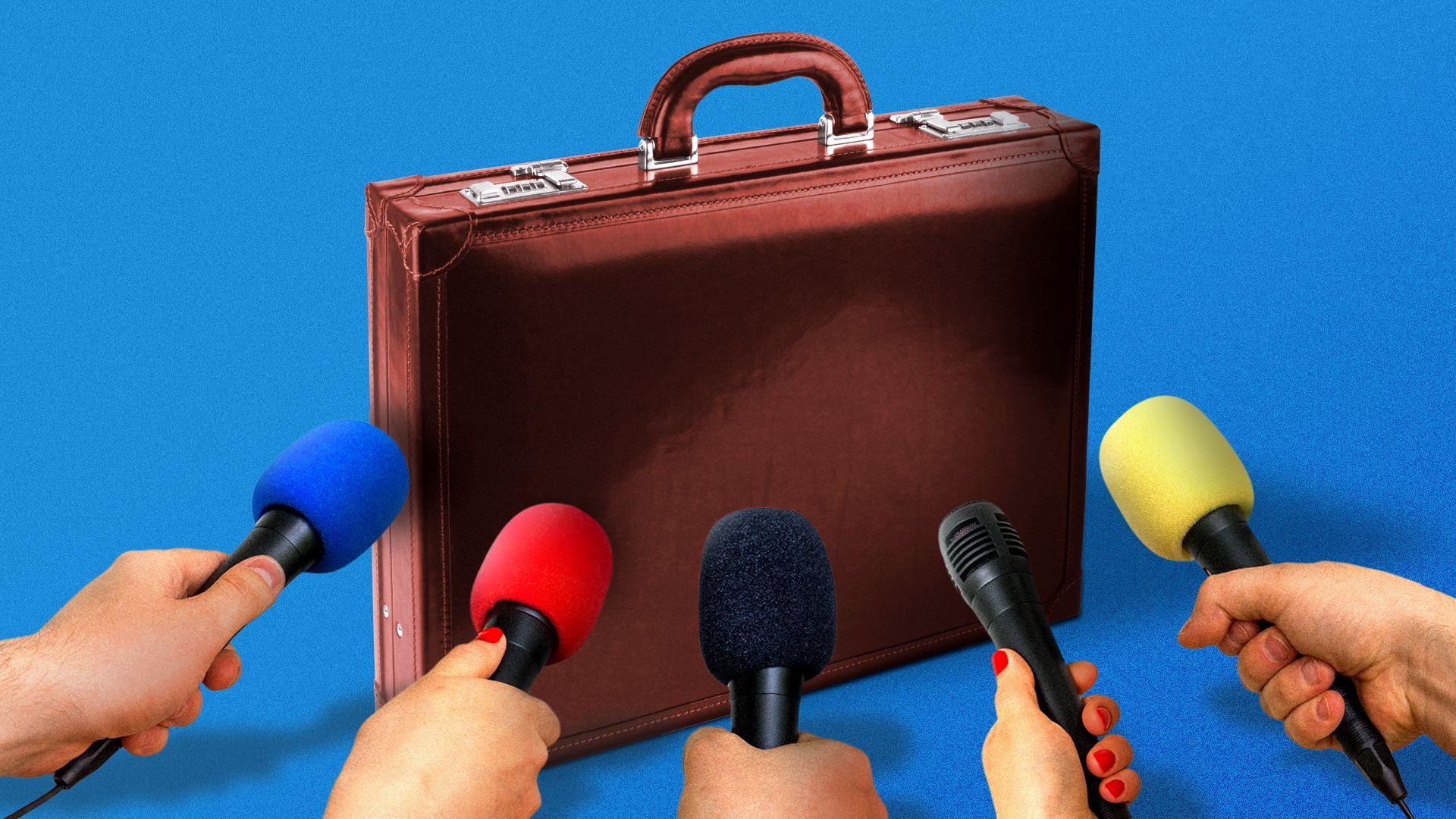
Illustration: Gabriella Turrisi/Axios
New Speaker Mike Johnson has an enormous staffing challenge in front of him, Axios' Nick Sobczyk and Peter Sullivan report.
Why it matters: Johnson has a tiny staff — some of whom have worked for him less than a year — and relatively few connections on K Street.
- He'll need a bunch of new tech and government spending experts to fill his office.
- This dynamic could also mean much more influence for Steve Scalise and his experienced leadership team, a possibility that lobbyists are already chattering about.
But Johnson has had two loyal top staffers steering the ship:
Hayden Haynes, chief of staff
Details: Haynes, a Louisiana native, has been chief of staff for Johnson since he took office in 2017, per LegiStorm. He managed Johnson's campaign during his first congressional race in 2016.
- Before that Haynes worked as a regional representative for a fellow Louisianan: former Sen. David Vitter.
- In that role, Haynes was plugged in with local groups and governments, which is part of how he ended up as Johnson's chief, per a D.C. source who knows Johnson's staff.
- "Hayden's a really effective political operator" who "knows Louisiana extremely well," said Dan Ziegler, a principal at Williams & Jensen who formerly worked with Johnson's staff on the Republican Study Committee.
- He is still relatively young, especially for a chief of staff to the now-Speaker, having graduated from college (Louisiana Tech) in 2011.
- You can check out his Twitter feed here, though much of it is about Louisiana Tech sports and Saints football.
Garrett Fultz, deputy chief of staff
Details: Fultz has also been handling policy in Johnson's office since 2017, rising to the deputy chief role this year, per LinkedIn.
- He's worked on an extensive slate of issues for the Louisiana Republican, including energy and appropriations.
- Before heading to law school at Tulane, he worked briefly as a petroleum landman for Hunter Energy.
What we're watching: Kevin McCarthy has a bevy of policy aides with leadership experience that could get a look as Johnson staffs up.
- One name to keep an eye on: Josh Hodges, another Vitter alum, was Johnson's first LD. He went on to work at DOE and on the National Security Council during the Trump administration.
- Ziegler will also be one of the new speaker's top connections to K Street.
3. Catch me up: Robocalls, AI and more

Illustration: Shoshana Gordon/Axios
💰 Critical funding: The White House yesterday called on Congress to fund "critical domestic needs," including $6 billion to keep the Affordable Connectivity Program running through 2024.
- Jenna Leventoff, American Civil Liberties Union senior policy counsel, said in an email that "we are concerned that $6 billion is not quite enough" and urged Congress to appropriate at least $7 billion.
- The White House also said Congress must fund the FCC's Secure and Trusted Communications Networks Reimbursement Program, which is intended to remove equipment and software in the country's communications networks (think Huawei) and replace it with trusted alternatives.
🤖 AI vs. robocalls: YouMail CTO Mike Rudolph told the Senate Commerce Communications, Media and Broadband panel Tuesday that generative AI "allows one person to do the work of hundreds," and the technology could be instrumental in helping fight robocalls.
- FCC Chair Jessica Rosenworcel announced at an AARP event this week that the agency at its November meeting will consider an inquiry into how AI impacts robocalls and texts.
🌐 BEAD push: Senators sent Commerce Secretary Gina Raimondo and NTIA head Alan Davidson a letter pressing for alternatives to the letter of credit requirement.
- Read Maria's previous reporting here on what advocacy groups are suggesting instead of the letter of credit requirement, which they say would shut out thousands of internet service providers from getting grant money.
⚖️ Meta sued: A group of 33 state AGs on Tuesday sued Meta, alleging the Facebook and Instagram parent knowingly issued products and features via its apps that pose psychological risks to children and teen users.
🇨🇳 Newsom meets Xi: The AP reports that "California Gov. Gavin Newsom had a surprise meeting with China's leader Xi Jinping in Beijing on Wednesday."
✅ Thank you for reading Axios Pro Policy, and thanks to editors Mackenzie Weinger and David Nather and copy editor Brad Bonhall.
- Do you know someone who needs this newsletter? Have them sign up here.
View archive