September 14, 2023

What a wild couple of days in tech policy. Good thing we're here to tell you everything you really need to know about Congress' big AI week, right?
- We'll be back in your inbox again next week, unless there's breaking news.
1 big thing: Lawmakers plug away at AI legislative work

Illustration: Eniola Odetunde/Axios
While Senate Majority Leader Chuck Schumer was hosting the AI forum this week, committee leaders were digging into the details of how AI can be regulated, Maria reports.
Why it matters: The nitty-gritty work of putting pen to paper will ultimately happen behind the scenes with key staff members negotiating language down to each word, despite the hype of Congress' AI week.
State of play: Four hearings directly related to AI were held this week alone.
The Senate Judiciary subcommittee on privacy, technology and the law convened company executives and academics Tuesday to examine leaders Richard Blumenthal and Josh Hawley's new framework of AI principles.
- Sen. Jon Ossoff asked for guidance on how lawmakers should define various AI systems as they write legislation to regulate the technology.
- Microsoft president Brad Smith said three areas should be considered when defining the scope for regulation: the most powerful frontier AI models, the deployers or applications of AI in high-risk cases like privacy, and the data center infrastructure where models and applications are deployed.
- Smith, who attended Schumer's forum the following day, also declined during the hearing to commit to Hawley that Microsoft would raise its age limit to use Bing's chatbot to 18 and implement age verification.
- "I don't want America's kids to be your guinea pigs," Hawley said to Smith.
Of note: Sen. Amy Klobuchar during the Judiciary hearing inquired about fake AI-generated election ads that she said have victimized both Democrats and Republicans.
- Sens. Klobuchar, Hawley, Chris Coons and Susan Collins on Tuesday introduced the Protect Elections from Deceptive AI Act, which would ban the use of AI to generate content deceptively showing candidates in political ads to influence federal elections.
- AI in political ads is one area in which the Senate is inclined to act more quickly as the 2024 elections near.
Meanwhile, the senators who sit on Judiciary were toggling between that hearing Tuesday and a Senate Commerce Committee hearing at the exact same time.
- Commerce Committee Chair Maria Cantwell announced at that hearing that she would introduce a bill to combat deepfakes and AI-generated media.
- Cantwell pointed to an incident in which "a scammer used AI to spoof the voice of their daughter telling them that she had been in a car accident and that a man was threatening to harm her if they didn't wire $10,000."
The Senate Homeland Security & Governmental Affairs Committee held a hearing this morning to look into AI in government procurement.
- Chair Gary Peters noted in his opening remarks that "over half of the AI tools used by federal agencies have been purchased from commercial vendors.
- "In order to successfully and effectively purchase and use AI tools, federal agencies have to be prepared to address issues like privacy concerns about the use of federal data to train commercial models and bias in government decision making."
The House Oversight panel on cybersecurity, IT and government innovation also convened an AI hearing this afternoon on the federal government's use of the technology.
- OSTP's Arati Prabhakar said she expects that some of the risks of AI can be addressed under existing laws and regulations, but "in some cases, we do expect that legislation will be required."
- DHS' Eric Hysen: "DHS will use AI to transform all parts of our operation, from detecting and mitigating cybersecurity vulnerabilities to enhancing maritime search and rescue operations and far beyond."
What's next: Schumer's next forum will focus on how the government can "encourage innovation," he told Axios in an interview yesterday.
- Congress will keep hearing from outside groups, including Fight for the Future and United Musicians and Allied Workers, who said they're planning an "AI Day of Action" early next month "aimed at corporations that seek to replace human artists with AI."
2. Bennet pitches his AI agency
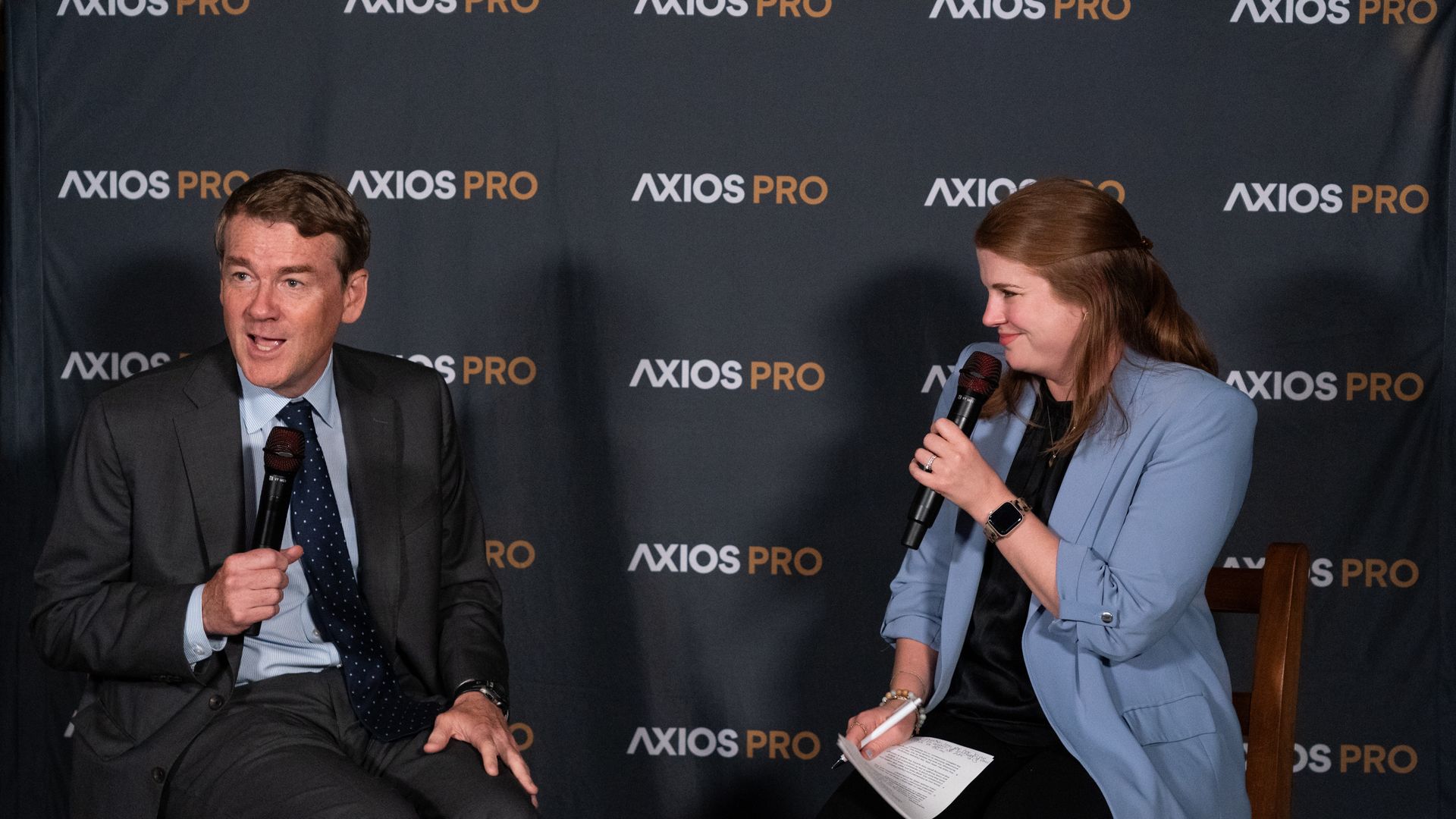
Bennet and Gold. Photo: Ralph Alswang for Axios
Ashley picked Sen. Michael Bennet's brain on all things AI and tech regulation at an Axios Pro Tech Policy Happy Hour at Hawk 'n' Dove this week.
Why it matters: Bennet has emerged as a leading voice in the Senate on regulating AI. His idea to create an agency to regulate major digital platforms, which would include on AI — is picking up steam in Congress.
- Creating an agency, which is also a feature of Sens. Josh Hawley and Richard Blumenthal's proposed framework, came up a lot during Schumer's AI insight forum yesterday.
- Schumer hasn't outright backed this idea but told Axios after the forum that there was support in the room for an agency.
What they're saying: "We should learn from our failure to regulate social media," Bennet told Axios. "My view is that we should have a new independent agency.... We've got to move on from where we started."
- "It's easy to beat up on [Congress] because of our incapacity to learn lessons, but this is life and death, man. To me, I feel like we are the proverbial frog being boiled alive here."
- "I think we need an agency that's dedicated to these subjects, especially with AI, that has the expertise to engage with my constituents and also with Big Tech to come to a set up rules of the road that over time, through a common-law regulatory approach, makes sense for the sector."
- Bennet pointed to the FDA and FCC as agencies that could be models.
The intrigue: Bennet said there's some trepidation among Republicans around adding an agency.
- But there is growing sentiment that Congress doesn't have the expertise to regulate AI and a new agency may be the right thing, he said.
- "I'm seeing other people begin to say ... 'You know what, we don't have the expertise to do this.'"
- Bennet also said he received unsatisfactory answers from tech companies after sending them a letter this summer asking how they'd take extra safeguards around AI for younger users and children.
Bennet said he's hopeful about the promise of AI to help bring equality to the K-12 school system in the U.S. by providing students tutors and other resources.
✅ Thank you for reading Axios Pro Policy, and thanks to editors Mackenzie Weinger and David Nather and copy editor Brad Bonhall.
- Do you know someone who needs this newsletter? Have them sign up here.
View archive