March 30, 2023

Happy Thursday! See you in just a few hours for our kickoff happy hour featuring Sen. Ed Markey at 6pm at Hawk 'n' Dove.
- We’ll be in your inbox less frequently next week since it’s recess — but we’ll have you covered if there’s any news you need to know.
1 big thing: Who's schooling Congress on AI
Illustration: Brendan Lynch/Axios
Congress gets a lot of flak for not being savvy on tech issues. But as artificial intelligence advancements heat up, some members are working hard to educate themselves, Ashley and Maria report.
- We caught up with lawmakers on whom they’re turning to for guidance, and got feedback from companies on the messaging they’re pushing on the Hill.
Why it matters: AI has the potential to transform our society, and as lawmakers grapple with how to regulate the technology, companies are scrambling to inform their opinions.
Behind the scenes: Generative AI is heavy on lawmakers' minds on both sides of the aisle. Here's some of what we're hearing has been happening:
- The New Democrat Coalition Action Fund's retreat this month on the Chesapeake Bay in Maryland included a panel titled “Charting a Course for AI Policy: Navigating Opportunities and Challenges” (which a spokesperson told Axios was written by ChatGPT).
- Rep. Jeff Jackson moderated the event featuring software company SAP, IBM, two technology trade groups and nonprofit EqualAI, per an agenda shared with Axios.
- This week, the Congressional Artificial Intelligence Caucus held an AI primer event with IBM and Austin Carson, formerly a Hill staffer and now president of nonprofit SeedAI.
- The invite to the briefing reads “There is a clear lack of understanding of what AI is, how widely it is deployed, how it effects our everyday lives, and what it is and isn’t capable of. We aim to remedy that in Congress.”
CEOs on the Hill: Sen. Mark Warner has met with OpenAI CEO Sam Altman and Scale AI CEO Alexandr Wang along with Tristan Harris, executive director of the Center for Humane Technology, per spokesperson Rachel Cohen.
- Topics discussed, per Cohen, included “potential regulation, growth models and projections on future development and national security challenges.”
- In addition to Altman, Rep. Don Beyer speaks periodically with Miriam Vogel, who chairs the National AI Advisory Committee, and think tank researchers (Beyer is also taking courses at George Mason University in pursuit of a degree in machine learning, his deputy chief of staff Aaron Fritschner said).
- Microsoft President Brad Smith did a swing through Washington in the early weeks of ChatGPT's deployment, meeting with press and policymakers, and Microsoft has kept up a hill presence in the weeks since, sources tell Axios.
What they're saying: “We believe AI may represent the most consequential technology advancement of our lifetime. There is enormous interest in the opportunity ahead. And responsibilities for those of us who develop this technology. We’re using this time to educate, be curious, and learn,” a Microsoft spokesperson told Axios.
- “There's a lot to be said for the work of OpenAI and other companies; I'm fascinated by it,” one veteran tech lobbyist told Axios. “But from a lobbying, D.C. tech policy perspective, I can just see the train wreck coming.”
- The lobbyist added it's harder for smaller companies to get engaged on AI on the Hill compared with behemoths like Google, IBM and Microsoft, which already have relationships in Washington.
- Lila Ibrahim, DeepMind's chief operating officer, told Axios: “We spent the past week in Washington engaging in conversations with policymakers, regulators and think tanks on how collectively we can develop guardrails to ensure we are maximizing the opportunities AI affords, while mitigating the risks.”
- Kent Walker, president of global affairs at Google and Alphabet, wrote in a blog post this week: “Regulators should look first to how to use existing authorities — like rules ensuring product safety and prohibiting unlawful discrimination — pursuing new rules where they’re needed to manage truly novel challenges.”
Threat level: Christopher Padilla, IBM's government and regulatory affairs vice president, said he worries there will be a “techlash" and emphasized that consumer-facing AI, such as ChatGPT, brings about fundamentally different risks from the AI work his own company is doing.
- IBM is pushing for risk-based rules. For example, the level of scrutiny on the medical advice a chatbot might give should not be the same as a recommendation for a good Greek restaurant, Padilla said.
- Future of Life has garnered more than 1,600 signatures on a petition it launched last week to put a pause of at least six months on all training of AI systems more powerful than GPT-4, warning of “profound risks to society and humanity.” Elon Musk and Steve Wozniak are among the signatories.
2. Q&A: Karan Bhatia, global policy chief at Google
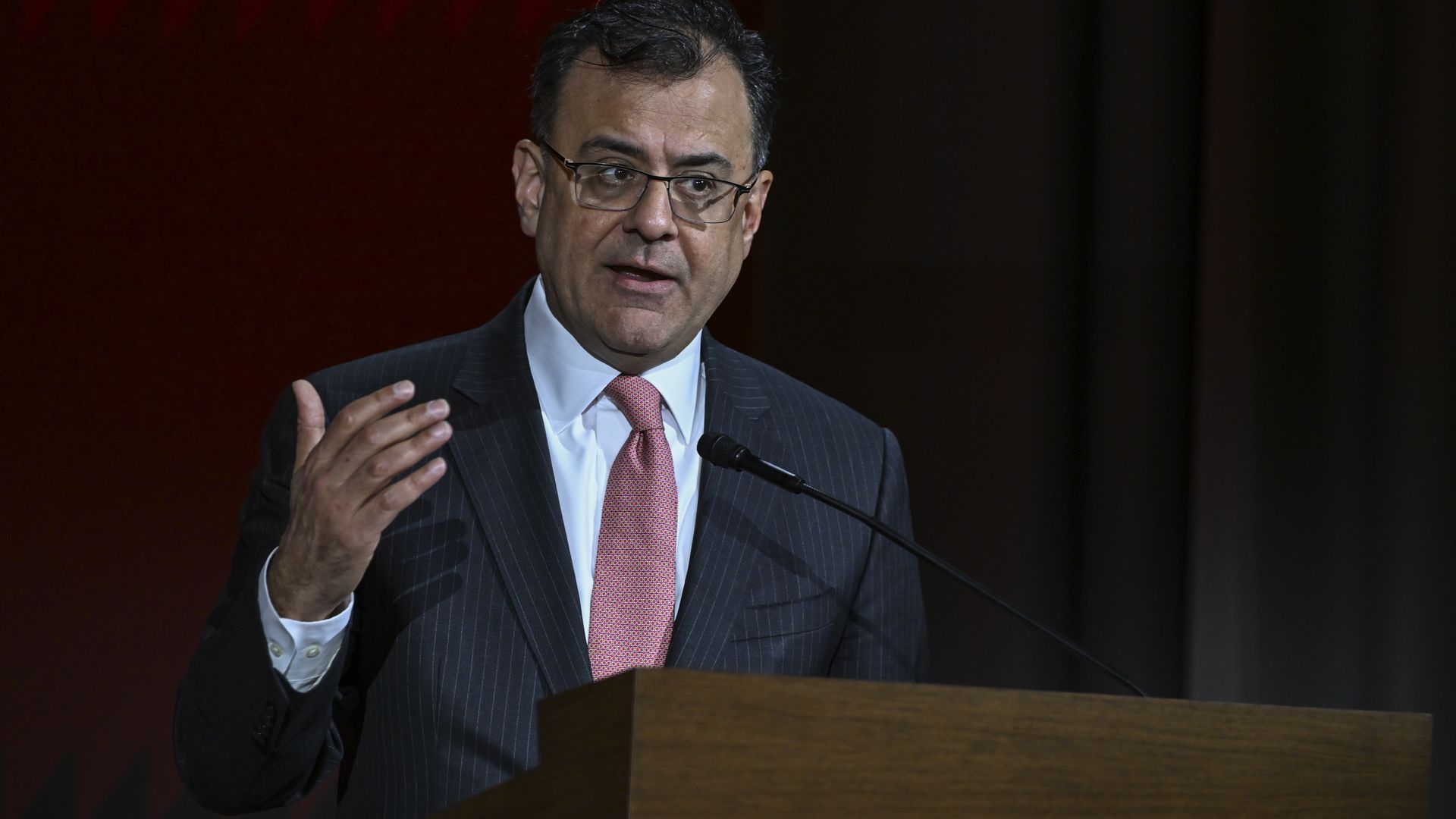
Karan Bhatia speaks at the U.S.-Turkey Business Forum in Washington on March 13. Photo: Celal Gunes/Anadolu Agency via Getty Images
Ashley caught up with Karan Bhatia, Google's global head of government affairs and public policy, this week in Washington. Bhatia participated in the State Department's 2023 Summit for Democracy, which partly focused on the role of the open internet and technology in democratic societies.
Below is an excerpt from the conversation, which has been edited and condensed for clarity.
What message are you bringing to the Summit for Democracy on behalf of Google?
The Declaration for the Future of the internet came out of the last summit, which we see as having been a very strong reclaiming of core principles of the internet: freedom of speech and expression online, movement of data and ideas across borders and standing up against authoritarian governments as they seek to potentially misuse technology.
- That notion of universality of access to the internet is really core to our mission and values. And frankly, in the last five to 10 years, we've seen an erosion of that vision.
In the U.S., we're seeing a trend of laws that threaten the open internet and access to information online, while we continue to push for those values abroad and encourage others to adopt them. How are you thinking about that?
Freedom of speech online and the internet as an enabler of democracy needs to be safeguarded everywhere, including the United States. There are policy trends and threats to that even in the U.S. These are freedoms that are hard-won and easily lost.
- These commitments, and these principles, are not just a reminder to authoritarian governments or even to other democracies around the world, they are a reminder to the United States as well.
- Now I will say that, in the grand scheme of things, the United States continues to have a relatively open and free internet. So I do think we, you know, are in a good position to be an advocate for that.
- But we do need to sort of hold the mirror up to ourselves as well, and make sure that we are living up to these principles.
Europe has been very active on regulating social media. What are your thoughts on current legislation from the EU?
European tradition is one that is fundamentally rooted in freedom of expression as well. What one has to watch for is that some of the regulatory initiatives there maintain the preeminence of freedom of expression.
- My biggest worry is that in a world right now where there are very divergent views of the internet, including, say, Russia's view of what the internet should look like, it's more critical than ever that the United States and Europe be aligned around a common approach.
- What we're seeing is an explosion of regulation that is applying fairly different standards to the internet, causing a fracturing of the idea of a global, interoperable internet.
Can you give me a doomsday clock, but for internet fragmentation?
We're a lot closer to midnight than we were 10 years ago, I'll tell you that....
- We're seeing such an explosion of regulatory activity in different places around the world that I fear the internet is increasingly becoming a harder place for smaller, more innovative platforms to get a foothold at a global scale.
✅ Thank you for reading Axios Pro Policy, and thanks to editors Mackenzie Weinger and David Nather and copy editor Brad Bonhall.
- Do you know someone who needs this newsletter? Have them sign up here.
View archive