

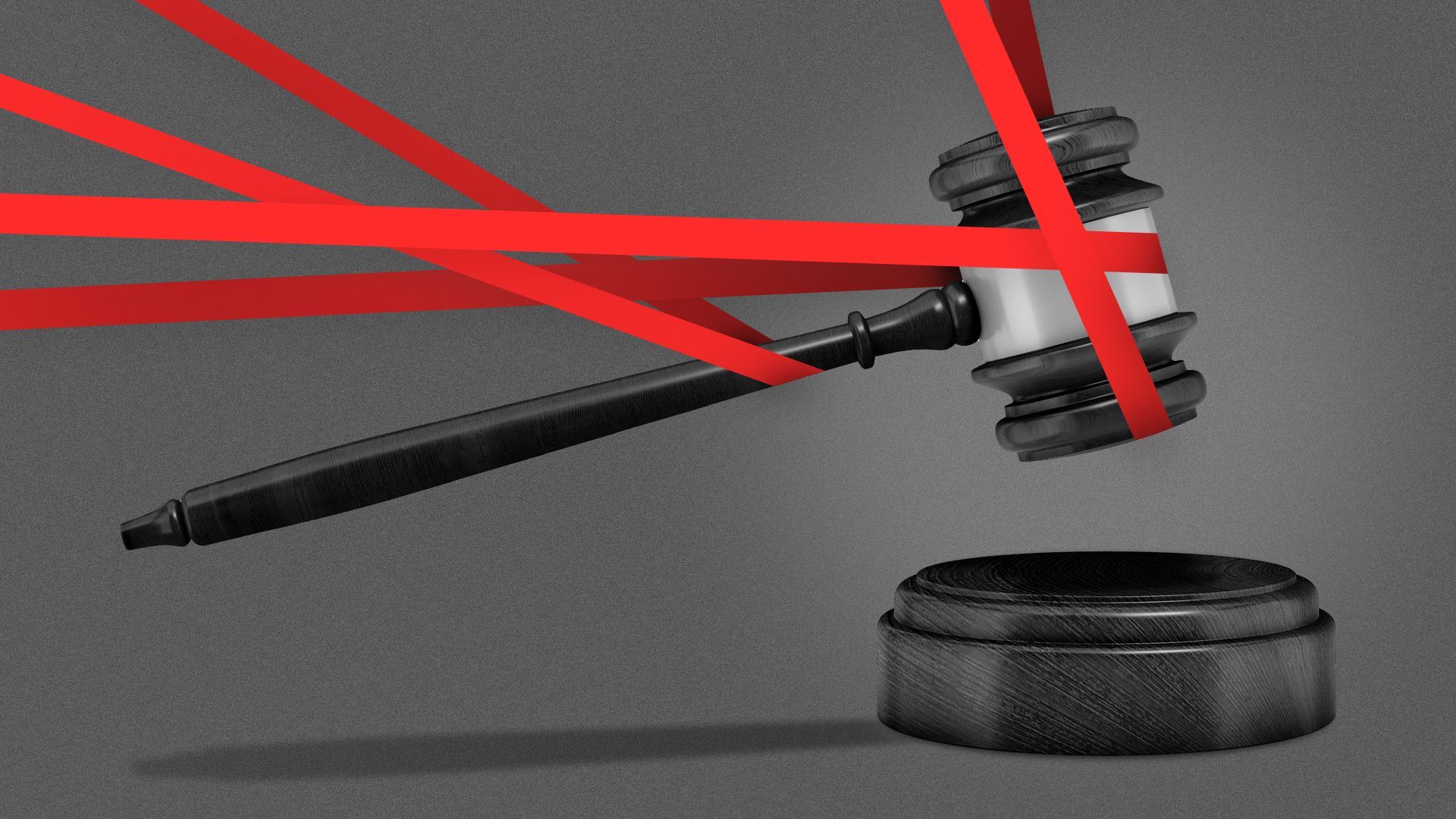
Illustration: Gabriella Turrisi/Axios
House GOP leaders are throwing cold water on what they say is a rush to regulate AI, making it plain that they prefer a different approach from the bipartisan one in the Senate.
Why it matters: If the two chambers aren't aligned, AI is poised to become another world-changing technology without real regulatory guardrails.
The big picture: House Majority Leader Steve Scalise, GOP committee chairs and Republican members of the chamber's AI working group met last week to discuss how to approach AI and expressed significant concern with regulating the technology, according to a person in the room.
- Members opposed the White House's AI executive order and the Senate's AI roadmap.
- House Republicans will not support bills that set up agencies, establish licensing requirements, spend money on R&D, "unleash" trial lawyers on developers, favor one technology over another or create "burdens on new developers," the person said.
House AI task force co-chair Ted Lieu said task force members on both sides of the aisle are in agreement that innovation should be cultivated while reducing the tech's potential to cause harms.
- "I was surprised to read about how unfamiliar Majority Leader Scalise is with the work of our bipartisan taskforce," Lieu said in a statement.
- Lieu said the task force is doing exactly what Speaker Mike Johnson asked for when he set it up: focusing on national security and keeping the U.S. competitive in the space.
- Rep. Jay Obernolte, Lieu's Republican counterpart on the task force, did not respond to a request for comment.
National security and competition are becoming the organizing principles for Republicans in both chambers around AI policy, Jacob Helberg, an adviser to Palantir and the U.S.-China Economic and Security Review Commission, told Axios.
- Helberg, who supports former President Trump's campaign, said House Republicans are engaged in "watchful waiting" and don't want to rush to regulate at the expense of innovation.
- That's at odds with Democrats and some Senate Republicans who view passing AI-elections bills as an urgent priority.
- At Helberg's Hill and Valley Forum last month, Johnson said he's against overly regulating AI companies, which he said would stifle innovation and competition.
Friction point: Another point of disagreement is funding agencies tasked with researching and overseeing science and technology.
- The bipartisan Senate AI roadmap calls for $32 billion a year for nondefense AI work.
- Sen. Todd Young, a member of Schumer's bipartisan AI working group, told Axios there is little daylight between his approach and Scalise's: "We're actually in agreement — no new bureaucratic agency, no heavy-handed licensing regime. Everything that has a chance of moving in the Senate this year is in line with these views."
- That multibillion-dollar package is unlikely to pass this year, but bills such as the CREATE AI Act and Future of AI Innovation Act, both cosponsored by Young, don't authorize new funds and are seen as "base hits" to get passed, a Young spokesperson said.
Differences on licensing are also heating up, with Sen. Josh Hawley holding a different view from his Republican colleagues in the House.
- Hawley's bipartisan framework, which includes licensing, with Sen. Richard Blumenthal will likely be introduced in the next couple of months, Blumenthal said.
- Blumenthal added they've been speaking with IBM, which is against licensing, to work through how regulation can be done.
- "Congress needs to take action on AI, not repeat all the same mistakes we made with Big Tech and social media," Hawley said.
- Helberg: "House Republicans understand that if a company now needs to ask permission of the government in order to do something, it's inevitably going to slow down the pace of development."
Zoom out: As the presidential election and potential flips of the Senate and the House draw closer, there's less incentive to work on policy regulation across the aisle as both parties try to paint the other as holding up progress.
The bottom line: Partisan disagreement is likely to be what ultimately makes getting major AI legislation passed difficult, despite its bipartisan beginnings.
- Billy Gribbin, spokesperson for Sen. Mike Lee, who has his own conservative AI working group, told Axios: "Lee believes that [Scalise] was right to resist the temptation to support any attempt to issue rushed, no doubt heavy-handed regulations that will serve to undermine competition in this emerging field."
