Charted: Where Kroger and Albertsons dominate




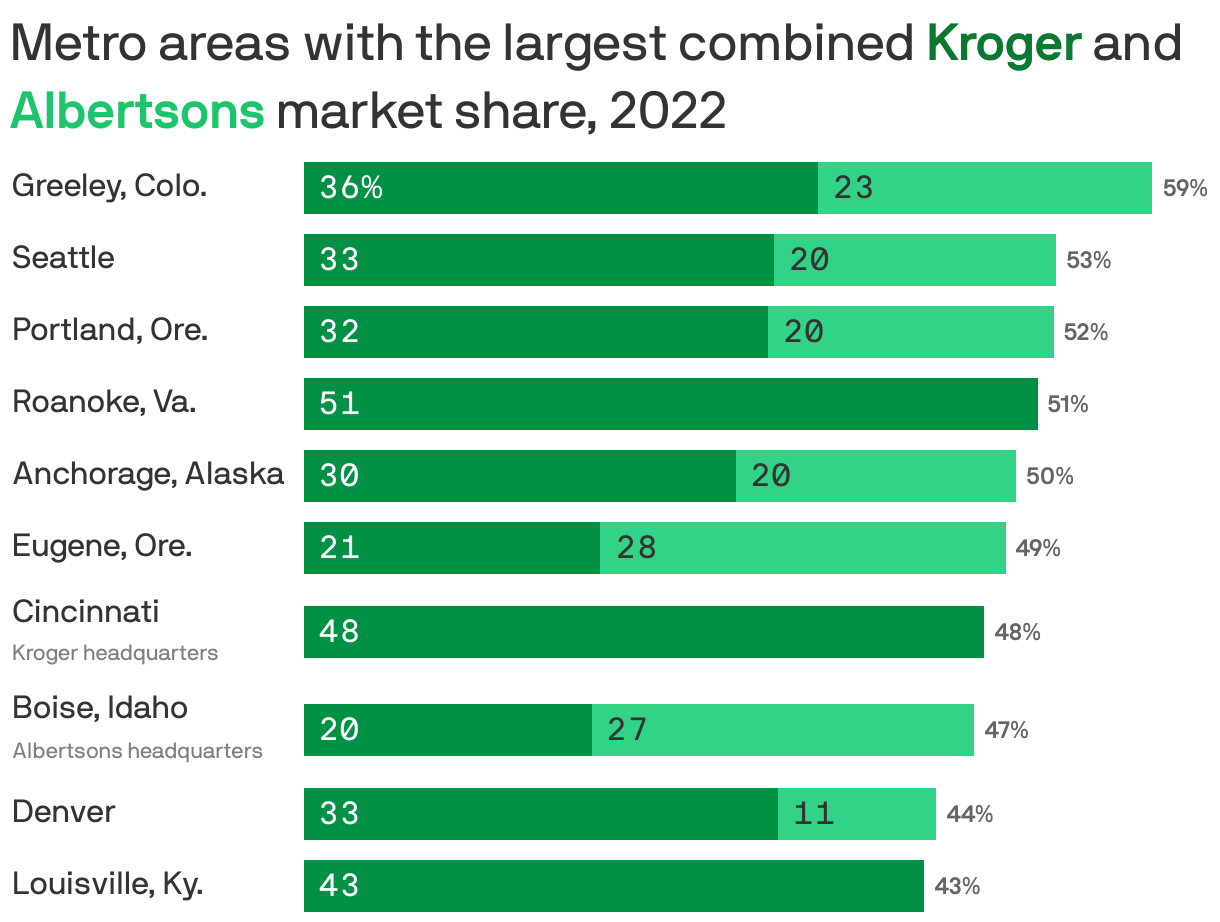
Although the merger of Kroger and Albertsons would create a national grocery juggernaut, some markets would be more affected than others — and some not affected at all, Richard and Axios' Erin Davis write.
Why it matters: When two of the largest food retailers propose a merger during a time of food inflation, antitrust scrutiny and corresponding store divestitures are assured.
Driving the news: Last week S&P Global Ratings said the number of stores the combined entity would be asked to divest by the FTC would be closer to the merger cap of 650.
- When Kroger and Albertsons struck the agreement, it was structured with the idea that the number of stores divested would be under 375.
Of note: The FTC reviews retail deals such as these on a market-by-market basis.
Details: As the chart shows, the two grocery store operators would have an outsized presence in the Northwest, on the West Coast, in the heart of the industrial Midwest, and in Colorado and Arizona.
Zoom in: It's those regions that would experience the divestitures, particularly local markets like Greeley, Colo., Seattle and Portland, Ore., where together the two have more than 50% market share.
Reality check: The FTC is under a lot of political pressure to give this deal — unlikely to close for several months — a close look.
