Burgess and Wenstrup exits will leave docs looking for new allies

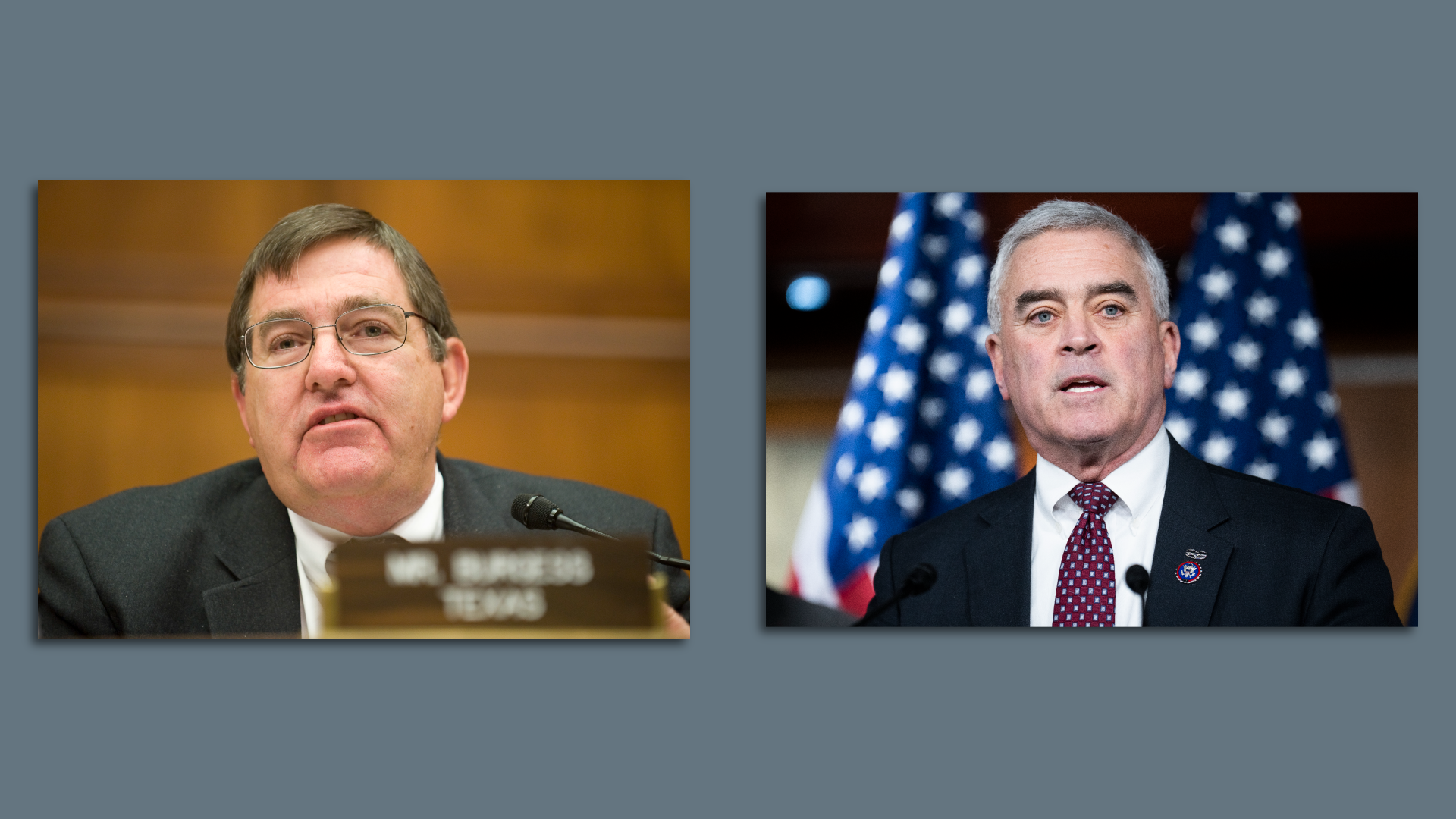
GOP Reps. Michael Burgess, left, and Brad Wenstrup. Photos: Bill Clark/Roll Call and Tom Williams/CQ-Roll Call via Getty Images
The retirement of two senior House Republican physician-lawmakers will leave doctors searching for new advocates as Congress takes up Medicare payment cuts, prior authorization reform and other hot-button issues.
Why it matters: Physicians and other providers need someone to look out for their interests as Congress decides what health policies will ride on an anticipated government funding deal in January and weighs the fate of other health policies.
- They had well-placed allies in Brad Wenstrup, a podiatrist who was elected in 2012 and serves on Ways and Means, and Michael Burgess, an OB-GYN and senior member on Energy and Commerce, who's completing his 20th year in the House.
- Both plan to complete their terms in the 118th Congress.
Zoom in: The continuing resolution delayed Medicare physician payment cuts until Jan. 1, but physicians groups worry that with the first government funding deadline not until Jan. 19, they will have to ask for retroactive payment fixes, which aren't unprecedented but can be messy.
- Doctors also are facing a 3.4% decrease in a key factor determining their base Medicare pay next year.
- Burgess and Wenstrup will be leaving at a time when the pandemic experience and medical misinformation have eroded some of the goodwill toward health professionals.
- There's also been increased friction between Republican lawmakers and the American Medical Association over positions the group has taken in support of abortion access and gender-affirming care.
What they're saying: Leaders of interest groups like the AMA and the Medical Group Management Association said they do worry about the departure of veteran lawmakers who had real-world medical experience.
- "They've obviously been strong advocates for both patients and physicians. And during this time of Medicare cuts, they've been very outspoken about what this means for health care access as well as practice viability," said AMA President Jesse Ehrenfeld.
- "Any time you lose the institutional knowledge of somebody like Dr. Burgess or Wenstrup, it's going to be harder," said Anders Gilberg, senior vice president of the Medical Group Management Association. "When organizations that represent physicians are going up to the Hill, having these champions, it's invaluable, really."
- Gilberg said one other advantage was the interest in policy and passing legislation that both showed.
- "There's just a lot of politics and dysfunction right now," Gilberg said. "And there's less of an appetite in dealing in the harder health care policy issues. One of the things that physicians bring to the table is a focus on policy."
Yes, but: The GOP doctors themselves were optimistic that others would take their place in Congress.
- "We are actually seeing several doctors stepping up to run in the House of Representatives," Wenstrup told Axios, declining to name names. "So I think that we may see a few more coming in as we leave."
- Although he said he doesn't know what's next after Congress, he plans to "stay engaged with trying to advocate for doctors to run."
- "If you go down the list, our Doctors Caucus has really grown since I've been here and became more organized," Wenstrup added. "We meet every week, we're asked to weigh in on policy. You know some things go through committee, but they want the approval of the Doctors Caucus, so I think they'll still be a good presence here."
- "There will still be plenty of people" advocating for doctors, Burgess told Axios. "The Doctors Caucus is going to endure. I'm not sure how many new physicians we have running, but even at our present level, with me and Wenstrup retiring, there are still going to be 15 to 16 doctors here."
- Burgess also pointed out that he's term-limited as the GOP Doctors Caucus chairman, so he would already have had to step down from the leadership position at the end of the 118th Congress. Rep. Greg Murphy will be the one co-chair left.
Of note: Burgess and Wenstrup sit on the two most influential health committees in the House and have been leaders on numerous health bills over the years. Both were both involved in the failed Affordable Care Act repeal-replace effort.
- Burgess also led the Medicare Access and CHIP Reauthorization Act, which was signed into law in 2015 and overhauled how physicians were paid.
- Wenstrup has sponsored the Safe Step Act and legislation that would allow Medicare to cover obesity drugs and breakthrough devices.
What we're watching: At least one doctor has announced a candidacy for Congress: Brian Williams, a trauma surgeon who is running as a Democrat for Texas' 32nd District seat.
