
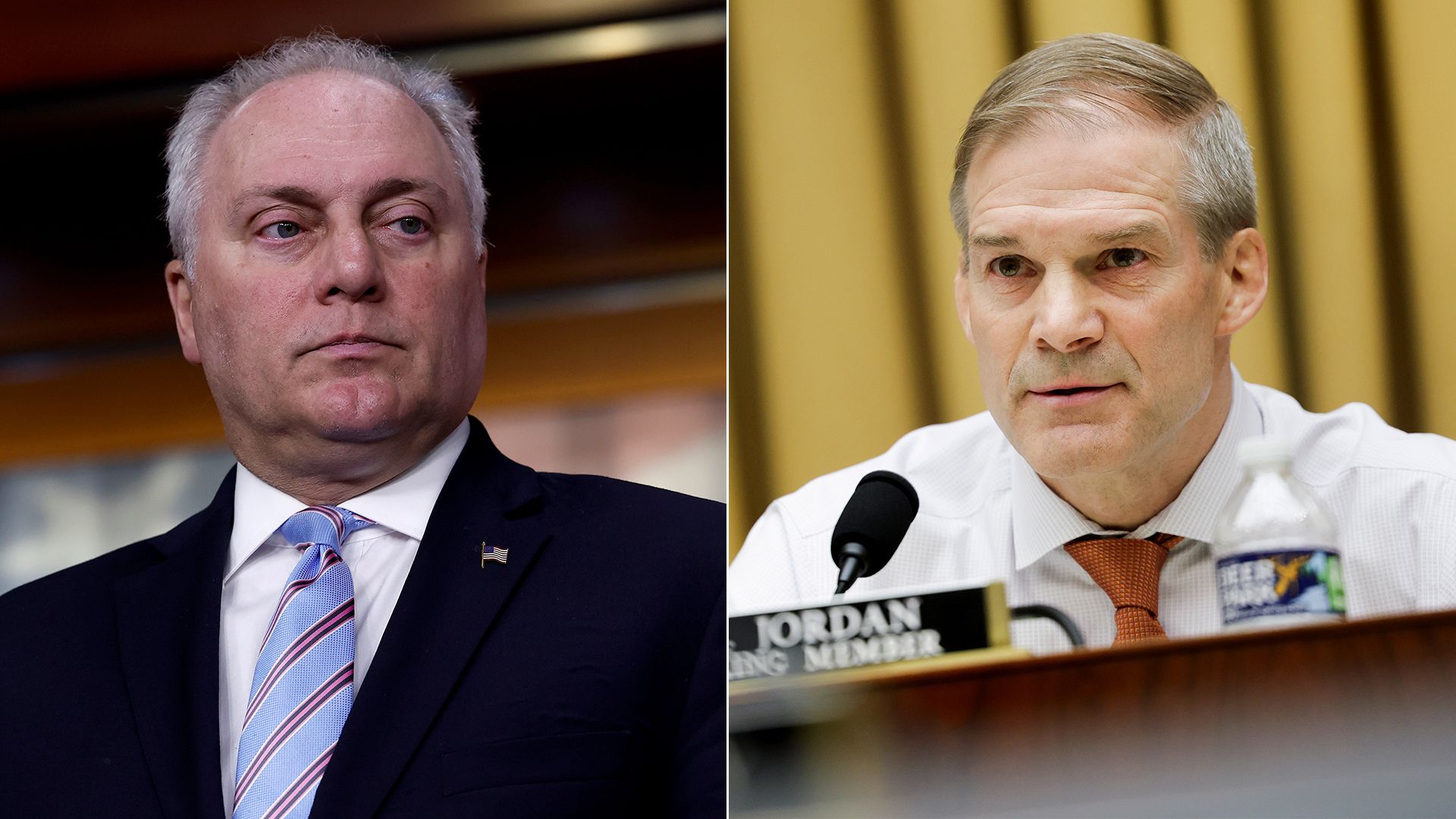
Photos: Anna Moneymaker/Getty Images; Kevin Dietsch/Getty Images
The next House speaker will have to confront an array of unfinished health care business — and do it all on a very compressed timeline.
- If past is prologue, here's a look at the two declared candidates as of Wednesday afternoon, Majority Leader Steve Scalise and Judiciary Chair Jim Jordan, and how they've made a mark on the issues:
Steve Scalise
Scalise joined Energy and Commerce in 2009, right after starting his first full term in Congress (he was first elected in May 2008 in a special election).
- A former Scalise staffer told Axios that joining E&C that soon into his Washington career drove home the importance of health policy. Scalise left the committee only this term, when he joined leadership.
- He also served as ranking member on House Oversight's select subcommittee on the coronavirus crisis.
Details: Scalise has worked on high-profile health legislation, including cosponsoring a Republican alternative to the Affordable Care Act when he was chair of the Republican Study Committee.
- He's been an outspoken opponent of the ACA for years. Here's a 2009 clip of him holding up a print version of the legislation and attacking it as a "government takeover."
- He was also heavily involved in whipping votes for the 21st Century Cures Act and the congressional response to the Ebola and Zika virus outbreaks.
Scalise spent months in the hospital in 2017 after being shot during a practice session for the Congressional Baseball Game, an experience that helped shape his view of the health system. A key is the belief that personalized health care and the doctor-patient relationship are important, per the former aide.
- "Health care is very personal to me," Scalise said during a 2020 health care panel at CPAC. "I would not be here today without the greatest health care system on the face of the planet. I'm not going to let them take that from you or anyone else."
- Scalise also was diagnosed with multiple myeloma, a blood cancer, this summer and has been undergoing chemotherapy.
- Because of his health, sources say there are some concerns about whether the speaker's job is a good fit right now.
- Extreme weather events in his home state of Louisiana, like Hurricane Katrina, have also reinforced the importance of health care infrastructure and shaped Scalise's views on the COVID-19 pandemic response, the ex-staffer said.
For all that, Scalise doesn't have a signature health care issue. "He always dives into the problem of the day," the former aide said.
- Looking forward, he expects Scalise to try to "put more meat" around the Healthy Futures Task Force, the subcommittee that put out policy recommendations for ex-Speaker Kevin McCarthy's Commitment to America.
- Other possible priorities could include making pandemic-era telehealth flexibilities permanent, strengthening Medicare Advantage and shoring up Medicare's finances, his former aide predicted.
We also profiled Scalise's current health staffer last year. You can read that here.
Jim Jordan
Jordan led the House Republican Study Committee before starting the House Freedom Caucus and serving as its chair.
- Over the years he's aligned himself more closely with House leadership, including McCarthy, and serves on House Oversight, in addition to heading Judiciary.
Go deeper: As Judiciary chair this year, he's conducted hearings on the fentanyl crisis, oversight of the Drug Enforcement Administration and gender-affirming care for youths.
- During the pandemic, Jordan had heated exchanges with infectious disease specialist Anthony Fauci on the government's response.
- He alleged that Fauci helped cover up COVID's origins from a lab and also opposed vaccine mandates.
- That could have implications for funding the Centers for Disease Control, National Institutes of Health, both of which come under the Labor-HHS spending bill that's been stuck in the Appropriations Committee.
It's worth noting that Jordan's personal office webpage on health care hasn't been updated since 2017.
- At that time, he was an outspoken foe of the ACA. Although he first opposed Republicans' repeal-replace plan, calling it "Obamacare Lite," he eventually led the House Freedom Caucus in supporting an amended version.
- "Our efforts in the House Freedom Caucus to hold the line and improve the American Health Care Act have paid off," Jordan said in a 2017 statement.
