April 09, 2025


🐪 We're almost there, Pros. Watch Axios.com for coverage of the House budget resolution vote today.
🚨 Situational awareness: Nearly 200 House and Senate Democrats have signed a letter to EPA chief Lee Zeldin arguing that his deregulatory agenda shows "a complete disregard for the central mission of the agency."
🌵 Calling New Mexico readers: Join Nick and Axios' Chuck McCutcheon on April 16 at 10am MT in Santa Fe for an event exploring the state's clean energy efforts. RSVP here.
🎶 Today's last song is from Brian Prest of RFF: A cover of "Please Please Please" by Julia DiGrazia, Sierra Carson and Kylie Spence.
1 big thing: ENR-approved mining bill could lead to wider deal

Senate Energy and Natural Resources advanced a bill today that would make it easier to site mining projects — and potentially build momentum around a bigger minerals package, Daniel writes.
Why it matters: Winning Democratic votes for the bill to address the Rosemont decision is a key marker of compromise for a broader package.
- ENR Ranking Member Martin Heinrich voted against the bill because he wants more funding for mining reclamation, but said he's "very close" to reaching a deal on language.
Driving the news: The Mineral Regulatory Clarity Act would leave the Rosemont decision in place. The 2022 ruling limited where mining companies can locate support facilities in areas that have an economically recoverable mineral resource.
- But the bill would allow mining companies an alternative permitting path for mills, shafts, crushers, and waste facilities on federal land.
- Without the bill, U.S. mining "would be severely impacted for the foreseeable future, setting back bipartisan efforts to create domestic supply chains for critical minerals," said Catherine Cortez Masto, the bill's sponsor.
- The committee approved the bill 14–6. It also voted 13–7 to advance a separate bill that would expand mining in Montana.
Environmentalists have criticized Cortez Masto's bill, saying it would gut safeguards to prevent mining pollution.
Between the lines: Heinrich said he wants to add maintenance fees at $400 a year for reclamation activities funded by the Abandoned Hardrock Mine Reclamation Program that the IIJA established.
- Although that fund has reached about $20 million, the need is in the billions, Heinrich said.
- "It would actually go toward cleaning up abandoned sites we have, which is an unmet need on a very large scale," he told Daniel.
- Heinrich and Cortez Masto said they were working on a deal on the fee structure to try to win Heinrich's support by the time the bill comes to the floor.
The committee also advanced the nominations of James Danly and Katherine MacGregor to be deputy secretaries at the Energy Department and Interior Department.
- MacGregor was advanced 14–6, with Heinrich, Ruben Gallego and independent Angus King voting in favor.
- Danly was advanced 13–7, with Heinrich and King voting in favor.
- The nominees got a mostly friendly hearing last week amid Democrats' questions about DOGE funding and agency staffing cuts. Heinrich today called the nominees "tested and qualified leaders."
What's next: Two other bills, including legislation to add copper to the federal critical mineral list, were postponed pending further review.
2. 1st look: Schatz and Sheehy eye AI to tame extreme weather

Sen. Brian Schatz is out with bipartisan legislation that would unleash AI to protect communities from extreme weather events, Daniel writes.
Why it matters: The bill, first seen by Axios, is a serious effort to lean on artificial intelligence to better predict and respond to increasingly devastating wildfires, hurricanes, floods and other disasters.
- The legislation comes as NOAA faces steep cuts to staffing and climate change initiatives.
Zoom in: The TAME Extreme Weather and Wildfires Act, co-sponsored by Sen. Tim Sheehy, would direct NOAA to develop a U.S. global weather dataset to train AI forecasting models.
- NOAA would also partner with the private and academic sectors on AI weather and wildfire forecasting, and innovate new AI weather and wildfire products and applications.
- Rep. Scott Franklin introduced a House companion bill.
What they're saying: "Extreme weather events are becoming more frequent, more severe, and more deadly, and AI can be a powerful tool in saving lives and livelihoods," Schatz said in a statement.
- "Our bill will harness AI's immense processing and prediction capabilities to improve weather forecasts and help communities better prepare for and respond more quickly to extreme weather events."
- The government response to extreme weather "hasn't changed in decades," Sheehy said. AI could provide answers to "know where, how big, and how bad weather is going to be, and can take preventative measures."
Context: A record 28 disasters across the U.S. in 2023 killed nearly 500 people, and each cost at least $1 billion in damage.
3. Cassidy hopes Trump tariffs include room for carbon
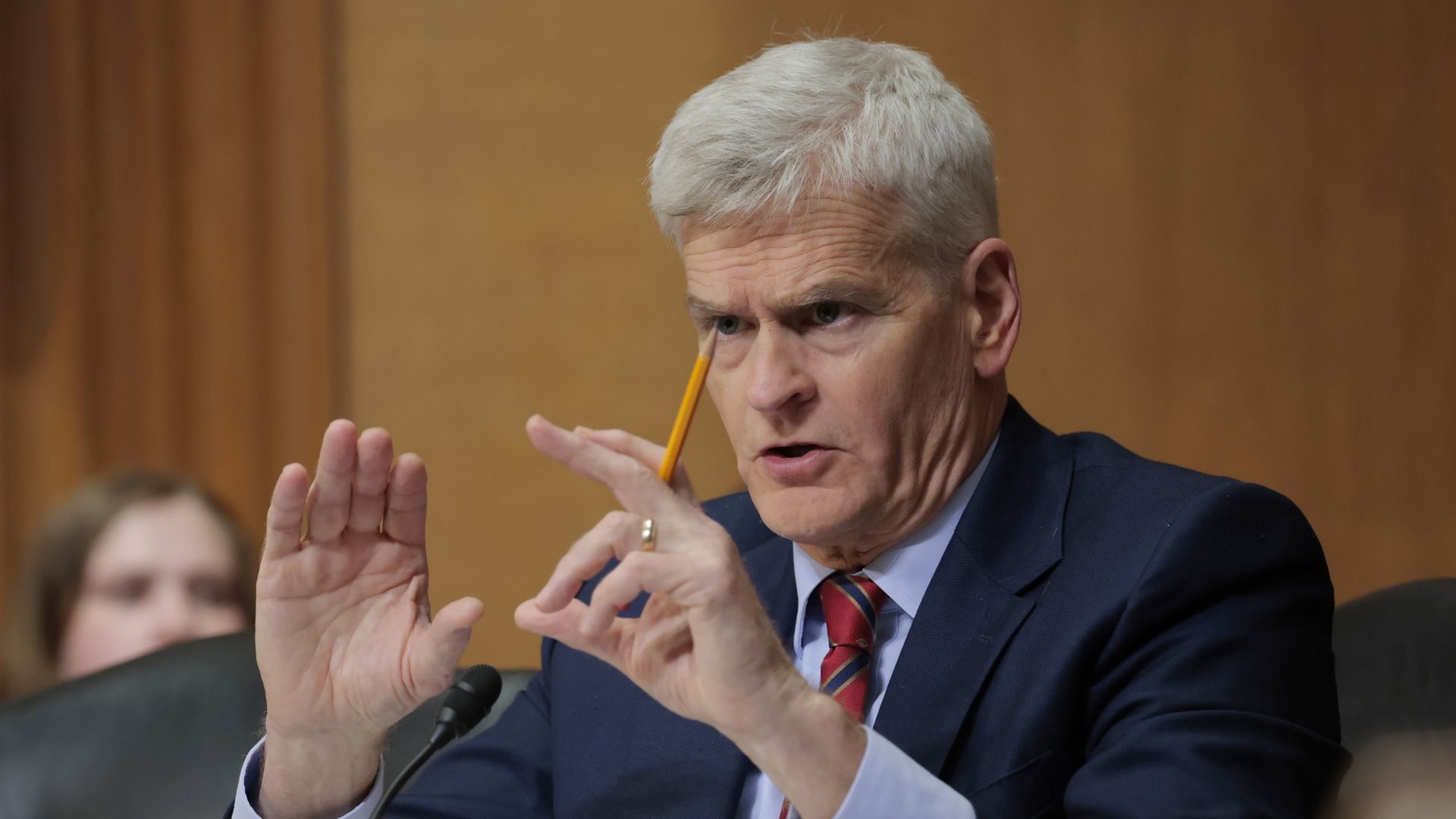
Sen. Bill Cassidy is trying to make his new carbon tariff proposal fit into the larger world of Trump tariffs, Nick writes.
Why it matters: The Foreign Pollution Fee Act is a GOP policy marker that has some buy-in from Trumpworld — but it enters an uncertain era of global trade and a burgeoning tariff war.
Driving the news: The bill, reintroduced yesterday, would impose a fee on a slew of industrial imports — including iron, steel, aluminum, cement, glass, fertilizer, hydrogen and solar components — based on their greenhouse gas emissions.
- The latest version drops oil and gas from that list. It would also spell out a formula for charging imports from countries based on their specific pollution profile relative to U.S. products.
- And it would let companies reduce tariffs by buying carbon removal credits.
The big picture: It's a long shot to pass in the near term, but the trade war changes by the day.
- Supporters see it as a way to achieve durable tariff policy that lasts beyond President Trump's tariffs, many of which were put on hold this afternoon.
Between the lines: Trump, during his speech last week announcing the tariffs, talked about other countries creating "filthy pollution havens" that have hurt U.S. manufacturers that comply with environmental regulations.
- Cassidy said he sees that as an encouraging sign, on top of the statements of support he gathered from Trump nominees during their confirmation hearings.
Sen. Sheldon Whitehouse, who's leading the carbon tariff charge on the Democratic side, told Nick he's still hoping to work with Cassidy on a bipartisan bill.
- But asked where carbon tariffs fit into Trump's tariff regime, Whitehouse replied, "Who knows?"
- "If you can decode what this insane administration is doing with tariffs, you're a better man than I am."
✅ Thank you for reading Axios Pro Policy, and thanks to editors Chuck McCutcheon and David Nather and copy editor Brad Bonhall.
View archive