February 20, 2025



🍻 Almost there! Ready for vote-a-rama?
- We won't cover that live, but we'll let you know if anything gets added or changed that you need to know about.
🎤 Join Daniel and Axios' Andrew Freedman in D.C. at 8am ET Wednesday for a look at ways to prepare the electric grid to meet future consumption needs. The event will feature Reps. Kathy Castor and Bob Latta and Sen. Tina Smith. Register here.
🎶 Today's last song comes from Joe Jackson, senior comms director for Sen. Cynthia Lummis: "I Hold On" by Dierks Bentley.
1 big thing: Energy dominance caucus has surprising bipartisan tilt
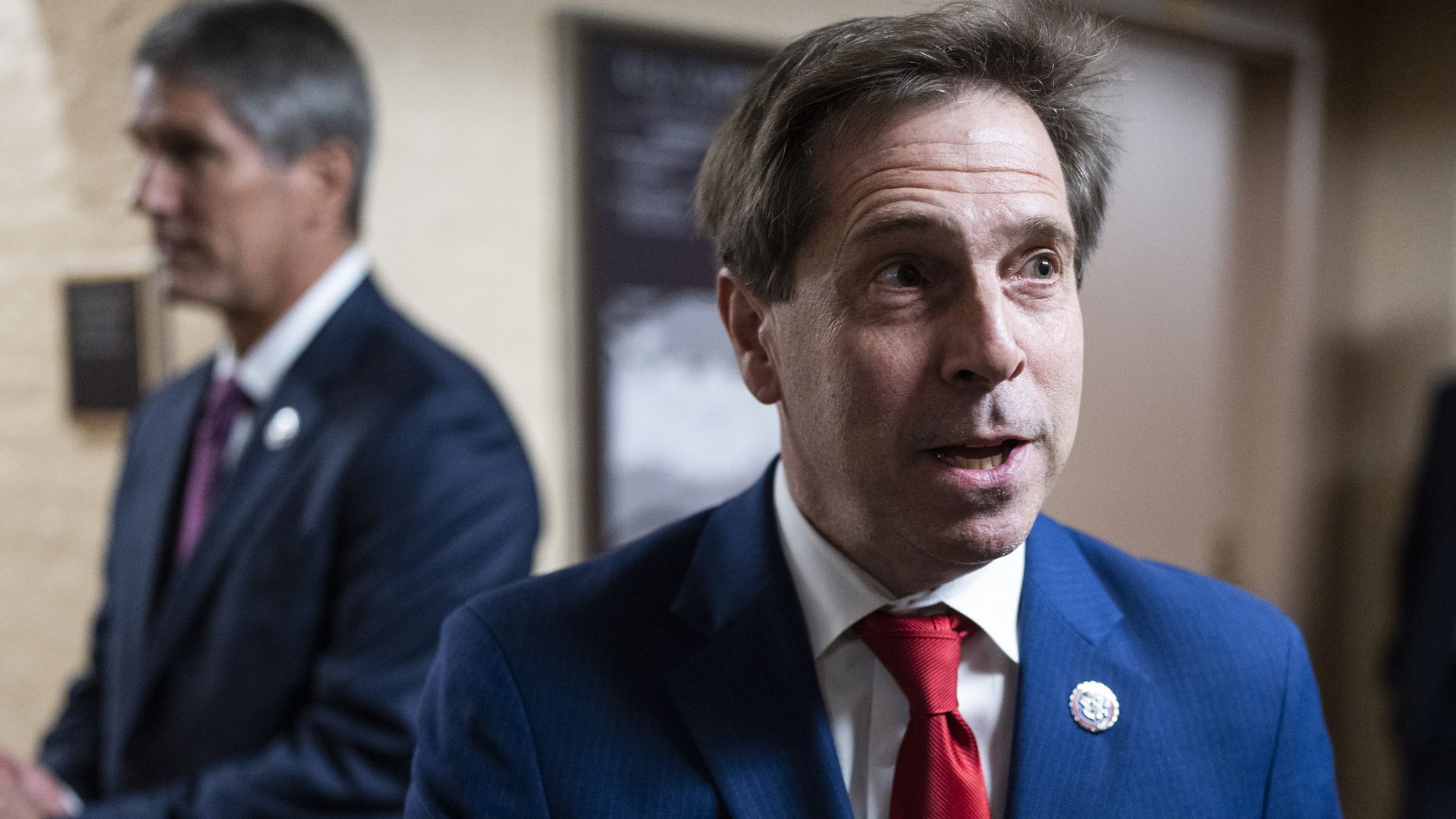
Rep. Chuck Fleischmann's new caucus to carry out the Trump White House's call to expand energy is finding a receptive audience — among Democrats, Daniel writes.
Why it matters: The makeup of the American Energy Dominance Caucus — with 10 Democrats joining six Republicans, at last tally — reflects a potentially rare bipartisan path forward for energy policy.
- The forum could help deliver crucial Democratic votes that get GOP energy priorities across the finish line — including a permitting overhaul, caucus members said.
Between the lines: Despite the Trumpian name, the caucus will let Democrats work across the aisle on issues that are important to them, said Edward Do, a spokesman for lead caucus Democrat Marc Veasey of Texas.
The big picture: Fleischmann, long a champion of nuclear power, wants the caucus to be as inclusive as possible to meet rising electricity demand.
- "I thought I would have 3-to-1 Republicans," Fleischmann told Daniel outside the House chamber.
- The goal is to arrive at "substantive answers for Republicans and Democrats who are interested in this.… It's not like 'Well, we're going to get back with you.' It's like 'No, let's address this.'"
- Fleischmann said long-distance transmission lines — a partisan issue that's contributed to derailing permitting proposals — is "going to be part of that."
What they're saying: Many of the Democrats represent competitive districts where oil and gas is a booming industry alongside wind and solar.
- "Approaching energy, we gotta find a balance — sometimes people are always 'One or the other. No fossil fuel, none of that,'" Texas' Henry Cuellar said. "And I think we can have all of the above."
- Cuellar led a successful effort to repeal the U.S. crude oil export ban in 2015 and was one of four House Democrats to vote for a Republican-led rollback of IRA credits in 2023.
Other caucus Democrats are Texas' Vicente Gonzalez; New York's Daniel Goldman; Minnesota's Angie Craig; Georgia's Sanford Bishop; New Jersey's Donald Norcross; Michigan's Hillary Scholten; California's Lou Correa; and Louisiana's Troy Carter.
Fleischmann, the top House energy and water appropriator, said he's "not unduly" concerned about Trump's funding freeze, which Democrats of all stripes have blasted.
- In addition to Congress' authority to authorize spending, he said, "the executive branch also has a role, not only in the budget, but to fulfill its duties."
2. FERC's Christie downplays Trump EO's impact

FERC Chair Mark Christie said the controversial White House executive order on independent agencies won't significantly change how the energy regulator works, Daniel writes.
Why it matters: The EO sparked criticism and fears among FERC watchers that Trump would erode the commission's political independence as it seeks to fast-track power plants and data center projects.
- Christie, however, told Daniel that it's "perfectly appropriate" for FERC chairs to consult with the White House on broad policy matters.
The big picture: Christie said the White House is most likely interested in "big sweeping regulations" that FERC initiates rather than the vast majority of the 1,000 filings it receives each year.
- "Why would any commission initiate a big, sweeping regulation that's contrary to what a presidential administration wants?" Christie said.
Between the lines: Christie acknowledged some open questions remain about how the White House may act in specific cases.
- "I would like to know more detail about: What do you mean by 'actions'? How far does that go?" he said, referring to which rules should go to the White House for review.
- He said the commission would continue following the statutes in its gas and electric proceedings and follow strict ex parte laws that prevent any discussion of contested cases without all the parties present.
Zoom in: Christie portrayed himself as in line with the administration on growing out the energy system to meet rising demand.
Christie also said FERC has fired no probationary employees to date and that DOGE hasn't contacted him.
- "We hire, we advance, we promote based on the individual's abilities, which is the way it ought to be," he said.
3. Mitch McConnell's energy legacy
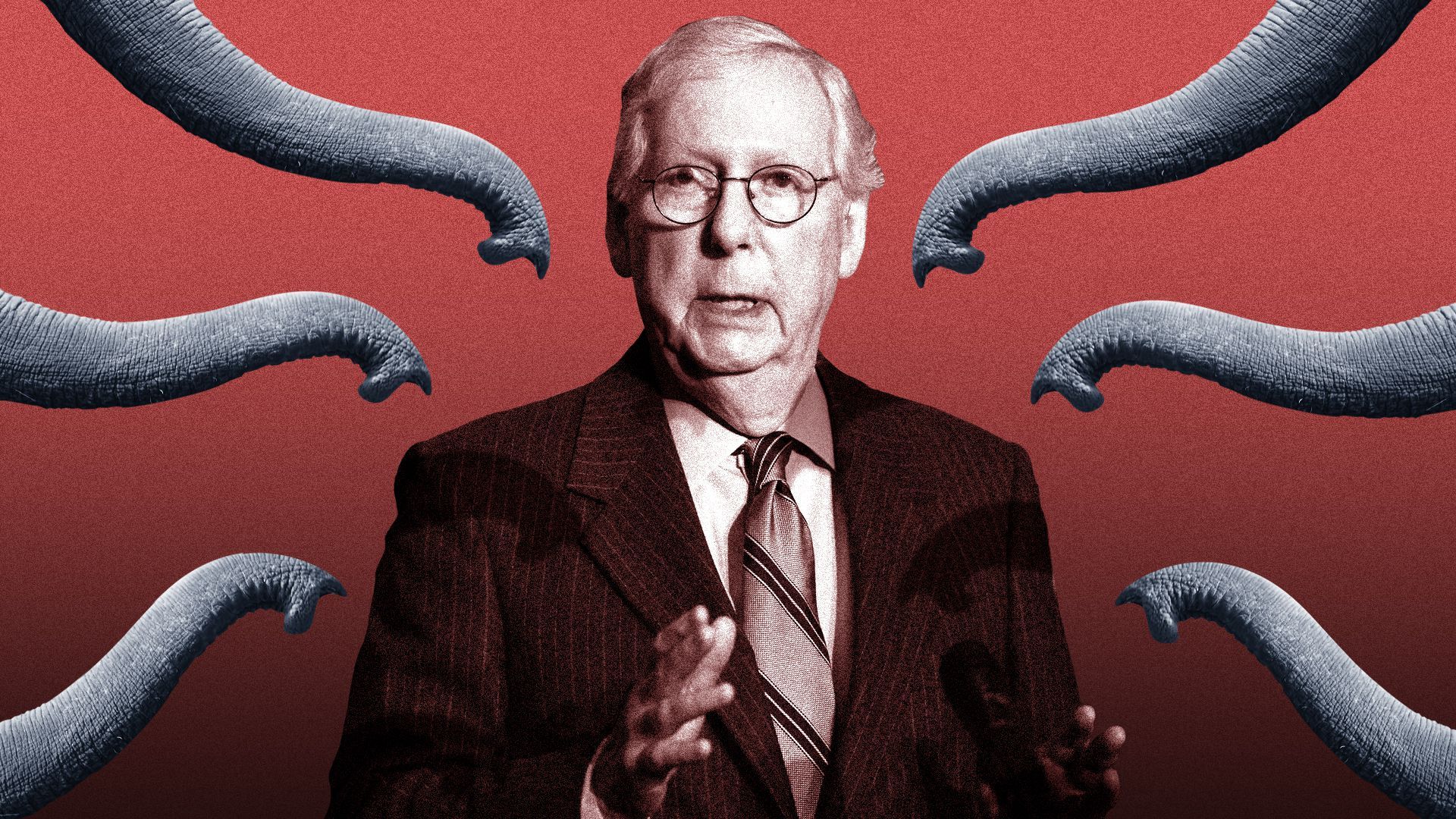
Sen. Mitch McConnell's retirement marks the departure of one of coal's biggest champions, Nick and Chuck write.
Why it matters: McConnell, a fierce defender of Kentucky's coal industry, was at the forefront for the GOP in virtually every energy battle of the past two decades.
Driving the news: McConnell, 83, announced today that he won't seek reelection in 2026.
- He led the Senate GOP from 2007 until last month.
- "The Senate is still equipped for work of great consequence, and to the disappointment of my critics, I'm still here on the job," he said on the floor.
Flashback: He was among the top voices decrying former President Obama's "war on coal" and in portraying the Waxman-Markey cap-and-trade bill as a "light-switch tax."
- "I don't think putting clamps on our economy when you know the Chinese and the Indians are not going to do it is a good idea," he told Fox News in 2009.
- He touted his work in those fights in a 2019 op-ed and said he was "committed to helping coal communities plan for the future with training and employment services as well as economic development."
As GOP leader, he was a highly disciplined political operator.
- "The idea of an off-the-cuff comment is anathema to him," Louisville Courier-Journal columnist John David Dyche wrote in a 2009 biography.
More recently, McConnell led GOP messaging on the Green New Deal and Democratic climate policies, forcing a floor vote on Sen. Ed Markey's resolution in 2019.
- Most Democrats — including Markey — voted "present" in protest.
- But McConnell was also instrumental in passing the IIJA, despite opposition from much of the GOP conference.
The bottom line: As the late Sen. John McCain once said, "There are few things more daunting in politics than the determined opposition of Sen. McConnell."
4. Catch me up: Budget moves and more

🗳️ 1. Vote-a-rama drama: The Senate is set to begin a marathon amendment session this evening on the GOP budget resolution. Democrats will be able to force Republicans to vote on politically uncomfortable proposals and message against the reconciliation push.
- "The kind of stuff that you're likely to see is amendments to ensure that we're not raising energy costs on consumers," Sen. Martin Heinrich told reporters.
👀 2. Fresh EO: Trump issued an executive order yesterday initiating a White House review of "unconstitutional" regulations.
- It directs agencies to deprioritize "actions to enforce regulations that are based on anything other than the best reading of a statute."
❌ 3. NEPA on notice: CEQ has moved to get rid of its NEPA implementing regulations in line with one of Trump's executive orders, which directed it to coordinate agency-level guidance for the law.
✅ Thank you for reading Axios Pro Policy, and thanks to editors Chuck McCutcheon and David Nather and copy editor Brad Bonhall.
View archive