Axios What's Next

May 31, 2023
Those annoying tags on T-shirts, dresses and everything else we wear could soon be a thing of the past, Jennifer reports today.
Today's newsletter is 1,069 words ... 4 minutes.
1 big thing: QR clothing labels
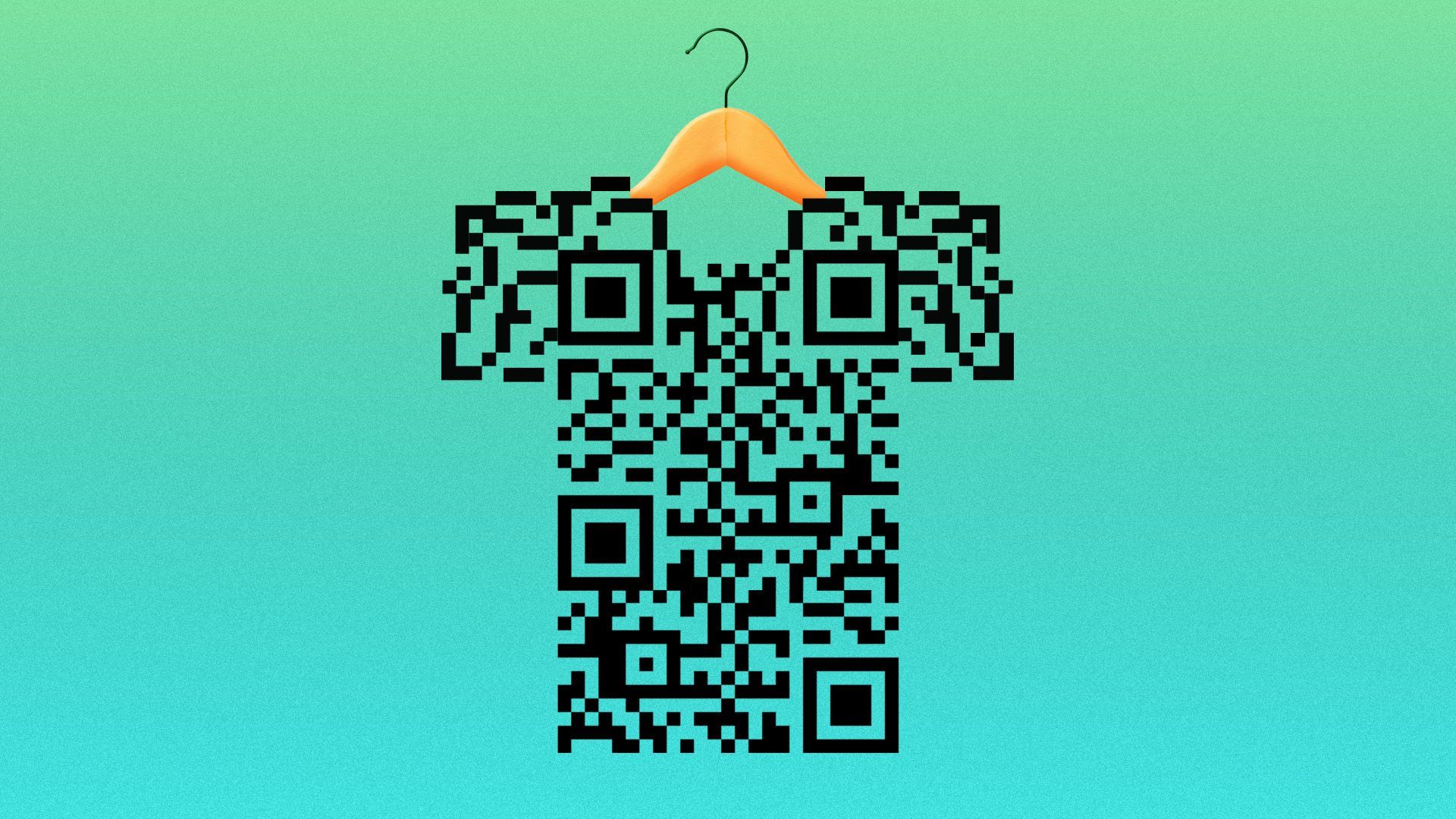
Illustration: Sarah Grillo/Axios
If the apparel industry gets its way, small labels with QR codes would replace the bulky clothing tags with washing instructions and other information on our threads, Jennifer reports.
Why it matters: Digital product labels could provide much more information to consumers, who could scan them for a library of details about the garment they're wearing (or might buy).
Driving the news: Garment manufacturers have been lobbying Congress and the Federal Trade Commission (FTC) for permission to replace physical clothing tags — which must include care instructions, fiber content, country of origin, etc. — with digital labels, most likely in the form of a QR code.
- A consumer could scan that code to get the legally required information and more — such as recycling instructions, supply chain information, product recalls, sustainability practices and more.
- And the landing page could be updated in real time.
For example: "Sometimes we produce garments knowing 'this much' about the material when we launch it, but three years down the road, something that was not recyclable is recyclable," Jennifer Patrick, global packaging and branding director at Patagonia, tells Axios.
Between the lines: A move to digital clothing labels would allow manufacturers to make the tags much smaller — and thus less itchy and annoying, says Jason Berns, head of product and manufacturing innovation at Ralph Lauren.
- It would reduce "label mangling," or the tendency of consumers to hack off clothing tags — keeping them intact for the next person who buys or inherits the item.
- It would also combat "label creep," the growing list of legal requirements from governments that have forced clothing makers to sew in ever-more-complicated (and cumbersome) care labels full of arcane laundry symbols.
Where it stands: The FTC currently requires garment labels to include "fiber content, the country of origin, and the identity of the manufacturer or another business responsible for marketing or handling the product."
- Those rules have been around since the 1960s, though other countries tack on other requirements that add length and complexity, said Stephen Lamar, CEO of the American Apparel & Footwear Association.
- The trade group has been pushing for the option to substitute QR codes for the existing clothing tags, making the case for what it calls "label modernization."
What they're saying: "Fashion is constantly evolving and changing, and yet we've got this labeling system that's kind of mired in the Eisenhower administration," Lamar tells Axios.
Yes, but: Pushback has come in the form of concerns from regulators and lawmakers about internet accessibility, and whether some consumers would be cut off from the required information.
The other side: Lamar contends that digital labeling could be a boon for accessibility.
- People sometimes struggle to read the teeny symbols on current label tags — particularly folks who are sight-impaired.
- As our clothing habits increasingly go "circular" — with people thrifting, recycling or composting garments instead of tossing them — digital labels will offer a more robust way for future users to access information about items, proponents say.
Case study: Ralph Lauren has "a little north of 220 million units with QR codes in the market today," Berns says. (The garments also have standard tags in them, to comply with current regulations.)
- "From a data perspective, we see some amazing things," he said. "We see a spike every weekend" in traffic to the sites linked to the QR codes.
The bottom line: With so many aspects of life going "phygital," it seems likely that we'll soon get used to scanning our shirts and skirts the way we do restaurant menus.
2. 5G comes to hospitals
Illustration: Natalie Peeples/Axios
Artificial intelligence may be grabbing headlines, but another technology revolution is finally starting to take place within hospitals: the switch to 5G.
Why it matters: 5G wireless networks could be game changers in enabling "smart" hospitals, Axios' Tina Reed reports.
- It's a future in which remote telesurgeries become the norm, and doctors receive patients' vitals and medical histories the moment they walk in the door with the help of 5G-enabled sensors and wearable devices.
State of play: Think about attending a big sporting event or concert where an old network is still in use.
- Your phone still "works," but it's nearly impossible to make calls or send photos because demand overwhelms the outdated system, says Dong Li, assistant professor at Emory University School of Medicine.
- Health systems are still stuck in that old sports stadium, Li says.
What's happening: 5G-enabled hospitals have come online in China, South Korea, Thailand, the U.K. and Israel.
What's next: A new Cleveland Clinic facility built from the ground up with 5G "will really be a test bed and a platform to launch new ideas and new innovation in health care technology," the clinic's chief information officer, Matt Kull, tells Axios.
Yes, but: It's tricky and costly to add 5G into older hospital buildings that weren't designed for it, Kull said.
The bottom line: 5G will allow faster and more accurate diagnoses, as well as the sharing of vast amounts of genomic data as the U.S. health system embraces more personalized medicine.
3. 📊 Hottest green home tech


People are more willing to pay over budget for solar panels than other in-demand green home features, Axios' Sami Sparber reports.
- That's according to a new survey from Payless Power, a Texas-based energy company.
The big picture: 37% of respondents said they would pay extra for solar panels or green certification from LEED or Energy Star.
- Those eco-friendly elements were the second-most-wanted green feature among respondents, with energy-efficient appliances and lighting nabbing the top spot.
Between the lines: Millennials and Gen Zers are 27% more likely than baby boomers to buy a green home, the survey found, with 70% of Gen Zers saying they would go over budget to do so.
4. One fun thing: AI masterpieces
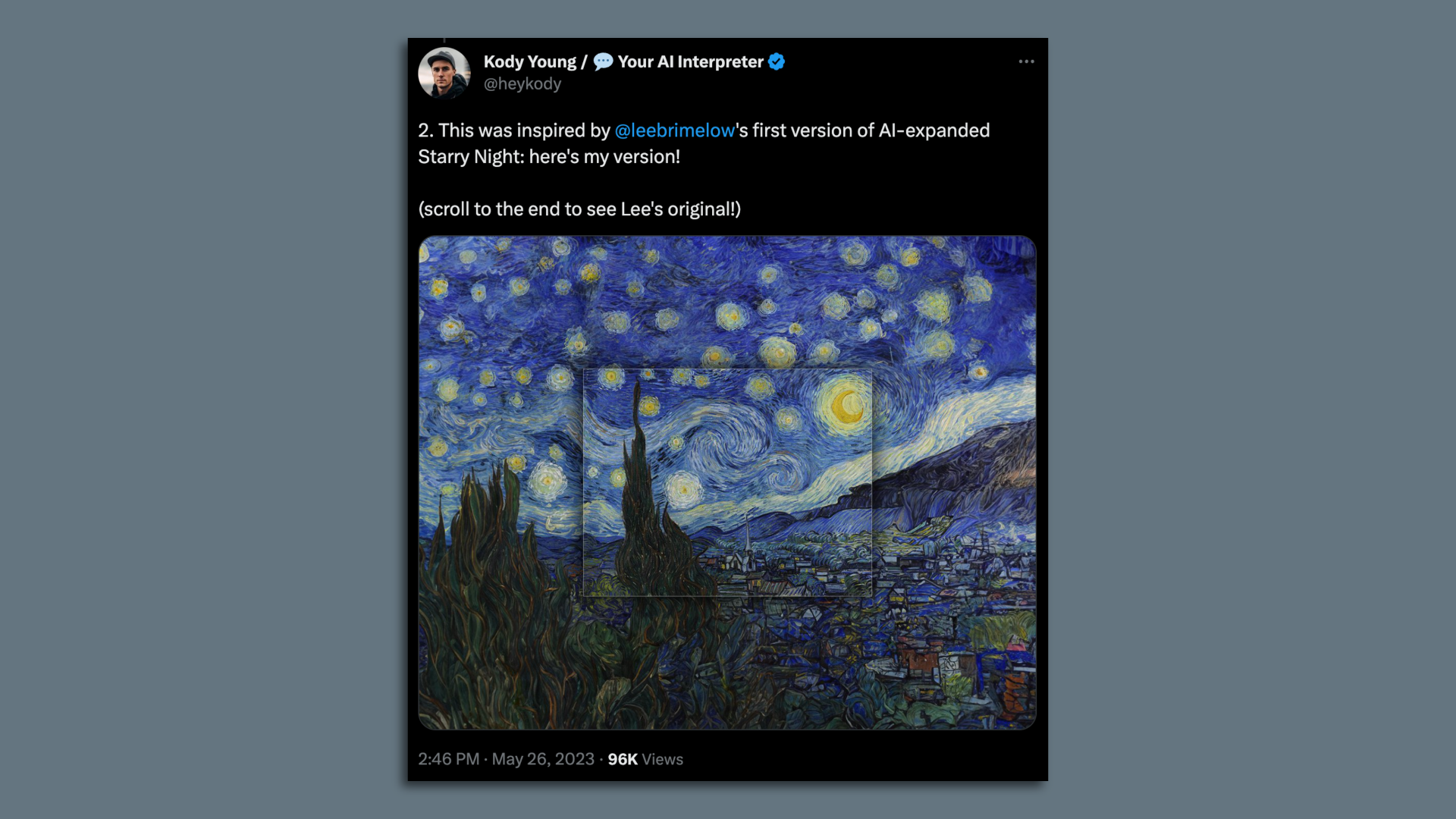
What happens if you use AI to extend the canvas of art's most famous masterpieces?
- AI strategist Kody Young used Adobe's new AI-powered Firefly tech to find out.
The results: Here's a look at van Gogh's Starry Night:
Yes, but: While Firefly seems to do well with landscapes, it struggles with humans — just look at this alien-esque bartender it generated for Edward Hopper's "Nighthawks."
💬 Alex's thought bubble: This is a pretty provocative application of new AI "content-aware fill" tech, which takes an image's existing content and extrapolates beyond the original work.
- It feels just a little subversive for AI to mess with van Gogh, da Vinci or Hopper.
See the rest over on Twitter.
Big thanks to What's Next copy editor Amy Stern.
Was this email forwarded to you? Get your daily dose of What's Next by signing up here for our free newsletter.
Sign up for Axios What's Next

The next decade of big, sweeping changes will unfold in cities and communities where new technologies like 5G, AI and drones are transforming how we work, live and play together. What’s Next will guide you through the revolution.