Axios What's Next

October 10, 2023

The "Jetsons" era of personal flight is nearly here, Joann reports today.
Today's newsletter is 914 words ... 3½ minutes.
1 big thing: Up, up and away
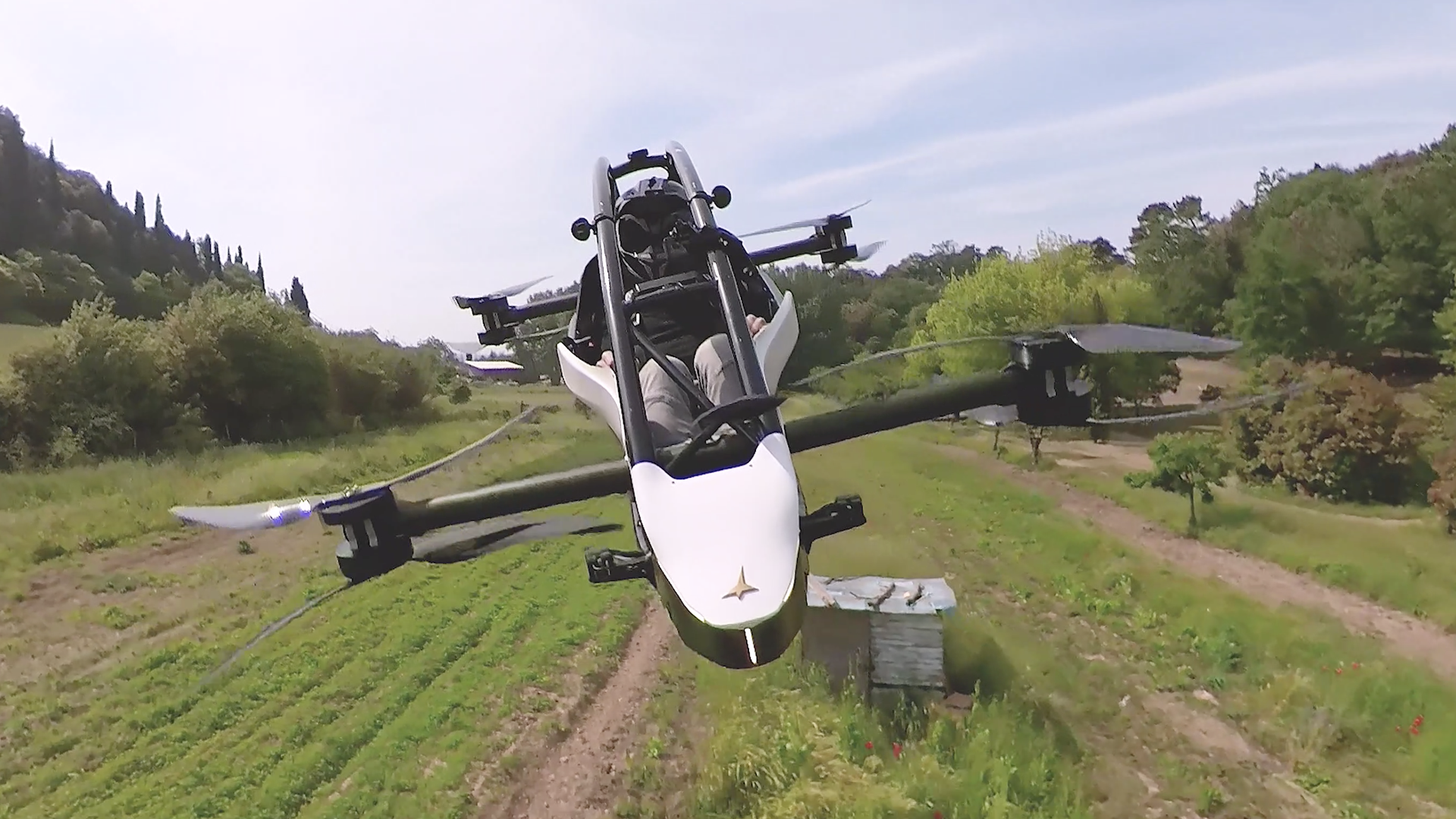
The $98,000 Jetson ONE can fly up to 1,500 feet in the air. Photo: Courtesy of Jetson
Personal flying machines are almost here, and anyone with the money and a few hours of training will be able to fly one, Joann reports.
Why it matters: Many people dream of flying, but getting a pilot certificate takes time, studying and dedication — plus small aircraft can be dangerous and expensive to own and operate.
- With new technologies — some borrowed from electric cars and video games — it'll soon be easier, safer and comparatively affordable for novices to take flight in their own aircraft.
Behold the Jetson ONE — a "jet ski in the sky," as CEO Stéphan D'haene describes it — which is available for $98,000, about the same price as a high-end Mercedes.
- It's one of several ultralight personal flying machines coming to market in the next year or so, including the $190,000 Helix from Pivotal (formerly known as Opener) and the Hexa from Lift Aircraft.
- The planes are envisioned for personal recreation, short-hop travel or "experiential" entertainment excursions.
Driving the news: The Jetson ONE made its inaugural U.S. flight last week at the UP. Summit in Dallas, an invitation-only gathering of entrepreneurs and investors focused on the future of transportation.
- Headquartered in Italy with plans to move to the U.S., Jetson has raised $15 million from investors, including rapper will.i.am. A second round of financing is expected soon.
- The company says it has 300 orders and plans to begin deliveries in 2024.
Details: The compact design is inspired by race cars, with a lightweight aluminum space frame and a carbon-Kevlar composite body.
- It takes off vertically and then tilts forward, flying at a top speed of 63 mph and at an altitude of up to 1,500 feet.
- It has eight propellers and is powered by eight electric motors and eight swappable battery packs generating a total of 84 kWh of power — about the same as a Tesla. That's good for about 20 minutes of flying time.
- The propellers on the single-seat fuselage fold in for easy storage, also making it easy to fit in the back of a pickup truck or van.
- At less than 200 pounds, it qualifies as an "ultralight" aircraft, which has relatively few regulations under the Federal Aviation Administration — users are not required to have a pilot certificate, for example.
Learning to fly a Jetson ONE takes about five hours of training, D'haene tells Axios.
- The pilot uses intuitive joystick controls to go up or down and to accelerate and steer, while the flight computer handles the complicated stuff — like keeping the aircraft stable.
- Of note: Redundant motors and propellers mean the plane can keep flying in the event of a failure. Still, it comes with a "ballistic parachute" that automatically deploys in an emergency.
What they're saying: "Our mission at Jetson is to democratize flight and make the skies available to everyone," said D'haene.
What's next: "We all want nothing more than to fly longer distances, for a longer time," Pivotal CEO Ken Karklin tells Axios. "That will come as battery technology matures."
2. Your CEO is probably obsessed with AI

Illustration: Annelise Capossela/Axios
If CEOs had their way, workers would be back in the office and pursuing AI advancements at the same time, Axios Closer's Nathan Bomey reports.
Why it matters: As the workforce is changing, so is technology — and executives' demands.
Driving the news: A new U.S. CEO survey from consultancy KPMG found that bosses are giddy about AI.
- 72% of U.S. CEOs say generative AI is a "top investment priority."
- 62% say they expect a return in 3 to 5 years, while 23% expect a return in 1 to 3 years.
What they're saying: "I think it's a recognition that generative AI is transformational and that it's not hype," says Paul Knopp, CEO of KPMG in the U.S.
- "It provides opportunities to potentially grow revenues, but it also will provide opportunities to make workforces and business processes more efficient."
Yes, but: The question of whether those efficiencies will translate into fewer jobs remains a concern for many.
- "I do think that, while generative AI won't lead to reductions in our workforce, people that have generative AI skills will be more valuable than people that do not," Knopp says.
And CEOs want those people to be applying their skills in an office environment.
- In the survey, which covered 400 U.S. CEOs at companies in various sectors with annual revenue of at least $500 million, 62% said they envision their staff working permanently at the office within three years, up from 34% a year ago.
3. Minnesota teens pre-register to vote

Illustration: Aïda Amer/Axios
Roughly 1,800 Minnesota teens have pre-registered to vote under a new state law meant to boost participation among young adults, Axios Twin Cities' Torey Van Oot reports.
How it works: 16- and 17-year-old residents who will eventually be eligible to vote can fill out a regular voter registration form in person or online.
- Once they're 18, the state's system will automatically add them to the voter rolls.
Yes, but: The pre-registration numbers amount to just 1% of the 150,000 Minnesota teens estimated to be eligible.
The big picture: The change was part of a bigger slate of new laws supporters say will increase access to the polls, including automatic voter registration for residents who apply for a driver's license.
Of note: Minnesota already has one of the nation's highest turnout rates for young voters.
- An estimated 36% of voting-eligible residents ages 18 to 29 cast ballots in the 2022 midterm elections. The national average was just 23%.
Big thanks to What's Next copy editor Amy Stern.
Was this email forwarded to you? Get your daily dose of What's Next by signing up here for our free newsletter.
Sign up for Axios What's Next

The next decade of big, sweeping changes will unfold in cities and communities where new technologies like 5G, AI and drones are transforming how we work, live and play together. What’s Next will guide you through the revolution.