Axios What's Next

May 18, 2023
Quick-swapping EV batteries is an idea that just won't die, Joann reports today β despite all the challenges involved.
Today's newsletter is 1,110 words ... 4 minutes.
1 big thing: Battery swapping gets a reboot
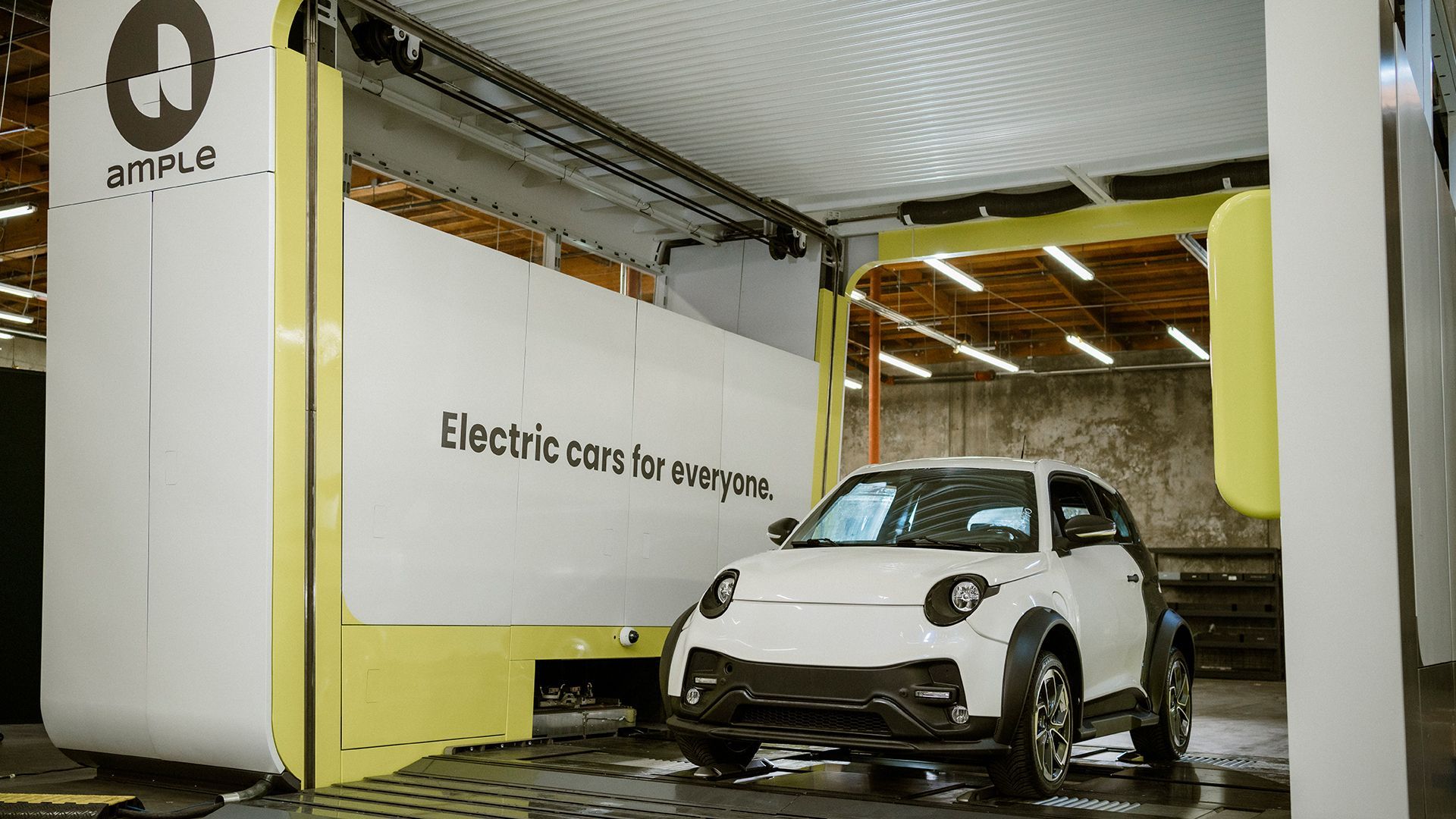
Ample's drive-through battery swapping station. Photo courtesy of Ample
Charging an electric vehicle (EV) is a time-consuming burden β which is why the notion of battery swapping, dismissed by Tesla CEO Elon Musk and many others as unworkable, is still percolating, Joann reports.
Why it matters: Many drivers won't embrace EVs unless the refueling experience is as seamless as filling up a gas tank.
Driving the news: Ample, a California startup dedicated to battery swapping, is introducing a new streamlined station that cuts the process in half, to about five minutes.
- That's about the time it takes to fill up a gas tank β and far less than the 30 minutes or more it takes to recharge most EVs at public fast-chargers.
Details: Ample's pre-fab stations can be deployed across a city in a matter of days. By installing multiple bays at a location, it can accommodate several cars at once.
- Ample has been experimenting with battery swaps for Uber drivers in San Francisco, and recently expanded to Spain and Japan.
- It also just signed a deal with EV maker Fisker to install its swappable batteries in the automaker's upcoming Ocean SUV.
- Ample will initially target commercial operators, including ride-hailing and delivery vehicles, co-founder and CEO Khaled Hassounah tells Axios.
How it works: Ample makes modular battery packs that can be integrated into EVs of any size and swapped out when depleted.
- The shoebox-size modules fit within an adaptor plate designed to match the shape and size of a given vehicle's original battery.
- That flexibility means car manufacturers like Fisker can install a swappable Ample battery as an option at the factory.
When a vehicle approaches Ample's drive-through station, the bay door opens automatically.
- Once parked inside, the driver initiates the battery swap using the Ample app.
- The automated system identifies the vehicle's battery requirements and swaps the depleted battery pack with a fully charged replacement.
Flashback: Battery swapping has been tried before, with little success.
- In the mid-2000s, Israeli entrepreneur Shai Agassi raised $900 million for a battery swap company called Better Place, which later folded.
- In 2014, Tesla opened a single battery swap station in California, and then abandoned the idea in favor of expanding its Supercharger network.
The problem: EV batteries are cumbersome and there's no industry standard design.
- Each battery is built specifically for integration within a given car's unique architecture. They're not plug-and-play like the AA or AAA batteries in flashlights.
- It's impractical for each swapping station to store and service many different sizes and types of batteries, says Sam Abuelsamid, principal e-mobility analyst at Guidehouse Insights. "That gets really expensive, really fast."
- Ample's modular design is meant to account for these issues.
Meanwhile: One fast-growing Chinese EV company, NIO, is using a standard battery in all six of its models.
- Similar to Tesla's Supercharger network, its swapping stations are proprietary, open only to NIO customers.
- 60% of NIO's 320,000 owners have opted to use one of its 1,383 Power Swap Stations in China and Europe, the company recently revealed.
The intrigue: NIO is adding about 1,000 more stations in China and up to 70 more in Europe this year to support what it calls "battery-as-a-service."
- Under this model, buyers pay separately for the vehicle and the battery β making EV ownership more affordable for those willing to sign up for a monthly battery subscription.
- In Norway, approximately 95% of users have opted for battery-as-a-service, NIO said.
The bottom line: Anything that makes EVs cheaper and refueling easier β whether it's battery swapping or more accessible charging β could help spur EV adoption.
2. Uber for teens
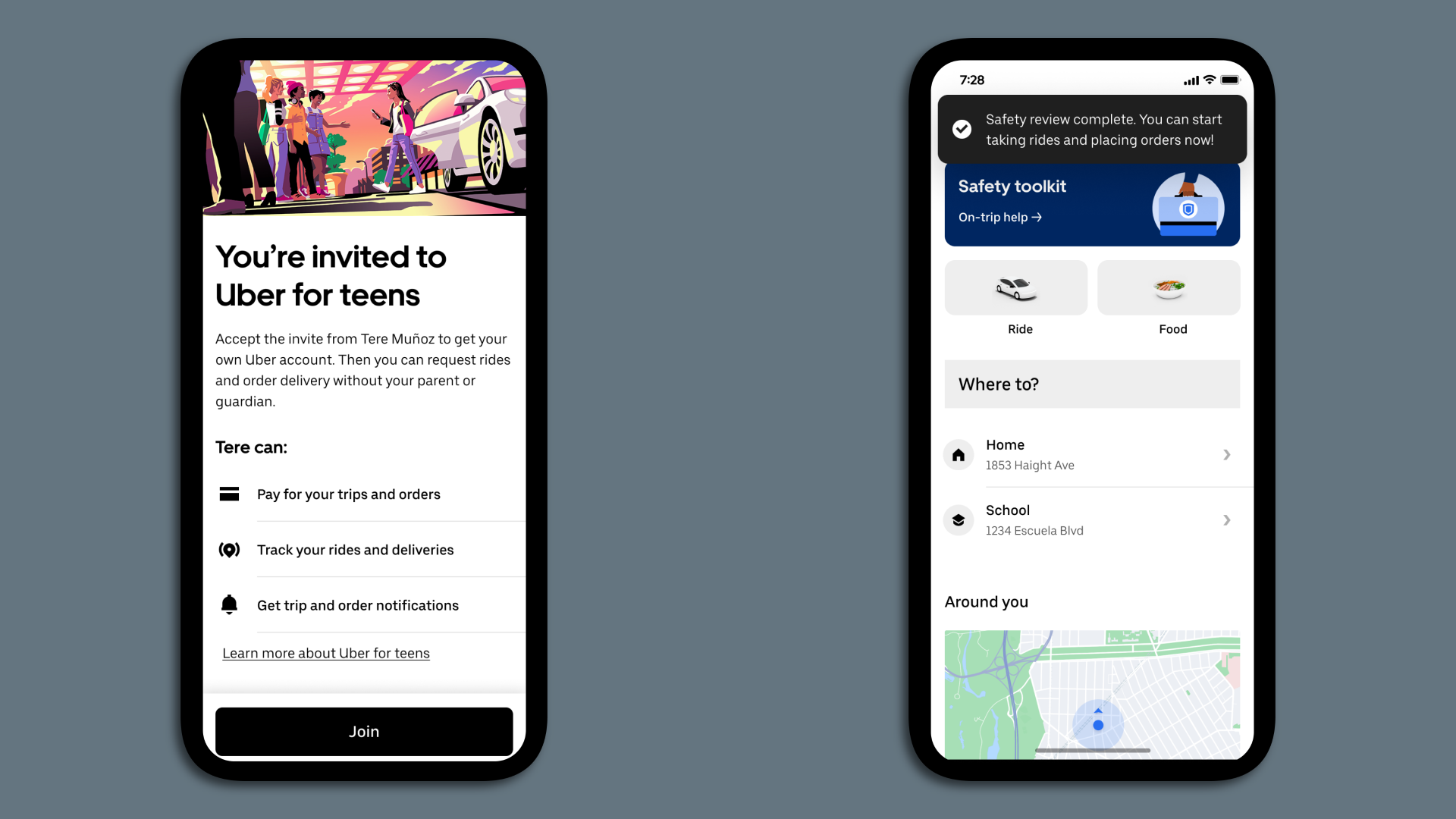
Screenshots courtesy Uber.
Uber is letting teens under 18 request and take rides on their own for the first time, Alex writes.
- A new "Teen accounts" feature allows 13- to 17-year-olds to set up their own accounts as part of a family profile.
Details: Only "experienced and highly-rated drivers" can drive teens, Uber says, and parents can track their kids' rides in real time β as well as call their driver.
- Drivers can opt out of picking up teenagers if they so choose.
State of play: Teen accounts will be available soon in a handful of cities, including Atlanta, Columbus, New York City and more.
Reality check: Teenagers have long bent Uber's age restrictions, often by booking rides through their parents, older siblings or friends.
Meanwhile: Uber is also expanding an option allowing parents and caretakers to request rides with a car seat; it's coming first to New York City and Los Angeles.
3. π The most dangerous biking cities

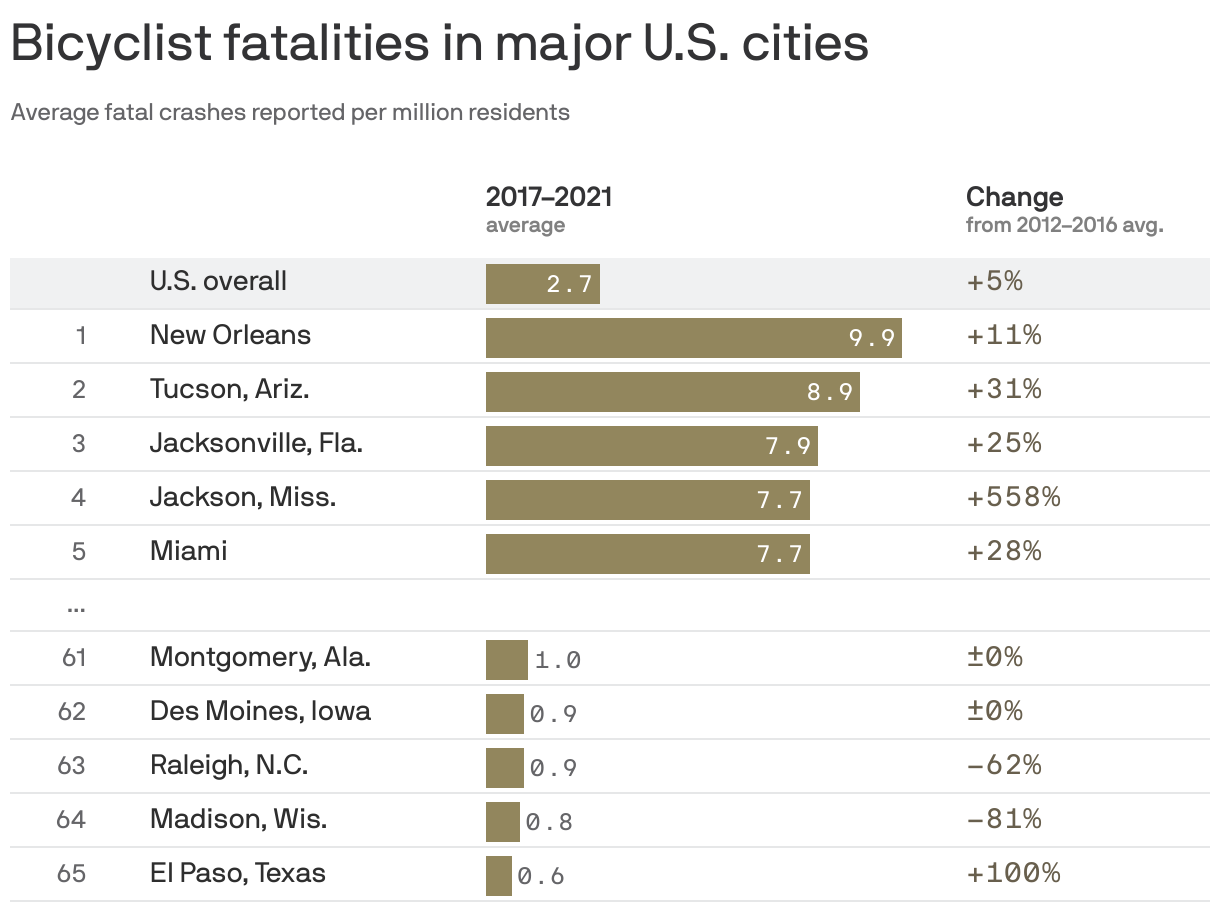
There were 2.7 fatal bicycle crashes on average for every million U.S. residents between 2017-2021, per data from the League of American Bicyclists via the National Highway Traffic Safety Administration β up 5% from 2012-2016.
- New Orleans (9.9), Tucson (8.9) and Jacksonville (7.9) had the country's highest rates of fatal accidents per million residents among major metro areas, Alex and Kavya Beheraj report.
Why it matters: Bicycle use exploded during the COVID-19 pandemic, leaving many cities scrambling to install new bike lanes and adopt other measures to keep riders safe and encourage cycling.
- Such projects have gained renewed urgency as bike-sharing platforms such as Citi Bike NYC and Chicago's Divvy Bikes have become popular options for quick A-to-B hops around cities nationwide.
Zoom in: Some of the country's best new bike lane projects are in Seattle, Portland and Bethesda, Maryland, per advocacy group PeopleForBikes.
What's next: Cities nationwide are applying for state and federal money β including some set aside as part of the 2021 infrastructure law βΒ to further develop their bike trail networks and other cycling infrastructure.
4. Saving AM radio

Illustration: Sarah Grillo/Axios
A bipartisan group of lawmakers wants to make it illegal for carmakers to eliminate AM radio from their cars, arguing public safety is at risk, Joann is first to report.
Why it matters: AM radio is one key way that government officials communicate with the public during natural disasters and other emergencies.
Context: Some manufacturers are eliminating AM radio from their electric vehicles (EVs) because of interference from the electric motors that results in annoying buzzing noises and faded signals.
- They argue that car owners can still access AM radio content through digital streaming packages or smartphone apps (though such services sometimes require a subscription).
The proposed legislation, introduced Wednesday by Sens. Ed Markey (D-Mass.), Ted Cruz (R-Texas) and others, would require all new vehicles to include AM radio at no additional charge.
- EV makers that have already eliminated AM radio (BMW, Ford, Mazda, Polestar, Rivian, Tesla, Volkswagen and Volvo) would be required to let consumers know.
- The law would also direct the Government Accountability Office to study whether alternative communication systems are as effective in reaching the public during emergencies.
Big thanks to What's Next copy editor Amy Stern.
Was this email forwarded to you? Get your daily dose of What's Next by signing up here for our free newsletter.
Sign up for Axios What's Next

The next decade of big, sweeping changes will unfold in cities and communities where new technologies like 5G, AI and drones are transforming how we work, live and play together. Whatβs Next will guide you through the revolution.