Axios What's Next
April 29, 2024

1 big thing: Smarter mowing robots

Illustration: Natalie Peeples/Axios
Buzzy new robotic lawn mowers let you use a smartphone app to boss them around, no perimeter wires required, Jennifer reports.
Why it matters: The perfectly coiffed green lawn that these mowers enable is a joyous symbol of the American dream — and a villainous lightning rod for environmental criticism.
Driving the news: The latest wave of autonomous mowers is quieter, battery-powered and gentler on your grass.
- They're also easier to set up and operate: You don't have to install a perimeter wire to keep them inside your property lines.
- They mow your lawn 24/7, constantly snipping the grass blade tips and leaving dainty cuttings behind as fertilizer.
- But they're expensive, prompting some neighbors to team up and share them for round-the-clock community mowing.
What they're saying: Once they're set up, "these machines run relatively autonomously," says Chris Price of Husqvarna, the leading manufacturer of autonomous mowers.
- "They go out, they cut the grass, they dock in a charger, and then they go back out again, depending on when you want them to run," Price, engineering manager for robotics at Husqvarna, tells Axios.
- "The machine is totally weatherproof, waterproof," Price adds. "It can live outside. We want to reduce all the barriers to you having to do any work to cut your grass."
Where it stands: Last year, Husqvarna introduced the first mower for the U.S. residential market that doesn't require boundary wires, which are arduous to install and easily broken.
- The $5,900 Automower 450XH uses a trademarked technology called EPOS (Exact Positioning Operating System) to navigate your yard.
- It's been "very well received," particularly for its "ability to run in parallel lines," says Scott Porteous, Husqvarna's product manager for robotics.
"The typical way that robotic lawn mowers used to operate is kind of like your Roomba, where it would just sort of bounce around your yard at random," Porteous says.
- With EPOS, "we can run it in systematic fashions, meaning we can make those nice pretty stripes that your landscapers leave behind after they get done cutting your grass — but you get it every day."
Other manufacturers are also getting into the no-boundary-wires game.
- Options include the Navimow i from Segway, the Mowrator S1 and the Mammotion Luba 2.
- A recent Wirecutter review of fenceless robot mowers puts Husqvarna's model at the top of the small-but-growing heap.
Reality check: The four-figure price tags on these mowers — and the fact that they don't observe property lines — means that teaming up with your neighbors to share one might make sense, Amanda Blum writes in Lifehacker.
Between the (neatly mown) lines: Executives at Husqvarna, a Swedish company, see big differences between American and European lawn care attitudes.
- "It's a bit more of a cultural phenomenon" to have a great lawn in the U.S., Price says.
- Americans want to be more "hands on" in programming their robot mowers and micromanaging the mow, he adds.
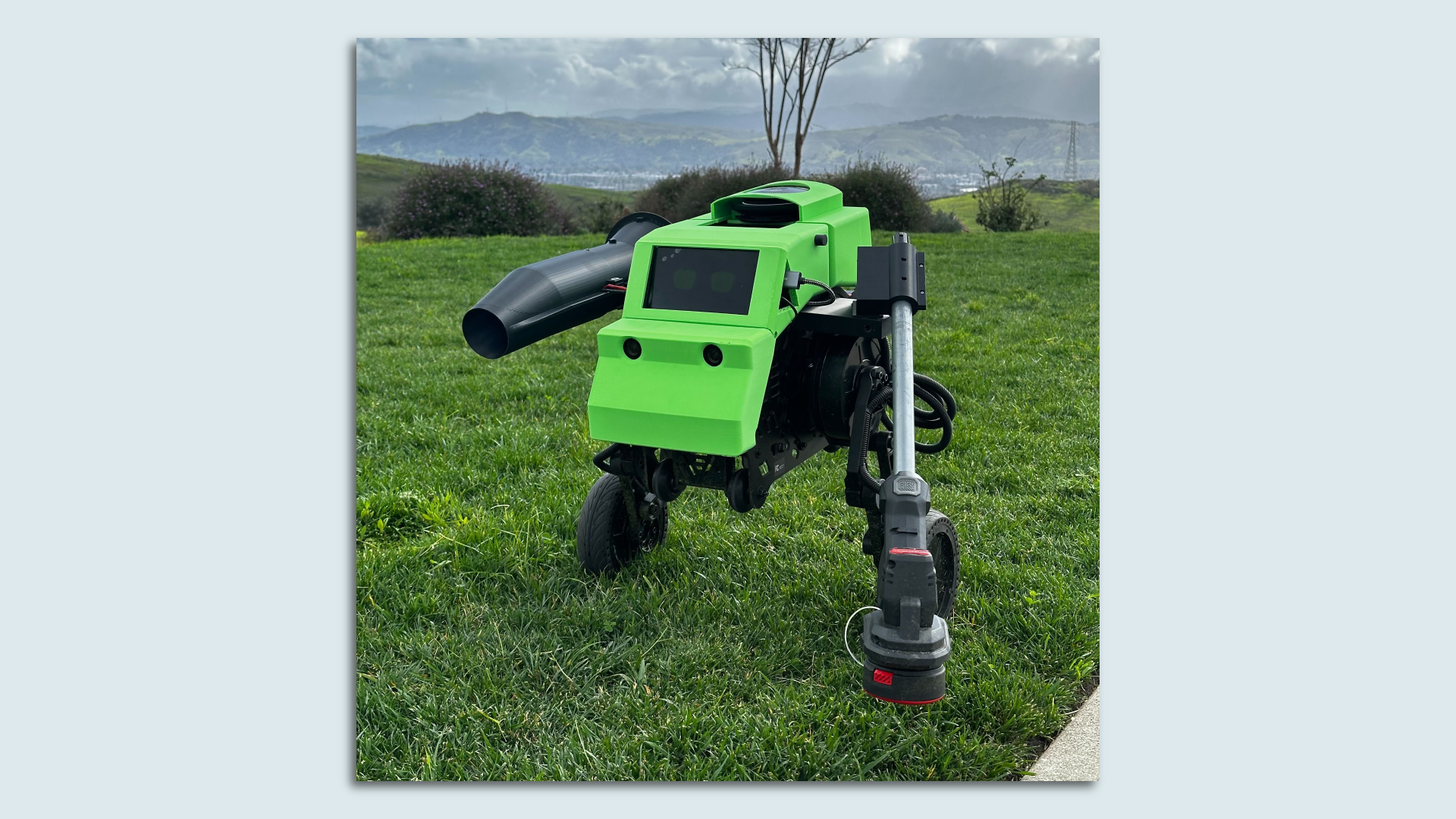
What's next: A San Francisco company called Electric Sheep is building what it says is the first commercial landscaping system based entirely on autonomous robots.
- The company uses a robot called RAM for mowing and one called Verdie for edging and trimming lawns and bushes and blowing leaves. (See a video of both in action.)
- Verdie and RAM don't require an engineer on-site. "They can just be shipped to a campus, [homeowners association] or park and begin tasks alongside the crew," the company says in a press release.
The bottom line: The market for such mowers is in its infancy, but expect them to become as ubiquitous as the Roomba and the Ring doorbell.
2. Tesla recall probed

Illustration: Gabriella Turrisi/Axios
3. AI in space

Illustration: Annelise Capossela/Axios.
4. One fun thing: Cow-cuddling internship

Cuddling doesn't get much cuter than this. Photo: Courtesy of Harvest Hosts
Axios What's Next

The next decade of big, sweeping changes will unfold in cities and communities where new technologies like 5G, AI and drones are transforming how we work, live and play together. What’s Next will guide you through the revolution.