Axios What's Next

August 01, 2024



A new AI tool could plan your next vacation with as little as a single photo as a starting point, Alex reports today.
Today's newsletter is 959 words ... a 3½-minute read.
1 big thing: AI vacation planning

Need a little help planning your next vacation? Try asking AI for some inspiration — or even a full itinerary.
Driving the news: Travel startup Mindtrip yesterday unveiled "Start Anywhere," an AI-powered tool that can build a trip itinerary with as little as a single photo as a starting point.
Why it matters: Travel is booming, but actually figuring out a specific plan beyond "Portugal" or "Japan" remains a pain point for many jet-setters.
How it works: Mindtrip users can upload a photo, a URL of a travel blog, an article, or a YouTube video as a starting place.
- Start Anywhere then offers up an itinerary replete with restaurants, activities, sights and so on. Travelers can then book that itinerary as is, or use it as a jumping-off point for creating their own plan.
- The tool's recommendations can be customized based on users' preferences.
- Users can also start with a copy of their hotel or flight reservations, if they've already booked their travel or accommodations.
Zoom in: Start Anywhere combines the power of ChatGPT with Mindtrip's own data on hotels, attractions, restaurants, etc.
- The company gets a cut when its users book trips through the travel search engines and aggregators it's working with.
The intrigue: Travel writers, bloggers and influencers can sign up for the company's "Mindtrip Creator" program to generate what are essentially referral links.
- If their readers or viewers click into Mindtrip and set up an account to build an itinerary based on their content, they get a cash payment.
- That comes as many AI companies are under fire for using digital content without creators' permission.
What they're saying: Mindtrip CEO Andy Moss tells Axios that Start Anywhere's big advantage is that it combines the broad instant-response power of generative AI with the company's specific travel data — as opposed to simply using a general-use chatbot to build an itinerary.
- For example, Mindtrip is smart enough to know that a once-popular restaurant is closed, so it won't include that in an itinerary, Moss says.
- "That's where AI is heading — blending this more real-time data and the knowledge base with the conversational piece."
What's next: Mindtrip is thinking through how to make its AI assistant helpful not just when you're planning a trip, but also when you're actually abroad.
- "If I'm standing in front of a cathedral in Milan or whatever, I'm much more tied into where my GPS is and what photos I'm taking, but I still want the assistant to be there," Moss says, "because I might want to actually find something serendipitously."
2. Meet Boeing's new CEO

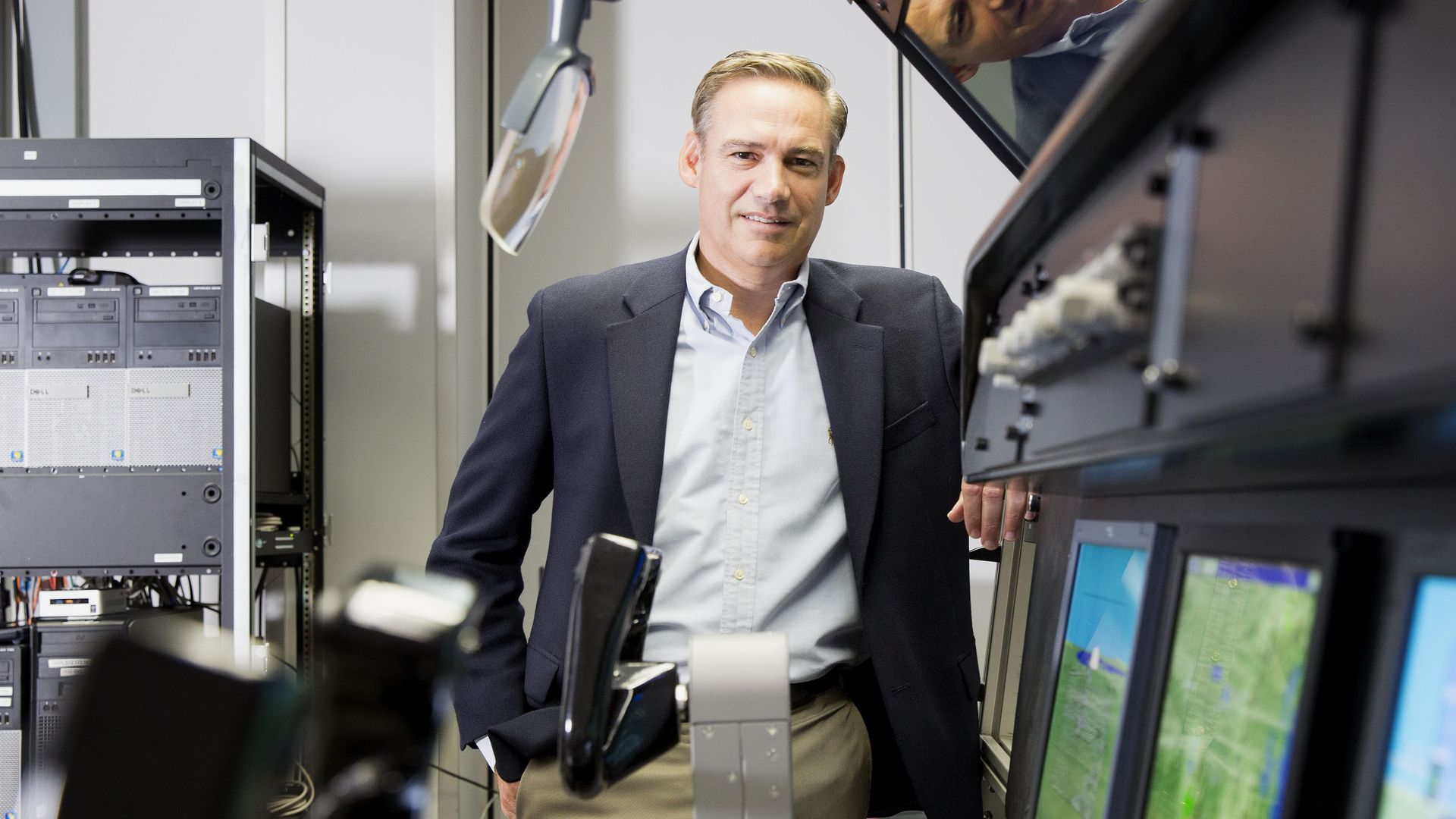
Boeing will be led by Kelly Ortberg starting next month, the company announced yesterday.
Why it matters: Ortberg, an outside hire and aerospace industry veteran, could usher in a crucial shift in Boeing's culture, which has been blamed for numerous safety lapses in recent years.
Zoom in: When Ortberg was CEO of Rockwell Collins — one of Boeing's big suppliers — he had a reputation for regularly walking the production floor.
- In contrast, outgoing Boeing CEO Dave Calhoun — who previously served as an executive at private equity firm Blackstone — has been criticized for reportedly retaliating against whistleblowers.
What they're saying: "One person cannot turn around a company, but Kelly should be able to cast a wider net for talent than a Boeing insider could," Ron Epstein, senior aerospace and defense analyst at BofA Securities, wrote in a research note yesterday.
3. Google's Olympics ad sparks backlash


A new ad featuring a dad using Google's Gemini chatbot to help his daughter write a fan letter to an Olympic gold medalist is roiling the internet.
- Many viewers see it as a tone-deaf portrait of AI sucking the humanity out of heartfelt traditions.
Catch up quick: Google's "Dear Sydney" ad shows a dad asking Gemini for help writing the letter, offering prompts about his daughter's love for track star Sydney McLaughlin-Levrone.
- Online commentators were quick to take offense — not only about the AI shortcut, but also about lazy parenting.
What they're saying: "The father in the video is not encouraging his daughter to learn to express herself," wrote Shelly Palmer, a media professor at Syracuse University.
- "Instead of guiding her to use her own words and communicate authentically, he is teaching her to rely on AI for this critical human skill."
Yes, but: Many users find that AI chatbots help them overcome the stress of staring at a blank page.
The other side: "We believe that AI can be a great tool for enhancing human creativity, but can never replace it," Google ad communications manager Alana Beale tells Axios.
- The goal was to celebrate Team USA and "to show how the Gemini app can provide a starting point, thought starter or early draft for someone looking for ideas for their writing," Beale says.
4. Travelers' favorite airplane seats
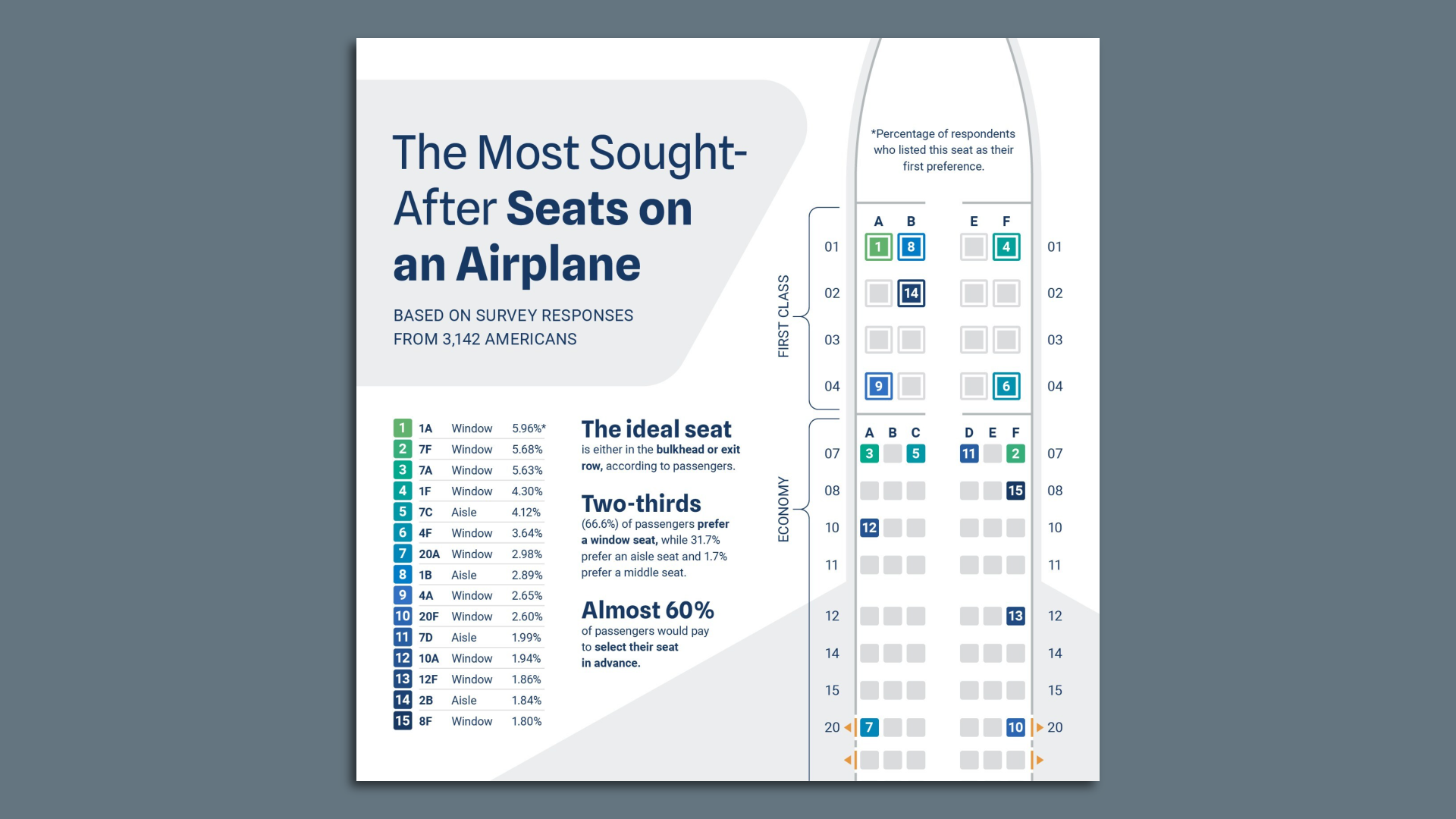
Front-row first class and economy spots are some of travelers' favorite airplane seats, new data finds.
Driving the news: Seats 1A, 7F and 7A — all front-row window seats in their respective classes — are the most popular options based on a typical Boeing 737-800 seat map, per Upgraded Points' recent survey.
By the numbers: Nearly 67% of passengers prefer window seats, while about 32% favor the aisle.
- 1.7%, for some reason, opt for the middle seat.
Zoom in: About 34% of respondents said Delta has the comfiest seats, followed by American and United, which both came in at around 16%.
What they did: The survey involved 3,142 U.S. passengers across 44 states and was undertaken between June 14-21.
💬 Alex's thought bubble: I need to know more about those middle-seat flyers.
- What do they know that I don't? Are they just big armchair fans? (As everyone knows, the middle seat gets both armrests). Many unanswered questions remain.
Big thanks to What's Next copy editor Amy Stern.
Was this email forwarded to you? Get your daily dose of What's Next by signing up here for our free newsletter.
Sign up for Axios What's Next
