Axios What's Next

January 05, 2022
We all know that New Year's resolutions are notoriously flimsy — most people give up by mid-month — and yet... we persist. A recent trend involves giving up meat and dairy for a month, as Jennifer A. Kingson writes.
- One resolution you can easily keep? Contributing a photo to this newsletter. Take a picture of something that tells us about "What's Next" and email it to us: [email protected].
Today's Smart Brevity count: 1,263 words ... 5 minutes.
🥦 1 big thing: Veganuary is a tough sell
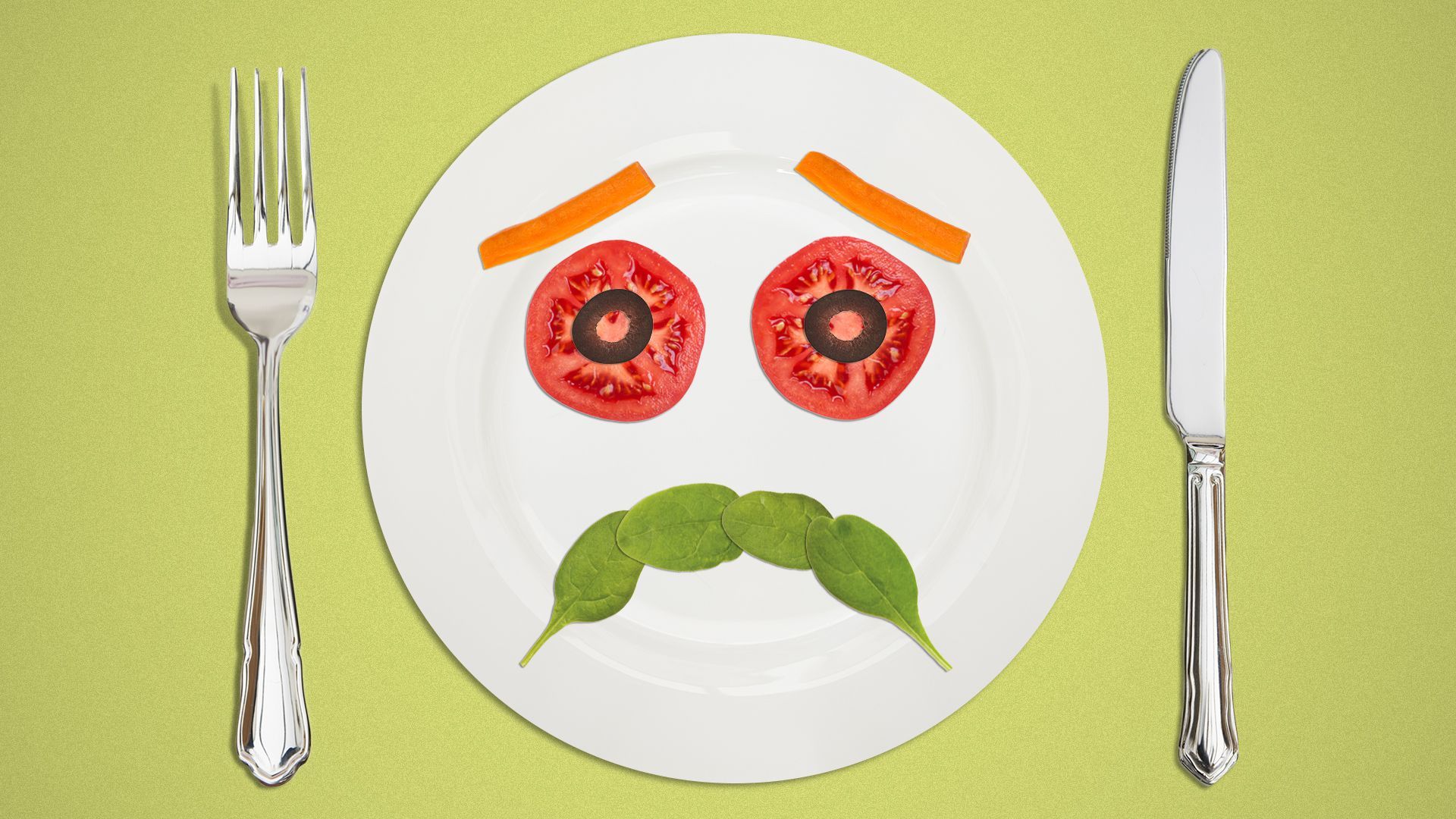
Illustration: Shoshana Gordon/Axios
Veganuary, a campaign that started in the U.K. to get people to give up meat and dairy for the month, is in its second year in the U.S., where it's catching on slowly, Jennifer writes.
- About 500,000 people have enrolled globally so far, and a trickle of restaurant chains and food brands in the U.S. are signing on. (More people sign up over time, as the campaign progresses, which brought the number to 582,000 last year.)
Why it matters: While food and drink companies are racing to introduce plant-based products, most people want to pare back their consumption of animal-based foods rather than eliminate them altogether.
- People like the idea of eschewing animal products, but tend to find the diet inconvenient, expensive and hard to stick to.
- Veganism is particularly hard to swallow for men, with survey after survey showing that about 80% of people who adopt the diet are female.
Where it stands: Veganuary — pronounced with a hard "g," as in "golf" — started in the U.K. in 2014, and last year people from more than 200 countries participated.
- The campaign is run by a nonprofit that asks people to take a 31-day vegan pledge, forgoing meat, fish, cheese, milk, eggs, etc. — and perhaps continuing to eat that way.
- "When someone signs up, they get a daily email from Veganuary with recipes, meal plans, our best advice for trying vegan," Wendy Matthews, U.S. director for the Veganuary campaign, tells Axios.
Proponents of Veganuary — who include Alec Baldwin, Paul McCartney and New York City's new mayor, Eric Adams — say that plant-based foods are better for the environment and our health, and reduce animal cruelty.
- Official sponsors in the U.S. include Beyond Meat, Aveda, Just Salad, Mellow Mushroom, Pokeworks, Fresh Brothers and Veggie Grill.
Between the lines: In 2019, Food & Wine declared that "Veganuary is the new Dry January," but also noted that sign-ups had been lagging expectations.
What they're saying: "I'm often asked about eating plant-based 85% of the time instead of going full vegan and what is the difference there?" Matthews said. "Any step towards more plant-based eating is a step in the right direction and a net positive."
The bottom line: Maintaining a vegan or vegetarian diet keeps getting easier as mass-market chains roll out new foods to meet consumer demand.
2. Deere's driverless tractor debuts
Deere's autonomous tractor goes into production this year. Photo: Deere & Co.
Deere & Company introduced the world's first autonomous tractor Tuesday, a technology breakthrough that could help farmers cope with a worsening skilled labor shortage, Joann Muller writes.
Why it matters: Farmers are getting older — 55 years old on average — and with more than 80% of the U.S. population residing in urban areas, there aren't enough laborers to do the work or operate machinery.
- So robots are the new farmhands as growers try to boost productivity to keep up with soaring global demand for food, biofuels and other agricultural products.
Driving the news: The giant green and yellow machine, which debuted at CES, the annual consumer electronic show in Las Vegas, represents a new era in agriculture.
- "The last time agriculture was on the precipice of this much change was when we were on the cusp of replacing the horse and plow," Deere Chief Technology Officer Jahmy Hindman tells Axios.
For the first time, a farm tool can do the work without a human or animal providing the labor.
- While Deere has had self-guided tractors since 1999, operators have remained in the cab. Now, its tractors can operate autonomously, 24 hours a day.
- All the farmer has to do is transport the machine to a field and configure it for autonomous operation. Using a phone or tablet, the farmer then swipes left to right on Deere's app to start the machine.
- The farmer can leave the field to focus on other tasks while monitoring the machine's status on a mobile device.
3. Color-coded return to work
Illustration: Brendan Lynch/Axios
As companies form return-to-office plans amid COVID risk, they're coming up with new ways to govern one of the key parts of in-person work: socializing, Erica Pandey writes.
The big picture: Some firms are experimenting with color-coded buttons, pins or wristbands that indicate how comfortable employees are with shaking hands, chatting in close proximity, or even exchanging hugs with colleagues whom they haven't seen in months, reports the New York Times' Emma Goldberg.
- With this solution, people can easily communicate their safety preferences without having to repeat themselves or risk appearing rude by turning down a handshake or hug.
What's happening: At a recent Salesforce conference, employees chose to don one of three pins, Goldberg writes: "Green: OK to hug. Yellow: Let's do the elbow/fist bump. Red: Let's wave hello."
- Clyde & Co., an international law firm, is having employees wear colored wristbands. Red, used by employees who may be nervous or immunocompromised, means keep your distance and wear a mask.
This corporate approach is gaining traction and providing new business opportunities for the wristband-makers that were walloped by the end of music festivals and such, the Times notes.
Wristband Resources told Goldberg that 60% of its revenue is now COVID-related bands. And sales were better in 2021 than 2019.
My thought bubble: It's a nice fix for now, but I predict (and hope) we won't be walking around for too long wearing buttons that encourage our colleagues to hug us.
4. Trip to the Moon? Meh

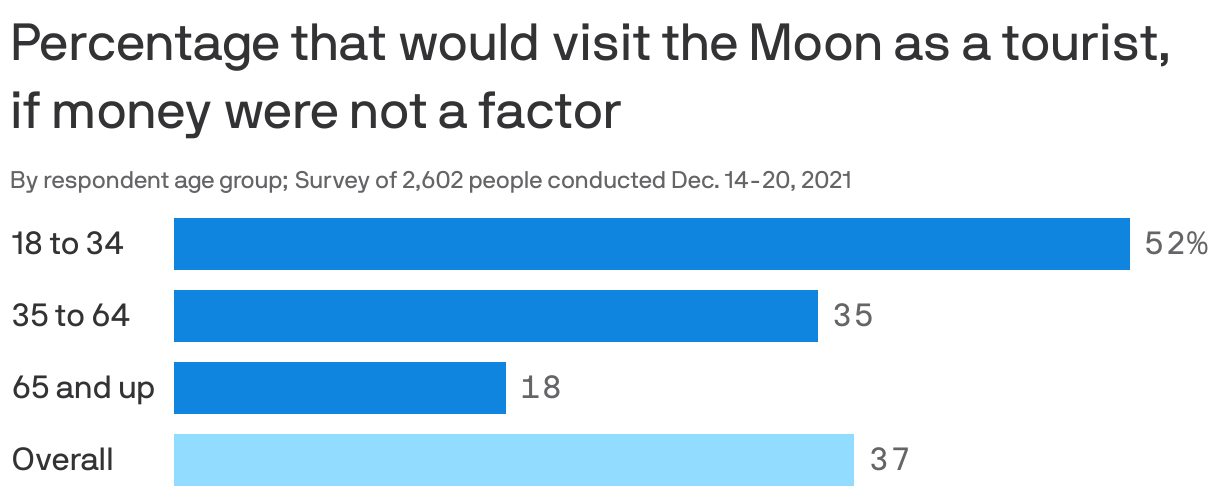
Private human spaceflight has advanced tremendously in the last year, but many ordinary people aren't ready to visit the Moon themselves, according to a new Axios/Momentive poll.
Why it matters: Private space tourism today caters to an ultra-rich clientele, but eventually, the companies in the business of sending people to space want to widen their reach to many more people, Axios space reporter Miriam Kramer writes.
Driving the news: The new poll found 61% of adults surveyed wouldn't be interested in taking a trip to the Moon even if money weren't a factor.
- Gen Z respondents, however, are more interested in a lunar voyage: 55% polled said they would take a trip to the Moon if money weren't an issue.
- The poll also found that 53% of respondents think SpaceX is "leading the push into space" ahead of Blue Origin, Virgin Galactic and Boeing.
The big picture: Space tourism is still far from a reality, and, for the moment, is centered on shorter suborbital flights.
- However, companies — specifically SpaceX — are working to make lunar tourism happen one day.
5. What's next? A high-tech bath
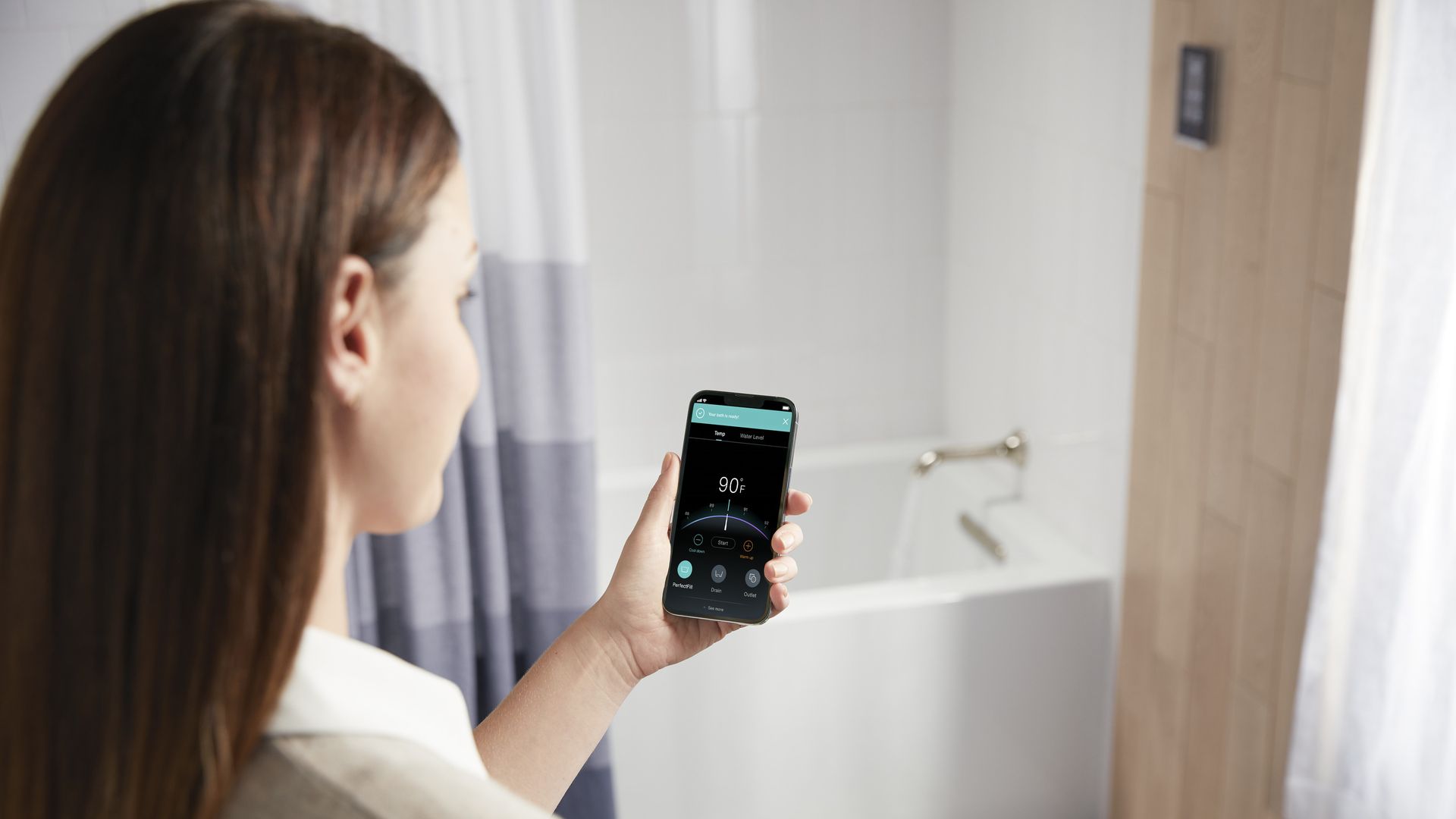
Kohler's PerfectFill smart bathing technology. Photo: Kohler
Who needs to bend over a tub and turn on the faucet when you can fill it using an app or voice command?
What's happening: The bath specialists at Kohler rolled out a bunch of new smart home technology this week at CES in Las Vegas, including PerfectFill, a $2,700 smart bathing feature that draws a bath to a preferred temperature and depth, Joann writes.
How it works: If you're busy cleaning up after dinner, just ask Alexa or Google to run the kids' bath for you.
- You don't have to stand around waiting for the tub to fill, and you don't have to worry the water will scald your child or overflow onto the bathroom floor.
- You can program up to 10 bath times through the Kohler Konnect app.
If you really want to splurge, you can opt for Kohler's $8,000 Stillness Bath, a multi-sensory bathing experience inspired by Japanese forest bathing.
- It combines water, light, fog and aroma to create what Kohler calls an "at home spa-like experience."
- The top of the line Infinity Experience allows water to flow over the edges into a hinoki wood base, for a trickling waterfall sound.
Was this email forwarded to you? Get your daily dose of What's Next magic by signing up for our free newsletter here.
Sign up for Axios What's Next

The next decade of big, sweeping changes will unfold in cities and communities where new technologies like 5G, AI and drones are transforming how we work, live and play together. What’s Next will guide you through the revolution.