
Axios What's Next

March 21, 2024
Airlines' on-time performance shot up significantly this past December compared to the meltdown month a year prior, Alex and Kavya Beheraj report today.
Today's newsletter is 744 words ... 3 minutes.
1 big thing: Right on schedule

More than 83% of U.S. flights departed on time in December 2023, per a new Axios analysis of the latest Transportation Department data.
Why it matters: It's a big upswing compared to December 2022, when Southwest Airlines' epic meltdown dragged the industrywide average down to about 70% for the month.
Zoom in: Florida's Destin-Fort Walton Beach Airport (89.5% on time), Salt Lake City International Airport (89.2%) and Hawai'i's Lihue Airport (88.8%) had the best on-time departure performance in December 2023 among airports serving more than 1 million passengers annually.
- Fort Lauderdale/Hollywood International Airport (67.2%), Baltimore/Washington International (69.5%) and Orlando International (76.1%) had the worst on-time performance — not counting Puerto Rico's Luis Muñoz MarÃn International, at 75.8%.
Between the lines: A variety of factors, from weather to issues at a particular airline, can affect any given airport's on-time performance.
- Denver International's numbers really tell that story. It posted an 81.1% on-time rate this past December, compared to 57.7% in December 2022.
- Denver is a major Southwest hub, and bad weather there helped spark the airline's infamous 2022 meltdown.
The bottom line: 83% is pretty solid nationwide performance — especially during a month when winter storms can really disrupt the entire air travel system.
2: EPA issues landmark rules to boost EVs

Illustration: Sarah Grillo/Axios
The Environmental Protection Agency has finalized new rules limiting tailpipe emissions from cars, SUVs and pickups as part of a push to accelerate the electric vehicle (EV) transition, Axios Generate's Andrew Freedman reports.
The big picture: The rules don't directly require automakers to sell more EVs
— but they're likely to favor them to comply with the tighter emissions requirements.
Between the lines: Manufacturers can count hybrids and plug-in hybrids toward the fleet requirements, in addition to battery-powered EVs.
- The production and sale of gasoline-powered vehicles would still be allowed.
Reality check: The rule comes as EV sales growth appears to have slowed, with consumers opting for cheaper hybrids and plug-in models.
- It also lands in the midst of a presidential campaign in which EVs have become a contested issue, with former President Donald Trump's campaign criticizing what it calls "a Biden EV mandate."
3: Buttigieg: Boeing has "real concerns" with quality
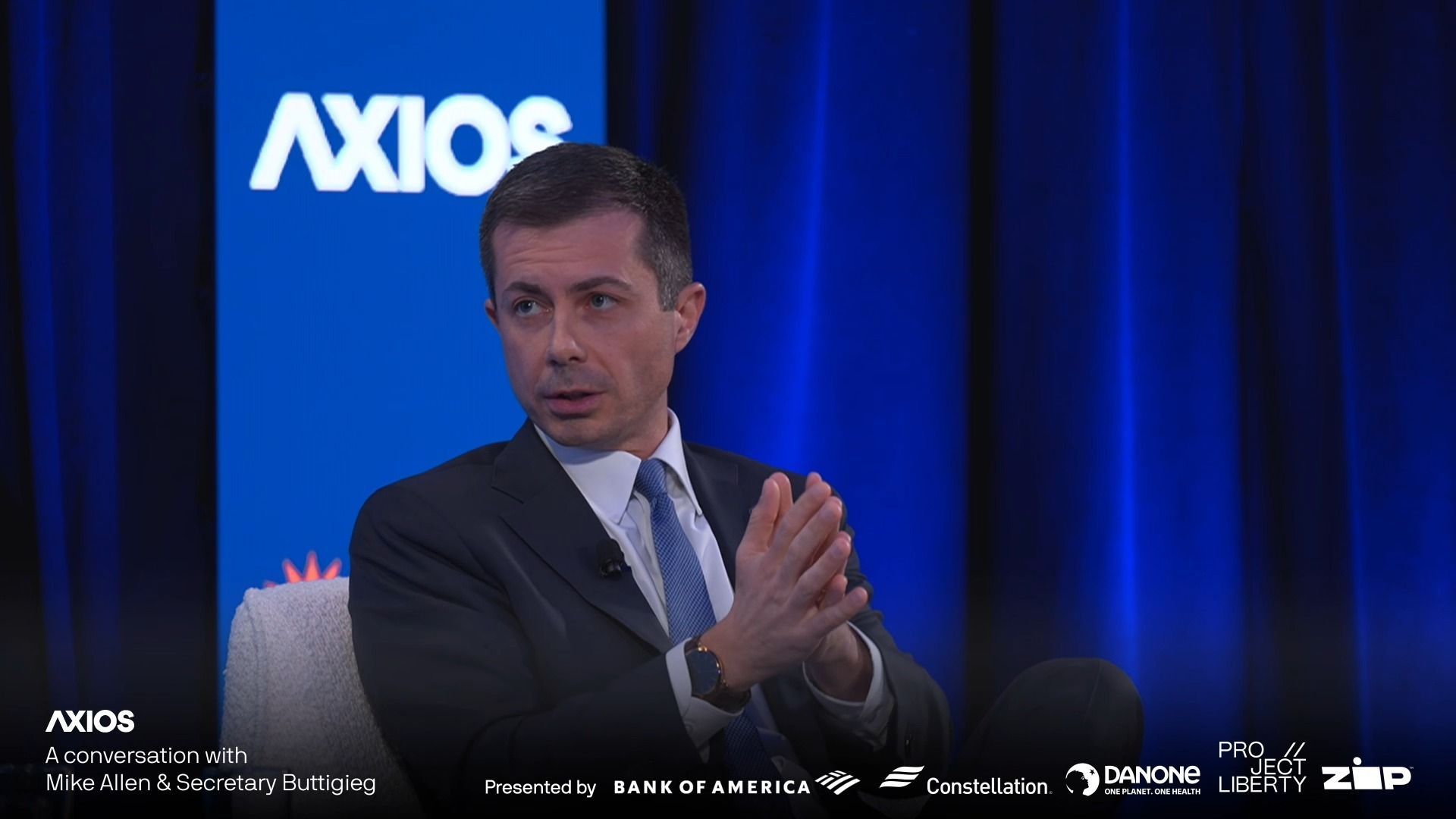
Transportation Secretary Pete Buttigieg speaks at the What's Next Summit on March 19. Photo: Forrest Carpenter/Axios
"There are real concerns with quality control at Boeing," U.S. Transportation Secretary Pete Buttigieg told Axios' Mike Allen at the annual What's Next Summit this week — but added that he still has no issue sitting in a window seat on Boeing planes, Axios' Hans Nichols reports.
Why it matters: Buttigieg is trying to assure the American public that flying is as safe as ever under President Biden, while still signaling that Boeing will be held to vigorous safety standards.
What they're saying: Buttigieg noted that a recent FAA decision will bar Boeing from increasing production "until they demonstrate that they have improved their safety standards."
- Asked if the recent string of high-profile incidents on Boeing planes is a case of the media suddenly seizing on every issue or a genuine systemic problem, Buttigieg said it's "a bit of both."
- "Every time I get on a plane, I know that I'm participating in the safest mode of transportation in America. And I know the people who work very hard to keep it that way. And that's part of why we're pressing Boeing so hard," he said.
Zoom out: Buttigieg said one of his primary goals is to make traveling by car as safe as traveling by plane.
- He bemoaned the 40,000 average annual U.S. road fatalities and said he wants to move toward a future when deadly road crashes seem "as quaint and as antiquated as losing your life to dysentery on the Oregon Trail."
What to watch: Buttigieg said the administration is trying to identify new technologies that will make infrastructure projects greener and most cost-effective.
- One he's particularly interested in: "self-healing potholes."
4: Joby CEO: Air taxis should be affordable

JoeBen Bevirt, founder and CEO of Joby Aviation, speaks at the What's Next Summit on March 19. Photo: Ronald Flores
JoeBen Bevirt hopes to make rides on his company's electric air taxis as cheap as hailing an Uber, he told Joann at the What's Next Summit this week, Axios' Shauneen Miranda reports.
- Bevirt, founder and CEO of electric air taxi developer Joby Aviation, said he wants the aircraft to be "accessible to everyone."
The big picture: Bevirt envisions a world where you get off a Delta flight and into one of Joby's air taxis for a ride downtown "as seamlessly as possible."
- "We're building vertiport infrastructure at JFK and LaGuardia and LAX to give that really fantastic customer experience of a tight integration between your Delta flight and your Joby flight," he said.
Big thanks to What's Next copy editor Amy Stern.
Was this email forwarded to you? Get your daily dose of What's Next by signing up here for our free newsletter.
Sign up for Axios What's Next

The next decade of big, sweeping changes will unfold in cities and communities where new technologies like 5G, AI and drones are transforming how we work, live and play together. What’s Next will guide you through the revolution.


