Axios What's Next

July 18, 2024
The screen on the new Lincoln Nautilus is huge and impressive — yet not distracting, Joann writes today.
- Join Axios on Tuesday, July 23 at 6:30 p.m. ET in Washington, D.C., for an event exploring the future of e-mobility, featuring conversations with Transportation Secretary Pete Buttigieg and Department of Energy deputy assistant secretary for sustainable transportation & fuels Michael Berube.
- RSVP here.
Today's newsletter is 1,105 words ... a 4-minute read.
1 big thing: Lincoln's screen sets the bar
Bigger dashboard displays have become a staple in today's gadget-packed cars — I just wish they all were designed as thoughtfully as the 48-inch panoramic screen in the new Lincoln Nautilus.
Why it matters: Digital-savvy car owners expect their vehicles to replicate their Apple or Android smartphones. But as cars morph into rolling computers, their colossal screens have turned into giant distractions.
The big picture: Tesla's 2009 Model S kicked off the giant screen era with the equivalent of a 17-inch iPad bolted to the center of the dashboard. Now some screens span the entire width of the car.
- Mercedes-Benz's MBUX Hyperscreen, for example, is a 56-inch curved glass display that stretches from door-to-door, incorporating three separate screens: a driver instrument panel, a large central display and a passenger screen.
- Many cars also abandoned analog switches and buttons in favor of touchscreen controls that might work well on a phone, but not in a moving vehicle.
- An extreme example that really irks me: To redirect the air vents in a Rivian R1T, you have to drag your finger across a virtual dashboard depicted on the giant touchscreen. A simple toggle switch in the vent would suffice.
Friction point: The problem with such systems is that they require drivers to keep jabbing at the screen, taking their eyes off the road.
- The European New Car Assessment Program, an independent safety testing agency, is so concerned about the potential danger that it's going to evaluate vehicle controls as part of its car safety ratings starting in 2026.
- The new rules are still being established, but cars must have physical controls for features like turn signals, hazard lights and windshield wipers to earn the highest rating, the agency tells Axios.
My thought bubble: The Lincoln Nautilus does it right, with a panoramic screen that spans the width of the car without overwhelming the driver.
- The display is located above the dashboard and set back, out of the driver's reach.
- That helps lift the driver's eyes up and out, closer to their normal field of vision.
- Information located farthest right of the driver — the time and weather, for example — uses larger graphics and fonts, so it's easy to read at a glance.
What they're saying: The challenge for designers was limiting the amount of information displayed on the Nautilus' giant screen, Christian Dodd, Lincoln's digital design director, tells Axios.
- "You have the real estate. Automotive people see blank space and want to fill it," he said. "But you get to a point where there's too much information and it becomes less useful."
Zoom in: The panoramic screen is a display only (although it's paired with a smaller, 11-inch touchscreen mounted lower on the center stack).
- Notably, there is no head-up display projected on the windshield as in most luxury models. Lincoln says it wasn't needed.
- The whole system is designed to prioritize the use of voice, using either Google Assistant or Amazon Alexa to set the cabin temperature, play music or get directions, for example.
- When the car is in park, the driver can access gaming, video streaming apps — and soon, Zoom meetings.
What's next: As cars become more automated, the windshield itself could become the entertainment screen.
2. Cybertruck outsells F-150 Lightning


Tesla's unconventional Cybertruck surpassed the Ford F-150 Lighting as America's most popular electric pickup truck in May, vehicle registration data shows.
Why it matters: Tesla, which has been ramping up production, claims to have 1 million Cybertruck reservations. But true demand for electric pickup trucks is unclear.
By the numbers: The Cybertruck ranked fifth among all battery-electric vehicles registered in May, according to data compiled by S&P Global Mobility.
- Running just over $100,000 for the initial Foundation Series, the Cybertruck had 3,907 registrations in May.
- Ford's F-150 Lightning, which launched in the spring of 2022, had 2,353.
- The Rivian R1T pickup, which launched in late 2021, was in third place among electric pickups, with 1,237 registrations.
Between the lines: Ford's Lightning came out of the gate hot, prompting the automaker to quickly double production in early 2022.
- But then in January 2024, Ford reversed course, saying EV demand was lower than expected.
- General Motors in October 2023 postponed the opening of a $4 billion electric truck plant in Michigan.
The bottom line: Year to date, the Lightning still outsold the Cybertruck.
3. Saudi airline buys 50 electric air taxi jets
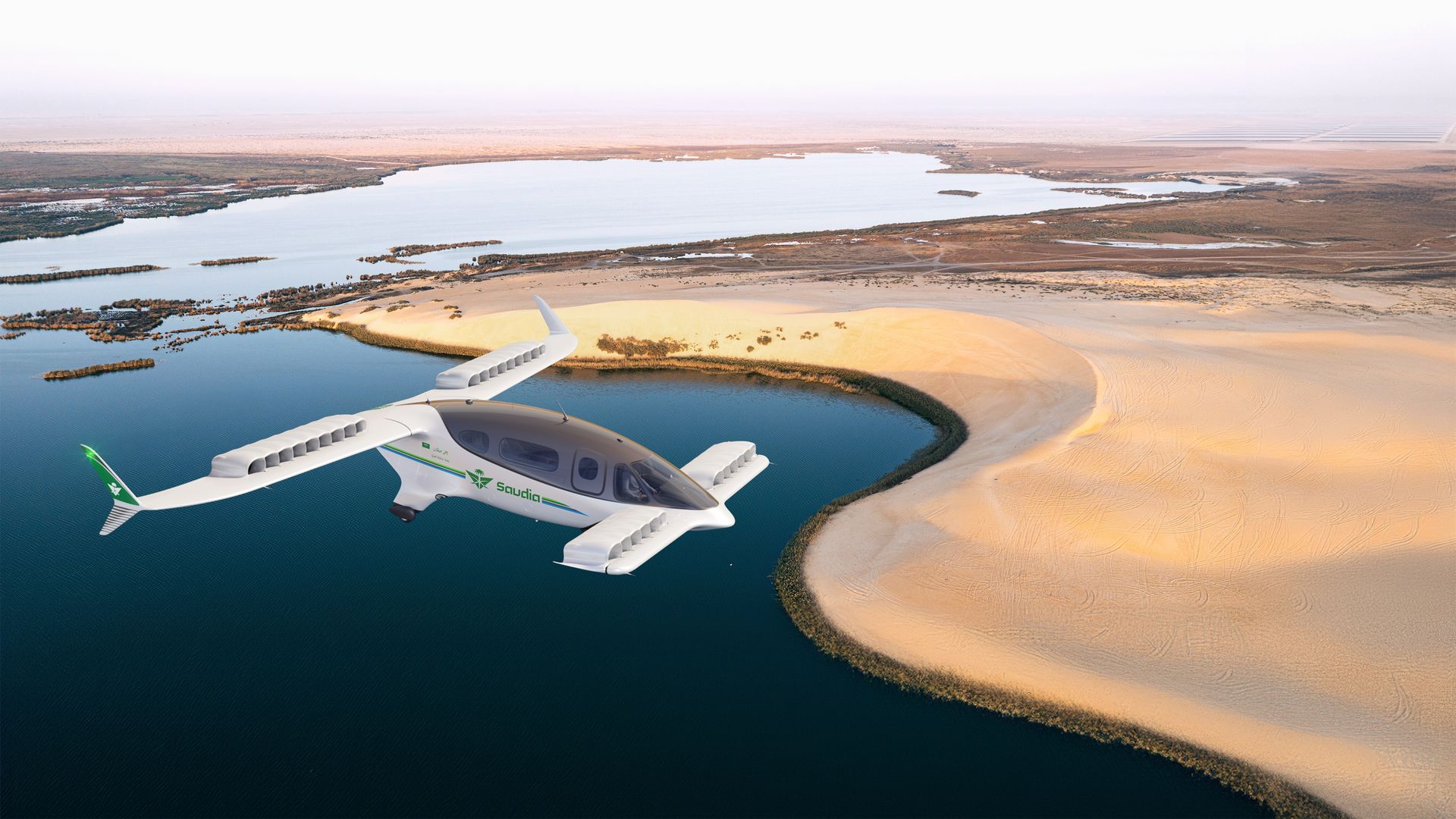
Germany-based air taxi developer Lilium has a "firm" order from Saudi Arabian airline Saudia Group for 50 of its electric jets, with an option to buy 50 more.
Why it matters: The order, worth an estimated $450 million, is the largest commitment yet by an airline in the electric vertical takeoff and landing (eVTOL) sector, the companies said.
- The Middle East is likely to be one of the first markets to deploy electric air taxis.
Driving the news: The purchase deal was signed at a ceremony today in Munich, about 18 months after the companies' initial agreement to collaborate on electric flight in Saudi Arabia.
- Saudia agreed to make pre-payments on the $9 million planes according to certain aircraft delivery and performance milestones.
- Lilium will also provide aircraft fleet maintenance and support services — including annual replacement of the planes' batteries, which represents a key source of recurring revenue, Lilium co-founder Daniel Wiegand tells Axios.
- The first aircraft is expected to be delivered in 2026.
Between the lines: Like other electric air taxi manufacturers, Lilium's aircraft takes off and lands vertically.
- But instead of electric propellers, Lilum's air taxi is propelled by an electric jet engine, which is more efficient in cruise mode.
- That enables it to fly longer-distance regional flights of an hour or two between cities — which represent a bigger, more lucrative market than urban air taxis, Wiegand says.
Zoom in: Saudia expects to use Lilium's electric jets to support Hajj and Umrah pilgrimages, and to offer faster access to key sports and entertainment events in Riyadh, for example.
4. Whole Foods launches "surprise bags"

Hundreds of Whole Foods stores are now offering "surprise bags" of surplus food via Too Good To Go, an app where customers can snag cheap eats that might otherwise become food waste.
Why it matters: The partnership is expected to save millions of meals annually and bolster sustainability efforts, the companies said in a joint announcement.
Driving the news: Two different surprise bags are on offer: a prepared food bag and a bakery bag.
- The $9.99 prepared foods bag may include soups, ready-to-eat meals and protein salads.
- The $6.99 bakery bag can contain items like breads, muffins and scones.
Yes, but: Each store will offer only four prepared foods bags and two bakery bags daily.
Big thanks to What's Next copy editor Amy Stern.
Was this email forwarded to you? Get your daily dose of What's Next by signing up here for our free newsletter.
Sign up for Axios What's Next