Lincoln's 48-inch car display sets the bar for dashboard screens

Add Axios as your preferred source to
see more of our stories on Google.
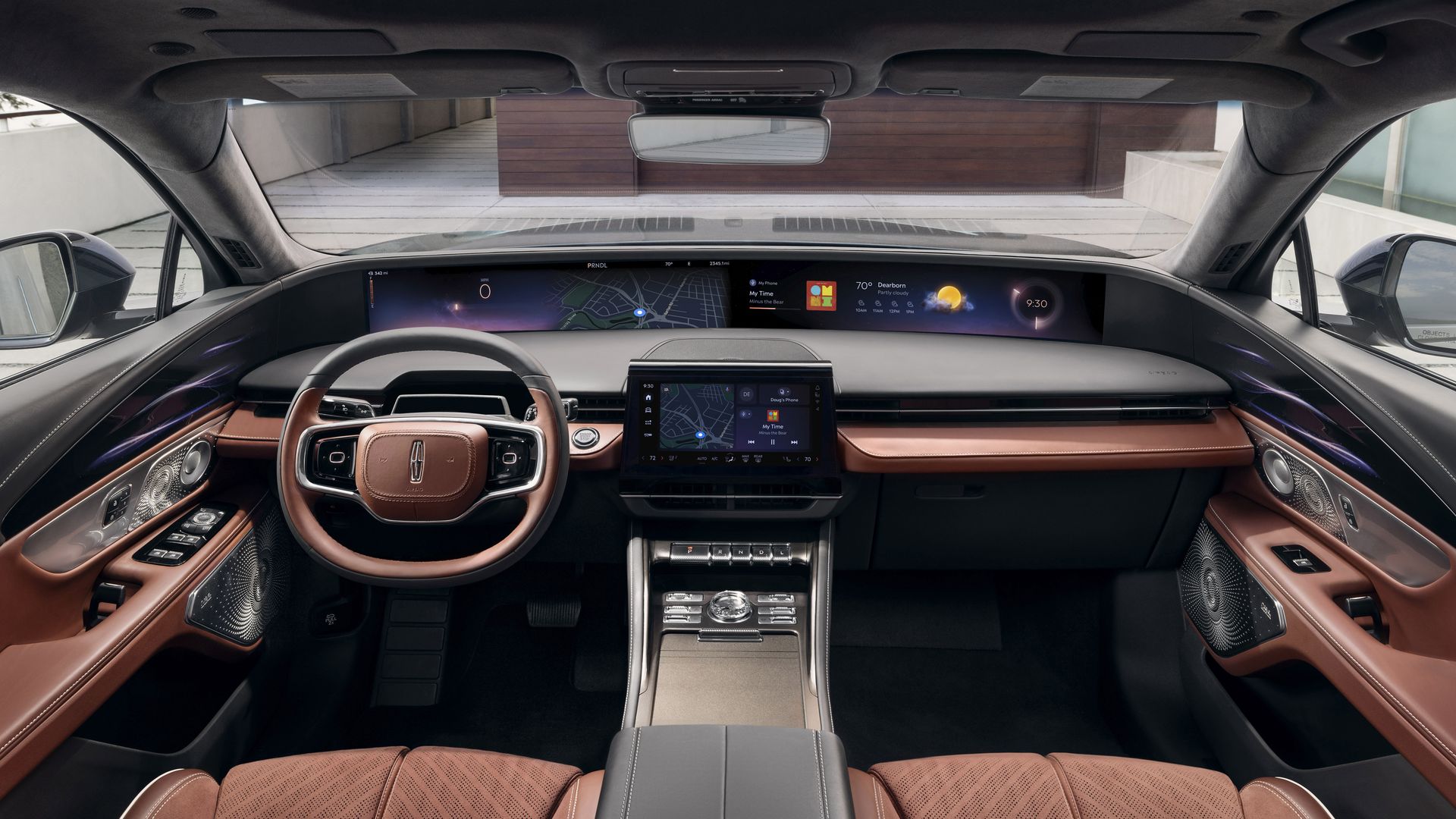
The panoramic screen in the Lincoln Nautilus gives the right amount of information with just a glance from the road. Photo: Courtesy of Lincoln
Bigger dashboard displays have become a staple in today's gadget-packed cars — I just wish they all were designed as thoughtfully as the 48-inch panoramic screen in the new Lincoln Nautilus.
Why it matters: Digital-savvy car owners expect their vehicles to replicate their Apple or Android smartphones. But as cars morph into rolling computers, their colossal screens have turned into giant distractions.
The big picture: Tesla's 2009 Model S kicked off the giant screen era with the equivalent of a 17-inch iPad bolted to the center of the dashboard. Now some screens span the entire width of the car.
- Mercedes-Benz's MBUX Hyperscreen, for example, is a 56-inch curved glass display that stretches from door-to-door, incorporating three separate screens: a driver instrument panel, a large central display and a passenger screen.
- Many cars also abandoned analog switches and buttons in favor of touchscreen controls that might work well on a phone, but not in a moving vehicle.
- An extreme example that really irks me: To redirect the air vents in a Rivian R1T, you have to drag your finger across a virtual dashboard depicted on the giant touchscreen. A simple toggle switch in the vent would suffice.
Friction point: The problem with such systems is that they require drivers to keep jabbing at the screen, taking their eyes off the road.
- The European New Car Assessment Program (NCAP), an independent safety testing agency, is so concerned about the potential danger that it's going to evaluate vehicle controls as part of its car safety ratings starting in 2026.
- The new rules are still being established, but cars must have physical controls for features like turn signals, hazard lights and windshield wipers to earn the highest rating, the agency tells Axios.
My thought bubble: The Lincoln Nautilus does it right, with a panoramic screen that spans the width of the car without overwhelming the driver.
- The display is located above the dashboard and set back, out of the driver's reach.
- That helps lift the driver's eyes up and out, closer to their normal field of vision.
- Information located farthest right of the driver — the time and weather, for example — uses larger graphics and fonts, so it's easy to read at a glance.
What they're saying: The challenge for designers was limiting the amount of information displayed on the Nautilus' giant screen, Christian Dodd, Lincoln's digital design director, tells Axios.
- "You have the real estate. Automotive people see blank space and want to fill it," he said. "But you get to a point where there's too much information and it becomes less useful."
Zoom in: The panoramic screen is a display only (although it's paired with a smaller, 11-inch touchscreen mounted lower on the center stack).
- Notably, there is no head-up display projected on the windshield as in most luxury models. Lincoln says it wasn't needed.
- The whole system is designed to prioritize the use of voice, using either Google Assistant or Amazon Alexa to set the cabin temperature, play music or get directions, for example.
- When the car is in park, the driver can access gaming, video streaming apps — and soon, Zoom meetings.
What's next: As cars become more automated, the windshield itself could become the entertainment screen.
