
Axios Vitals

July 17, 2025

Happy Thursday! Today's newsletter is 961 words or a 3.5-minute read.
1 big thing: Immigration order puts clinics in a bind
Community health centers face a legal mess following the Trump administration's directive to restrict undocumented immigrants' access to their services.
Why it matters: The federally funded clinics are supposed to serve everyone — but now, only if they fulfill a citizenship requirement.
- Health centers aren't sure how to square that, and worry that a mistake could get them kicked out of multiple federal programs. That could be crippling amid health workforce challenges and looming Medicaid cuts.
There's "a high level of confusion," said Louise McCarthy, CEO of the Community Clinic Association of Los Angeles County.
- "We don't want to break any rules. We don't want to jeopardize our funding. We want to make sure that we can speak to our patients. ... But what can we tell them?"
Friction point: The health centers serve more than 32 million people annually. But leaders told Axios they don't track patients' immigration status, let alone ask for proof of citizenship before providing care.
- Nothing in last week's notice changes the underlying requirement in federal law that health centers must serve any resident in their designated service area, said Sara Rosenbaum, a professor emeritus of health law and policy at George Washington University.
HHS hasn't yet issued further guidance. It could fall to the Health Resources and Services Administration, which runs point on the health center program, to work out conflicts down the road.
- Meanwhile, the National Association of Community Health Centers held a call on the policy change earlier this week that attracted 3,000 member clinics and other participants, the organization told Axios.
- Health center leaders say that for now they're seeking legal guidance, putting strapped clinic staff on the spot.
- They worry noncompliance could risk the loss of federal grants and benefits including discounted drugs and malpractice insurance — which could be a death knell for health centers.
Between the lines: The policy will likely have a chilling effect on immigrants' use of health center services, even for those with the required documentation.
2. A one-two punch on health care and credit

Millions of low-income Americans already face the prospect of losing their health insurance, and now they're looking at another worry: lower credit scores.
Why it matters: Poor credit scores not only make it harder to borrow money, but also to accomplish such basic things as land a job or rent an apartment.
How it works: The Trump administration last week got a federal court to toss a Biden-era rule that would have removed medical debt from people's credit reports.
- At the same time, cuts to Medicaid and the Affordable Care Act in the GOP tax-and-spending package will likely mean people pay more for health care.
- "You really are double hammering households," says Michael Calhoun, president of the Center for Responsible Lending, a consumer advocacy group.
- Meanwhile, other debts are also about to show up on credit reports, including delinquent student loans, after a years-long pause, and buy-now, pay-later purchases. And cuts to food stamps, or SNAP, present an additional strain.
Follow the money: Some argue that it's a win for consumers who pay their bills on time to have more information on their credit reports.
Yes, but: Consumers routinely complained to the Consumer Financial Protection Bureau about medical debt errors on their credit reports, says Julie Margetta Morgan, a former associate director at the agency.
3. Where states restrict contraceptive access
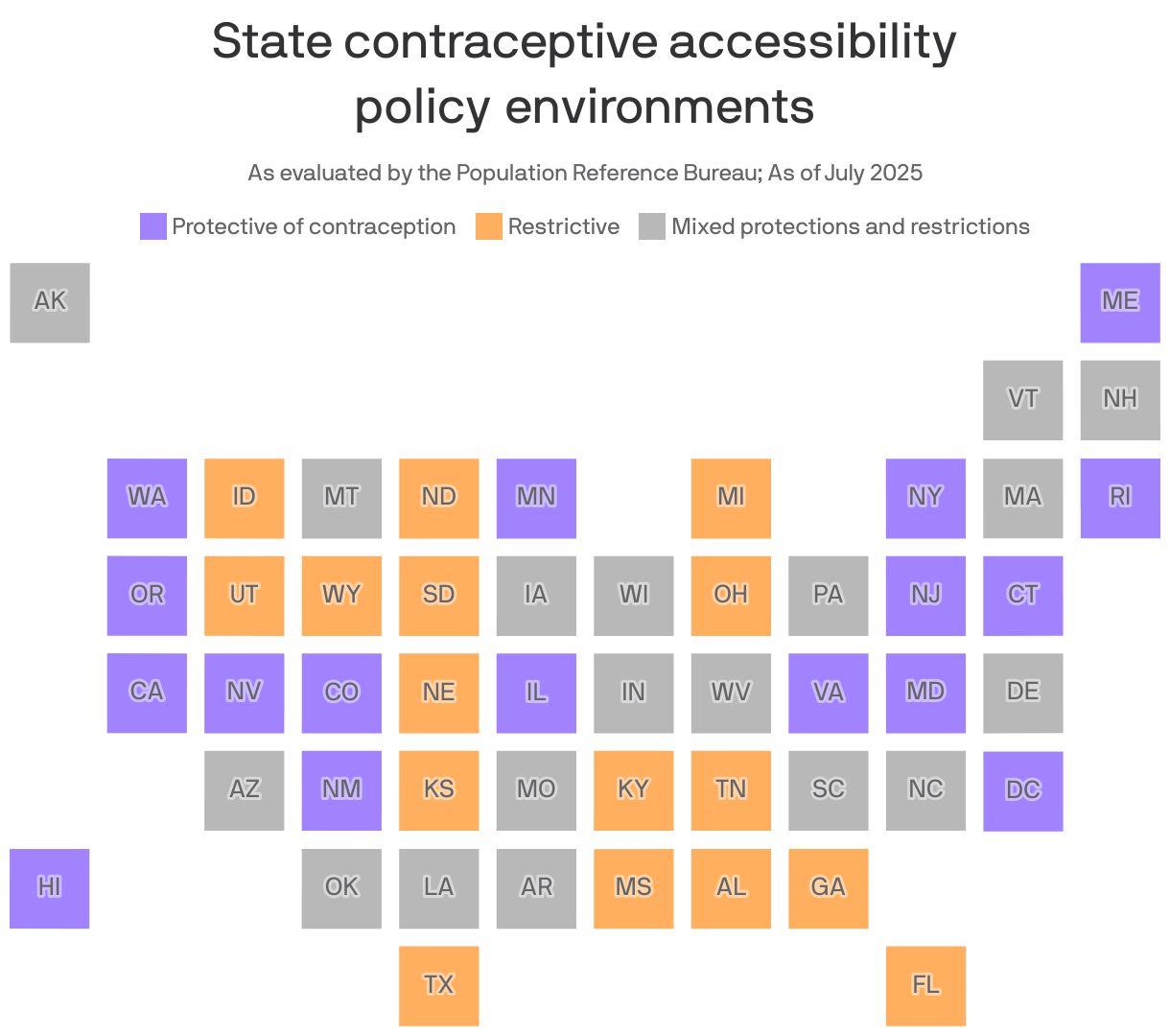
State laws regulating birth control remain a patchwork, with wide variations in access and restrictions in some locales requiring parental consent or allowing providers to opt out of dispensing contraception, a new scorecard from the Population Reference Bureau shows.
Why it matters: Contraception access has become a political flashpoint since the Supreme Court ended Roe v. Wade, with Democrats unsuccessfully pressing to codify nationwide contraceptive access and some patients concerned that conservative state legislatures could enact new curbs.
What they found: Nearly 35% of Americans, or 121 million people, currently live in a state that actively restricts access.
- Of the 16 states the group identified in that cohort, the most restrictive including Kansas, Mississippi, Florida, Alabama and Wyoming.
- The most protective included California, Washington, Connecticut, New York, New Mexico, Maryland and Oregon.
"Reproductive health care access depends on where you live," said Cathryn Streifel, senior program director at PRB and co-author of the scorecard.
- "State policies are more important than ever in shaping the reality of contraceptive access on the ground," she said.

4. LGBTQ+ youth lose specialized 988 suicide line
LGBTQ+ youth who call the national 988 suicide prevention hotline will lose access to counselors specifically trained to serve their needs starting today.
Why it matters: Nearly 40% of LGBTQ+ youth seriously considered attempting suicide in 2023, according to the Trevor Project, and 988's specialized services for LGBTQ+ youth were considered a lifeline for young people who were struggling.
Driving the news: The Substance Abuse and Mental Health Services Administration will stop funding the program, nearly three years to the day after it launched.
What they're saying: "Everyone who contacts the 988 Lifeline will continue to receive access to skilled, caring, culturally competent crisis counselors who can help with suicidal, substance misuse, or mental health crises, or any other kind of emotional distress," the agency said in a statement.
By the numbers: Since its launch, the 988 line has received 16.5 million contacts, including more than 11 million calls, nearly 3 million texts and 2.4 million chats, KFF reported this week.
- More than 650,000 contacts were made to the number this May, compared with 545,000 in May 2024.
5. Catch up quick
👉 Health Secretary Robert F. Kennedy Jr. shook up his top staff just months into his tenure, firing two top aides this week after losing confidence in them. (Axios)
✂️ More employers plan to pass along health care costs to workers in 2026. (CNN)
💰 Why it's important to get health insurance when traveling abroad. (WSJ)
Thanks for reading Axios Vitals, and to senior health care editor Adriel Bettelheim and copy editor Matt Piper. Please ask your friends and colleagues to sign up.