Axios Vitals

November 30, 2023
Happy Thursday, Vitals gang. Today's newsletter is 956 words or a 3.5-minute read.
Situational awareness: Mandy Cohen, in her first Hill hearing as CDC director, will testify this morning about rebuilding trust in the agency.
1 big thing: GOP's repeal caution
Illustration: Gabriella Turrisi/Axios
Republican lawmakers may not be thrilled with former President Trump's renewed push to repeal and replace Obamacare — but few are firmly ruling it out, Axios' Peter Sullivan writes.
Why it matters: The Affordable Care Act has become more popular and even more entrenched in the health care system since the GOP's failed repeal attempt in 2017 contributed to Democrats' big electoral gains the following year.
- A fresh repeal effort could be just as perilous, but Trump's continued fixation with the law could put pressure on Republican lawmakers to make another run at it if the GOP gains full control of Washington next year.
What they're saying: Two top Senate Republicans signaled they could be open to a revived effort.
- Sen. John Cornyn (R-Texas), while criticizing the ACA, said he would "be interested to hear exactly how" Trump would approach repeal.
- Trump in a social media post late Tuesday night reprised his attack on the health care law, while emphasizing that he wants to "replace" it with a still-unspecified "MUCH BETTER" plan.
- Sen. Mike Crapo (R-Idaho), who's in line to run the Finance Committee if the GOP retakes the Senate, said he's open to plans that were similar to the 2017 repeal and replace bills. Those generally would have curtailed spending — with millions estimated to lose coverage as a result — while relaxing federal insurance protections.
Yes, but: Other GOP moderates threw cold water on the idea, and Republican lawmakers haven't taken a serious look at what "repeal and replace" might look like today, when 40 million people are covered under the law.
A version of this story was published first on Axios Pro. Unlock more news like this by talking to our sales team.
2. PBM business could trip up Cigna-Humana deal

Photo: Joe Buglewicz/Bloomberg via Getty Images
A deal reportedly brewing between health insurance giants Cigna and Humana will very likely face antitrust challenges over their respective pharmacy benefit management businesses, experts tell Axios.
Driving the news: The companies are discussing a stock-and-cash deal that could be finalized by the end of the year, presuming talks don't dissolve, WSJ reports.
- The combination would be huge. Cigna is now valued at $78 billion and Humana is at roughly $60 billion.
- With 35 million members between them, the combined company would have the scale to rival UnitedHealth Group and CVS Health.
What they're saying: The companies' respective insurance businesses may not trigger antitrust concerns, since Cigna is more focused on the private market while Humana is centered on government business, including Medicare Advantage.
- Cigna is reportedly exploring a sale of its Medicare Advantage business, which investors see as preparation for a possible Humana bid, wrote TD Cowen analyst Gary Taylor.
- "We actually think antitrust concerns could be alleviated in the medical insurance part of this deal since there would be very little overlap that couldn't be solved by divestitures," Julie Utterback, a senior equity analyst for Morningstar, wrote in an email to Axios.
Yes, but: That "leaves an elephant in the room," Taylor wrote — PBMs.
- "Given the extraordinary regulatory scrutiny of PBMs, this aspect of the deal seems certain to be challenged," he said.
- Utterback said it was hard to imagine Cigna giving up Express Scripts, the country's second-largest PBM, which it acquired for $54 billion in 2018. At the same time, it would be hard for Humana to divest of its PBM, which largely serves its own customers.
- "It gets trickier on the PBM side of things where we are unsure of how a deal could be structured to satisfy regulators," Utterback wrote.
Flashback: Humana and Cigna flirted with the idea of merging in 2017 after regulators struck down their deals to combine with Aetna and Anthem, respectively.
Yes, but: Insurance behemoth UnitedHealth Group, the largest in the U.S with more than 47 million enrollees, would still eclipse a combined company.
3. Suicides reached record levels last year
A record number of people in the United States died of suicide last year, while the country's suicide rate reached the highest level in over 80 years, according to new federal data.
The big picture: The startling statistics underscore the toll of the nation's mental health crisis coming out of the COVID-19 pandemic, amid rising rates of anxiety and depression, Axios' Jason Millman writes.
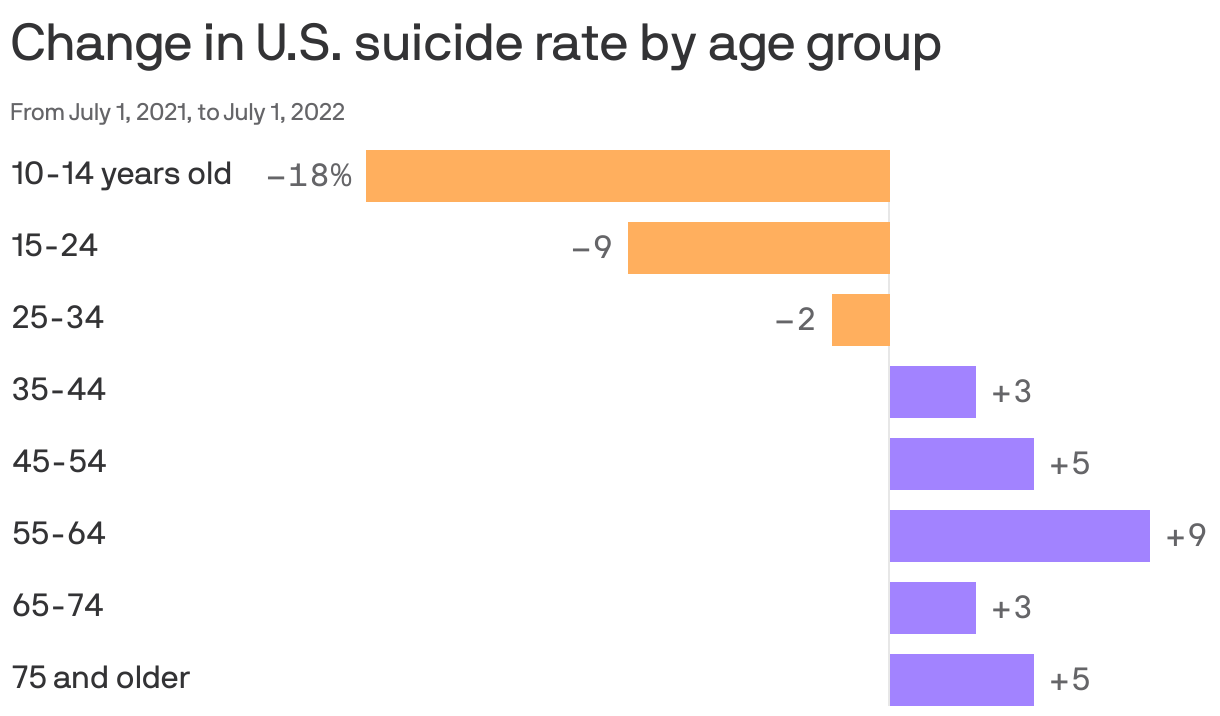
By the numbers: Nearly 50,000 Americans took their own lives last year, a 3% increase from 2021, according to provisional data from the CDC's National Center for Health Statistics. That number is likely to grow when data are finalized, the agency said.
- The suicide rate of 14.3 deaths per 100,000 people was 1% higher than in 2021 and is the highest rate since 1941.
- Suicide rates significantly decreased among younger people — by 18% for kids ages 10-14 and by 9% for people ages 15-24 — possibly indicating that efforts to address the youth mental health crisis are working.
Of note: Life expectancy rose by over a year in 2022 but remained below pre-pandemic levels, the CDC also reported Wednesday.
4. COVID vax update in the states

Illustration: Shoshana Gordon/Axios
About 16% of adults have received an updated COVID-19 vaccine this fall, according to updated CDC survey data.
By the numbers: The states with the highest rates as of Nov. 18 include Vermont (33.2%), Washington, D.C. (30.1%) and Minnesota (26.8%).
- Those with the lowest are Mississippi (5.4%), Louisiana (8.2%) and Florida (8.3%).
Meanwhile, cases of the BA.2.86 variant have tripled in the past few weeks, USA Today notes.
5. Catch up quick
🩺 About 10% of all U.S. doctors are now employed by or affiliated with UnitedHealth Group. (Stat)
💉 Who gets new weight-loss drugs depends greatly on an outdated, much-maligned measure: body mass index. (The Atlantic)
📈 Can Eli Lilly become the first pharma company valued at over $1 trillion? (Wall Street Journal)
🙅♂️ Cost Plus Drugs co-founder Mark Cuban says he has no plans to run for president. (NBC News)
Thanks for reading Axios Vitals, and to health care editor Jason Millman and copy editor Matt Piper. Please ask your friends and colleagues to sign up.
Sign up for Axios Vitals

Healthcare policy and business analysis from Tina Reed, Maya Goldman, and Caitlin Owens.