Axios Vitals

January 14, 2025

Happy Tuesday! Today's newsletter is 913 words or a 3.5-minute read.
1 big thing: Fewer Black, Hispanic med students
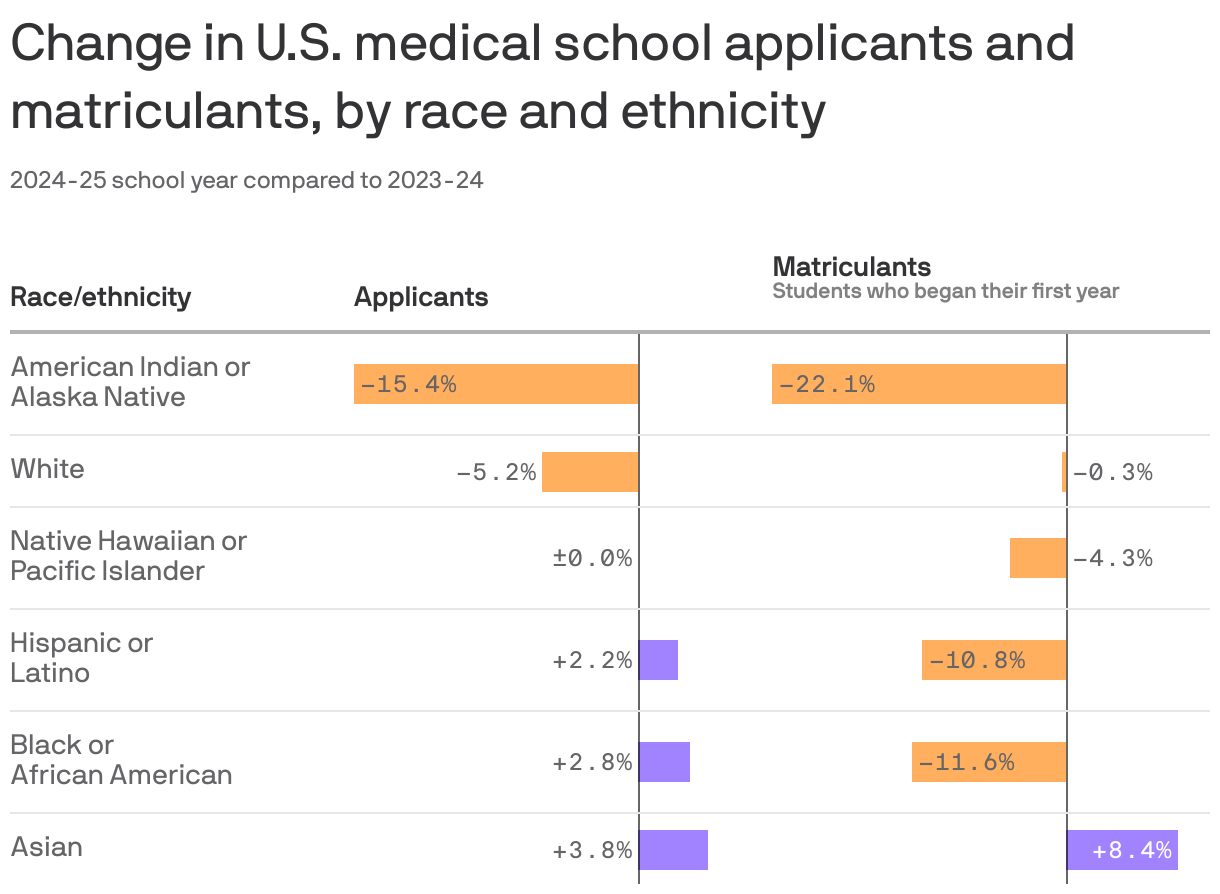
Enrollment of first-year Black and Hispanic medical students fell sharply in the year after the Supreme Court struck down affirmative action in higher education, according to new data from the institutions.
Why it matters: Research shows that a racially diverse physician workforce can improve patient outcomes.
- About 5% of doctors in America are Black, compared with 14% of the general population. About 6% of doctors in the U.S. are Hispanic versus about 20% of the general population.
What they're saying: The declines are "much larger than we would we would expect," even taking the Supreme Court decision into account, Norma Poll-Hunter, senior director of the Association of American Medical Colleges' human capital portfolio, told Axios.
By the numbers: 11.6% fewer Black students and 10.8% fewer Hispanic students began their first year at an M.D. degree-granting institution this year compared with a year earlier, according to the AAMC.
- But the schools saw a 2.8% and 2.2% increase in Black and Hispanic applicants, respectively.
- The current first-year class of M.D. students is about 51% white, 32% Asian, 11% Hispanic and 9% Black.
Zoom in: Higher education institutions are dismantling their DEI initiatives as those programs become targets of Republican officials. That could further erode medical school diversity going forward, Poll-Hunter said.
- The Supreme Court ruling meant schools could no longer consider race in admissions. But they still can take into account criteria like the economic status and education level of applicants' parents, whether or not they were raised by a single parent or if they attended public schools in certain cities.
- Medical schools are continuing to work on comprehensive admissions processes, Poll-Hunter said. Programs that introduce primary school and undergraduate students to medical careers and prepare them to be competitive applicants will be crucial to building a robust physician workforce, she added.

2. California's fires leave psychological scars
The health effects of the deadly wildfires in Southern California could include long-lasting anxiety, depression and post-traumatic stress disorder in survivors, in addition to the physical toll.
The big picture: Both the loss and uncertainty surrounding wildfires are traumatic to displaced communities, Jeff Katzman, a Connecticut-based psychiatrist who grew up in Pacific Palisades, California, told Axios.
- "There is the lingering, not knowing status of what happened," he said. "There's the experience of loss of an entire community that has generations of meaning."
Between the lines: Like other modern tragedies, destruction in California is being shared immediately on social media.
- "There's something potentially positive about it that people who have suffered together or are in this together can connect and can share resources and can share experiences," said Katzman, director of education at Silver Hill Hospital.
- On another level, he added, it can be "difficult to integrate" seeing so much relatable, devastating information, leading to a sense of helplessness.
Context: Research published last year found a link between wildfires and worsened mental health by analyzing psychotropic prescription data on 7 million people over an eight-year period following 25 large fires on the West Coast.
- People exposed to California's deadliest wildfire, the 2018 Camp Fire, showed greater chronic symptoms of PTSD, anxiety and depression, according to research published in 2023.
3. Biden team takes "moonshot" victory lap
The creation of ARPA-H and first-ever limits on "forever chemicals" in consumer products and drinking water are among the legacies of the cancer "moonshot," Biden administration officials said during a valedictory event on Monday.
Why it matters: The moonshot aimed to cut the cancer death rate by at least half and was a passion project for President Joe Biden, though some skeptics said the substantial sums directed at it could have been better spent.
Driving the news: Biden administration officials said the initiative resulted in more than 125 government actions and new commitments from 250 companies, nonprofits, academic, institutions and patient groups.
- They pointed to a not-yet-finalized rule to limit nicotine in cigarettes, funding for cancer screening at federally qualified health centers, expanded support for women's health research and Medicare reimbursement for cancer navigation services.
What to watch: The moonshot faces an uncertain fate under the incoming Trump administration and Republican Congress. During his first term, Trump proposed cuts to federal research programs, though bipartisan majorities in Congress maintained strong funding.
4. Health workers rank high for ethics: Gallup
Health workers, along with K-12 teachers and military officers, are consistently viewed as the most ethical professions — but even their ratings have dropped considerably, new Gallup polling shows.
Why it matters: The decline reflects falling confidence in U.S. institutions overall, with views of some medical professionals falling below pre-pandemic levels.
What they found: Nurses, pharmacist and doctors were among the five professions with "majority positive" ratings in the Dec. 2-18 poll. But nursing home operators had a "net negative" rating.
- Despite their place on the list, trust in medical doctors and pharmacists has fallen. Doctors' ethics rating is at the lowest since the mid-1990s, Gallup said.
- Polling released last year separately showed that more people are trusting in their own ability to assess health information or turning to friends for guidance amid lack of trust in public health agencies.
Only auto mechanics have experienced improved ratings since the 2000s.
5. Catch up quick
💉 Declining immunization rates due to public distrust or more restrictive federal policies should rekindle preventable infectious diseases in all age groups. (NYT)
🤖 A new AI tool for fighting health insurer denials may save hospitals billions of dollars. (CNBC)
🚔 Security measures at the nation's largest health care conference have been stepped up this week in the wake of the killing of UnitedHealthcare CEO Brian Thompson. (Axios)
Thanks for reading Axios Vitals, and to senior health care editor Adriel Bettelheim, managing editor Alison Snyder and copy editor Matt Piper. Please ask your friends and colleagues to sign up.
Sign up for Axios Vitals