Axios Vitals

April 07, 2025

Welcome back. Today's newsletter is 947 words or a 3.5-minute read.
🚨 Situational awareness: HHS Secretary Robert F. Kennedy Jr. visited the epicenter of the measles outbreak in West Texas yesterday after a second child with the virus died.
- He posted on X that the most effective way to contain the spread is the MMR vaccine. There have been 642 confirmed cases in the U.S. this year, nearly 500 in Texas.
1 big thing: HHS cuts felt locally
The reality of deep cuts to HHS hit home for many last week when half of the department's 10 regional offices closed, leaving 22 states and five territories without a local point of contact for heating assistance, child care programs, Meals on Wheels and more.
Why it matters: The department's regional offices not only act as a conduit for federal grants and aid, but also forge relationships between health departments, academic institutions and community-based organizations.
- "Given that rebuilding trust in public health and science starts locally, this could hamper communications and valuable partnership development," said Anand Parekh, chief medical adviser at the Bipartisan Policy Center.
Catch up quick: HHS last Tuesday moved to shutter regional offices in New York, Boston, Chicago, Seattle and San Francisco as part of its stated efforts to streamline and centralize operations.
- One Administration for Children and Families staffer in the Boston regional office said the team worked with child care programs, states and tribes in all six New England states.
- "We're being abruptly cut off from those folks, so the grantees don't know who to contact," the employee said.
The department didn't elaborate on criteria for the closures or how the work would be redistributed, but has said it focused on the offices in the highest-cost cities.
State of play: HHS is keeping regional offices in Philadelphia, Denver, Kansas City, Atlanta and Dallas.
- The work at the closed offices doesn't just disappear, current and former HHS staff warned to Axios. Closing five regional offices could strain staff at remaining offices across the country.
- "Just as a practical matter, some of our regions were already very big geographically, and we already had people traveling long distances within their region," said Carole Johnson, who led the Health Resources and Services Administration during the Biden administration.
2. Key safety hotlines disrupted by HHS cuts
Teams manning government hotlines for reporting adverse events from foods, supplements and cosmetics, and call centers that provide other essential safety information were among the thousands of HHS employees laid off last week.
The big picture: Though the department is hurriedly calling some workers back, the episodes show how information blackouts are becoming a feature of the Trump administration's efforts to reorganize the health bureaucracy.
- "Very important offices that were directly involved with food safety and public health were axed," one FDA employee, who requested anonymity out of fear of retaliation, told Axios.
Zoom in: The Food and Cosmetic Information Center fields tens of thousands of calls annually from consumers and industry representatives about recalls, nutritional information and food business requirements.
- But communications and outreach staff within the FDA's Human Foods Program that operates the center were caught up in the workforce cuts that began last Tuesday.
The phone hotline was available to take reports on Friday but the webform and online chats were offline.
- "All employees affected by the reduction in force may be asked to temporarily work until their government service ends on June 2," HHS spokesperson Andrew Nixon said when asked whether staff had been rehired to manage the hotline.
3. Emergency care is at risk: RAND report
The future of emergency care is getting more precarious, due to more complex cases, lower reimbursements and other stressors faced by emergency departments, according to a new RAND report funded by the Emergency Medicine Policy Institute.
The big picture: Concern about emergency room care has been on the rise, driven home by frequent overcrowding, understaffing and the ever-expanding nature of the care they're expected to provide.
- But don't forget: It also wasn't long ago that emergency room care was at the center of the policy debate over surprise medical bills. Then, Congress' solution was partly aimed at lessening the leverage ER doctors and other providers had with insurers under the threat of large out-of-network bills.
What they found: Several factors have led to the present situation, in which "the viability of emergency care as we know it is at risk," per the RAND report:
- Patients increasingly have more complex medical and social needs, and the severity of illness when they show up in the ED has also been on the rise.
- ED physician payment levels have been decreasing among government and commercial payers, especially when accounting for inflation.
- What's more, emergency departments must provide care to everyone who seeks it, regardless of their ability to pay — a source of financial stress when care goes uncompensated.
4. States lose billions in childhood vax funding

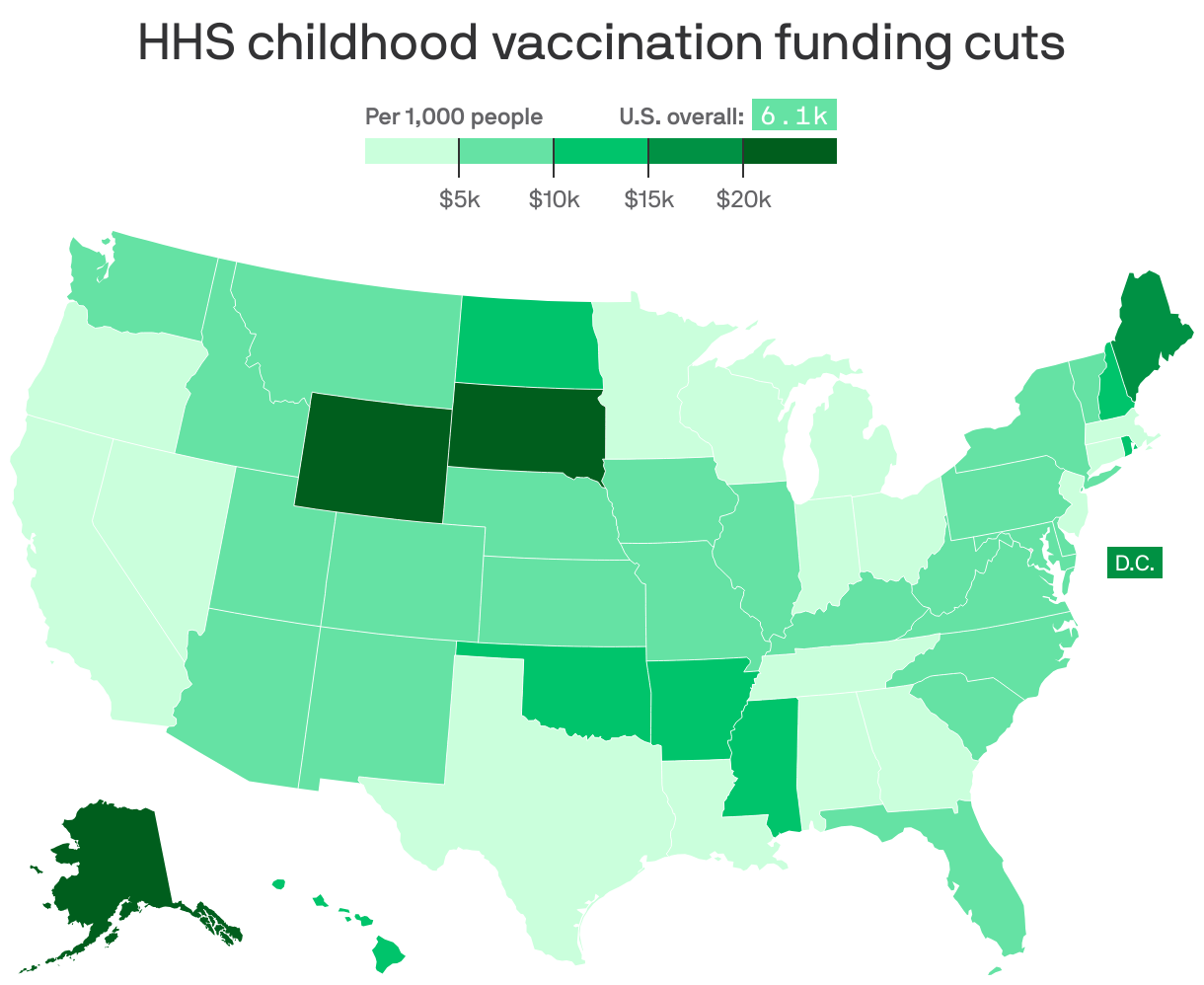
States and cities are losing over $2 billion in childhood immunization and vaccination funding as part of broader cancellations of pandemic-era federal public health spending, per government data.
Why it matters: Federal money helps fight preventable and sometimes deadly diseases like measles.
Driving the news: A 42-page HHS document lists a sweeping variety of recently terminated public health grants, with about six pages dedicated specifically to awards for "immunization and vaccines for children."
Zoom in: South Dakota (about $35,000 cut per 1,000 people), Wyoming ($35,000), and Alaska ($22,000) are losing the most funding on a per-person basis.
- Florida (about $226 million), California ($176.3 million) and Texas ($125.2 million) are losing the most funding overall.
The big picture: The childhood vaccination cuts are part of a Trump administration effort to claw back billions of dollars in federal public health grants stemming from the COVID-19 pandemic.
What's next: 23 states and Washington, D.C., filed a lawsuit last week over the HHS grant cancellations.
5. While you were weekending

🚫 The Trump administration won't let Medicare cover anti-obesity drugs. (Axios)
🍼 Unsanitary practices persist at a baby formula factory whose shutdown led to mass shortages, workers say. (ProPublica)
💰 Three states will be in an especially tight bind if Congress cuts Medicaid. (NYT)
💊 The threat of future tariffs on pharmaceutical imports has alarmed the health care community. (CBS News)
Thanks for reading Axios Vitals, and to senior health care editor Adriel Bettelheim, managing editor Alison Snyder and copy editor Matt Piper. Please ask your friends and colleagues to sign up.
Sign up for Axios Vitals