Axios Vitals

January 11, 2024
Happy Thursday. Today's newsletter is 943 words or a 3.5-minute read.
1 big thing: States' 2024 health agendas

Illustration: Natalie Peeples/Axios
As state legislatures get back to work, state policymakers are eying measures to bolster their burned-out health care workforces, make prescription drugs more affordable and reform their Medicaid programs.
Why it matters: Policymaking in Washington tends to slow down in a presidential election year, and the current Congress — so far the least productive in decades — has struggled to advance even bipartisan health measures.
- States are expected to be far more active this year, as policymakers look to continue pandemic recovery efforts and address voter concerns over health care costs, Maya writes.
- "Coming out of the pandemic, there has been just so many different challenges that have been exacerbated, I think, with more strain across the system," said Hemi Tewarson, executive director of the National Academy for State Health Policy.
Yes, but: States' ambitions could be restrained by the expiration of federal pandemic aid that allowed their budgets to swell over the past few years.
Zoom in: Retaining and growing the health care workforce will be a state priority this year, Tewarson said. Providers have left the field in droves over the past couple of years on the heels of the pandemic.
- At least 21 states last year considered legislation related to minimum nurse staffing levels, including several that approved staffing ratios.
- Tewarson also expects states to focus on growing the roles of community-based health workers like doulas, peer support workers and family caregivers, who can help fill gaps in care and make services more accessible.
- Drug prices will again be a big focus. More prescription drug affordability boards are coming to life, and other states could revisit legislation this year. The recent FDA approval of Florida's drug import plan could spur similar plans from more states.
- And it could be an active time for state Medicaid waivers. In presidential election years, states ideologically aligned with the current administration are more inclined to try to push through policies that a future administration is less likely to approve.
2. Where ACA signups are surging
President Obama and President Biden during a 2022 ceremony for the Affordable Care Act. Photo: Al Drago/Bloomberg via Getty Images
A record 20.4 million people have enrolled in the ACA marketplaces with a few days left in the sign-up season, the Biden administration said Wednesday.
By the numbers: That already represents a 25% increase from the then-record 16.3 million sign-ups during the 2023 enrollment season.
- And the enrollment increases are much larger in some states, predominantly red ones.
- The largest increases are in West Virginia (63.4%), Louisiana (62.7%), Ohio (51.9%), Tennessee (49.8%) and Indiana (49.3%)
- There were also increases of 40% or more in Mississippi, Arkansas, South Carolina and Georgia; and enrollment increased above 35% in Alabama, Arizona and Texas.
Yes, but: These numbers can still go up. The HealthCare.gov enrollment season doesn't end until Jan. 16 — it runs longer in some states with their own marketplaces — and there's typically a surge just before the deadline.
Zoom in: Krutika Amin, associate director of KFF's program on the ACA, writing on X said there's likely a "substantial share" who've lost Medicaid coverage in the unwinding who are gravitating to the marketplaces. (Just over 14 million people have been disenrolled from Medicaid, according to KFF's tracker.)
- Enhanced subsidies, boosted enrollment outreach and elimination of the "family glitch" may also be driving enrollment, she said.
3. Rising gender dysphoria diagnoses

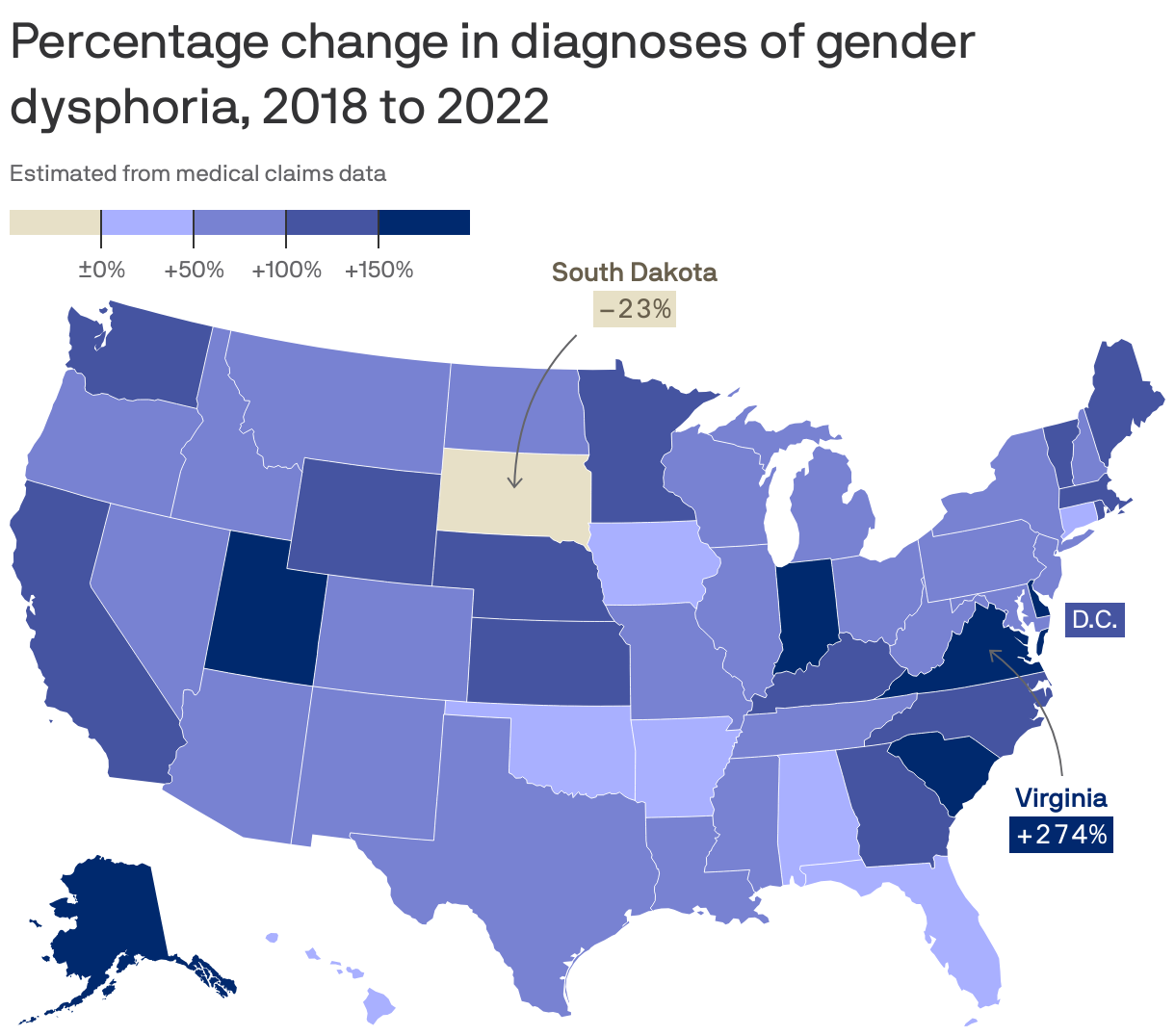
Gender dysphoria diagnoses rose in every state except for South Dakota between 2018 and 2022, according to a new Definitive Healthcare report.
Why it matters: The nearly nationwide increases suggest growing demand for gender-affirming care, even amid efforts in many states to restrict access, writes Axios' Alex Fitzpatrick and Kavya Beheraj.
- Not all transgender people experience or are diagnosed with gender dysphoria, but such a diagnosis is often a first step when seeking gender-related mental health care or gender-affirming care.
Zoom in: Virginia (+274%), Indiana (+247%) and Utah (+193%) have seen the greatest increases in gender dysphoria diagnoses, while South Dakota (-23%), Hawai'i (+6%) and Connecticut (+10%) have seen the biggest drops or lowest increases, based on medical procedure and diagnosis claims data.
- The share of gender dysphoria diagnoses among patients under 18 increased from 17.5% to 20.4% between 2018-2022 — perhaps a reflection of trans identities and gender identity ideas becoming "more accepted by society," as the report put it.
The bottom line: While gender dysphoria diagnoses are generally increasing, receiving one is only an early step on many transgender Americans' physical and mental health care journeys.
- What comes next continues to depend heavily on where they live and what resources are available to them.
4. FDA OKs import of syphilis drug in shortage

Photo: Sarah Silbiger/Getty Images
The FDA will temporarily allow imports of a syphilis drug that's in shortage as rates of the sexually transmitted infection have soared in the U.S.
Driving the news: French drugmaker Laboratoires Delbert was cleared to send to the U.S. a version of penicillin used against syphilis, per Bloomberg.
- Pfizer's version of the drug has been in short supply since April, around the same time the CDC reported syphilis cases were at the highest levels in over 70 years.
- The drug is the only treatment for the congenital form of the disease, rates of which have increased more than tenfold in the past decade.
Flashback: The FDA last year also allowed imports of cancer medication cisplatin from a Chinese drugmaker amid ongoing shortages that have hit oncology especially hard.
5. Catch up quick
🏛️ How the FDA regulates vaping products could come before the Supreme Court this term. (Bloomberg Law)
🥑 Nearly 21 million kids can receive food benefits this summer under a federal program recently made permanent. (Axios)
📱 Elevance Health is providing free smartphones to some Medicaid enrollees to help them access care. (Modern Healthcare)
🇦🇺 Australia's efforts to reduce stillbirths hold important lessons for the U.S., which lags behind other wealthy countries. (ProPublica)
Thanks for reading Axios Vitals, and to health care editor Jason Millman and copy editor Matt Piper. Please ask your friends and colleagues to sign up.
Sign up for Axios Vitals

Healthcare policy and business analysis from Tina Reed, Maya Goldman, and Caitlin Owens.