Axios Vitals

June 27, 2024

Happy Thursday, Vitals crew. Today's newsletter is 846 words or a 3-minute read.
1 big thing: Little progress on equity
More than 20 years after a landmark report chronicled the existence and drivers of health inequities in the U.S., a sequel finds little has improved.
Why it matters: Despite greater awareness, inequities are baked into the U.S. health care system and will take intentional policy change and structural redesign to dislodge, the National Academies of Sciences, Engineering, and Medicine concluded yesterday.
The big picture: While the ACA and other major changes to the health care system have improved care for people of color, other changes have slowed down progress.
- For instance, important components of the ACA have also been blocked from implementation, it noted.
- "The United States likes to see itself as the world's standard bearer of excellence in health care. Yet when compared to other industrialized nations, we are not the exemplars we believe we are," wrote the co-chairs of the committee that created the report.
The intrigue: The report specifically calls out the U.S. insurance system for its lack of universal coverage and the wide differences in how Medicare, Medicaid and commercial insurance pay for care.
- Although coverage-related inequities primarily impact the populations disadvantaged by them, the effects can be felt systemwide, they argue.
- Among other recommendations, it suggests Congress should create a pathway for Medicaid payment policies to be on par with Medicare
The bottom line: As the report repeatedly emphasizes, health inequities affect everyone — and solving them benefits everyone.
2. Small business cost crunch
Employee health care costs are increasingly eating up larger shares of payroll costs for America's smallest businesses, according to a new analysis from the JPMorgan Chase Institute.
Why it matters: The pain of health care costs is nothing new. But this analysis, based on de-identified data from Chase business banking accounts, offers a more granular look at the disproportionate burden on the smallest businesses that often isn't captured by other data.
What they found: For the typical small business with at least two employees and revenues of $600,000 or less, 12% of payroll costs went to health care benefits last year, the analysis found.
- For businesses with revenues of at least $2.4 million, that figure was 7%.
- The U.S. Bureau of Labor Statistics reported that health insurance on average was 5.8% of compensation costs for small businesses, which it defines as firms with up to 49 employees.
What they're saying: "Health care expenses are eating a bigger and bigger chunk of the expense and profitability line for these businesses," Dan Mendelson, CEO of Morgan Health, told Axios.
- "It is more difficult for these small businesses, which really are the engine of the of the economy, to thrive."
3. The most popular psychedelic
Magic mushrooms are the most-used psychedelic drug in the United States, according to a new report from RAND.
Why it matters: The close look at Americans' use of psychedelics can help policymakers figure out how to regulate the substances as mental health treatments or even legalize them for recreational use.
By the numbers: 3.1% of adults reported using mushrooms, also known as psilocybin, in the past year, a new national survey found.
- About 12% U.S. adults reported having used mushrooms in their lifetime, while a similar share reported using LSD.
- 7.6% said they've taken MDMA, also known as ecstasy, during their lifetime.
- Less than 1% of U.S. adults reported using any psychedelics in the past month.
Where it stands: It's a critical time for federal officials to decide how to regulate psychedelics, said Beau Kilmer, lead author of the report and a senior policy researcher at RAND.
- "We saw this with alcohol, tobacco, we've seen this with cannabis as well," he added. "Once you have the companies and they've got their lobbyists, it makes it a lot harder to, for example, increase taxes or impose certain regulations."
4. COVID rising, again

The annual summer surge of COVID-19 infections has begun, fueled by the spread of new variants.
Why it matters: People congregating indoors to avoid extreme heat and an extremely busy July 4 travel period are expected to drive up infections.
- While experts expect this summer wave to remain mild, it's a reminder to remain vigilant, particularly among those who are medically vulnerable.
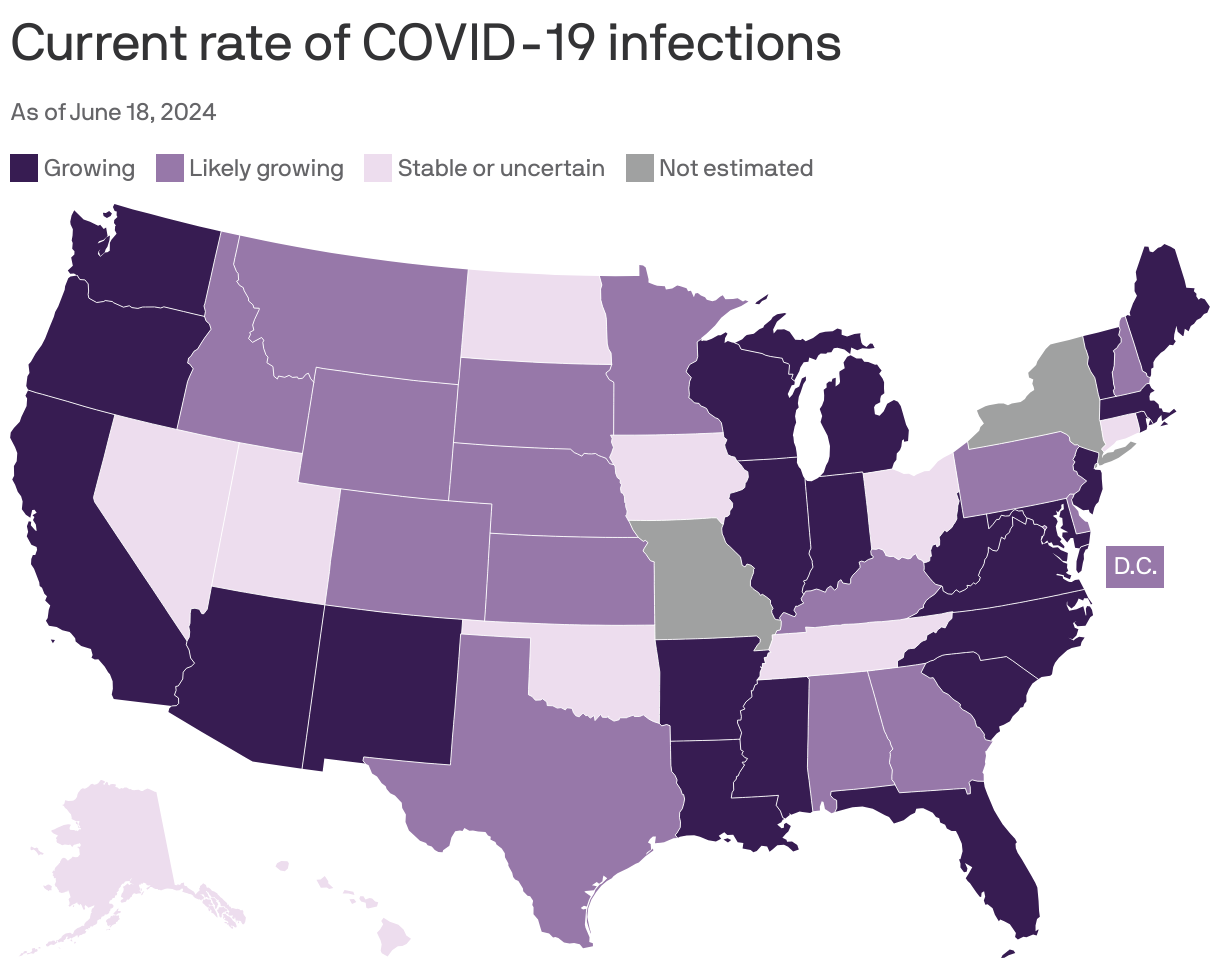
By the numbers: Cases are growing or likely growing in 39 states, and they don't appear to be declining in any state, according to the latest CDC data.
- Hospitalizations and deaths remain low.
- Wastewater surveillance, which is one of the more reliable ways of tracking COVID spread after testing dropped off, shows that COVID levels are rising in the Midwest, Northeast and South.
What we're watching: CDC vaccine advisers today will discuss who should get the updated COVID-19 shots that will be released in the fall.
5. Catch up quick
💉 The CDC narrowed its recommendation for which older adults should get RSV shots. (New York Times)
💊 The FDA issued long-awaited guidance on how drugmakers and device manufacturers can improve clinical trial diversity. (Stat)
🏛️ The Supreme Court appears ready to allow emergency abortions in Idaho while litigation continues, according to a ruling mistakenly posted early yesterday. (Axios)
🟢 A new treatment option for COPD was approved by the FDA yesterday. (Reuters)
Thanks for reading Axios Vitals, and to health care editor Jason Millman and copy editor Matt Piper. Please ask your friends and colleagues to sign up.
Sign up for Axios Vitals