
Axios Vitals

December 12, 2024

Hello, Thursday! Today's newsletter is 997 words or a 4-minute read.
1 big thing: How NIH pick may upend the agency
President-elect Trump's nominee to lead NIH has drawn scorn for his views on herd immunity and COVID, but Jay Bhattacharya's arrival would put a renewed focus on why a research institution with a nearly $48 billion budget doesn't have more breakthroughs.
Why it matters: The controversial Stanford professor could rattle the scientific establishment and turf-conscious lawmakers in Congress, but also satisfy skeptics' calls for a serious look under the hood at how NIH works.
Catch up quick: Trump last month nominated Bhattacharya, a Stanford University health economist, to run the NIH and its nearly 19,000 employees across 27 institutes and centers.
- Bhattacharya was a polarizing figure during the pandemic, criticizing COVID-19 lockdowns and vaccine mandates, and pushing the idea of protecting vulnerable populations like the elderly while letting others resume their lives.
- Ex-NIH director Francis Collins dismissed it as fringe thinking and a diversion from mainstream science. He and others said it was dangerous.
What's received less attention is Bhattacharya's work analyzing aspects of NIH funding and calls for revamping the agency.
- He's floated the idea of setting term limits for NIH officials, reevaluating the agency's process for reviewing grant proposals and rethinking how the NIH measures success so it can take on more high-risk, high-reward research.
- He and his collaborators have suggested the NIH should double down on novel and incremental research in basic science that the private sector doesn't have an incentive to invest in.
- But the agency, as a taxpayer-supported institution, still is under pressure to deliver results.
What we're watching: Any changes could be slow in coming since the NIH director doesn't have the undisputed final word.
- Committees at the NIH and across agencies are bound by the Federal Advisory Committee Act, or FACA, of 1972.
- Changes instituted under former President George W. Bush's NIH director Elias Zerhouni in 2006 took an act of Congress.
2. Rage over insurers could spoil industry outlook
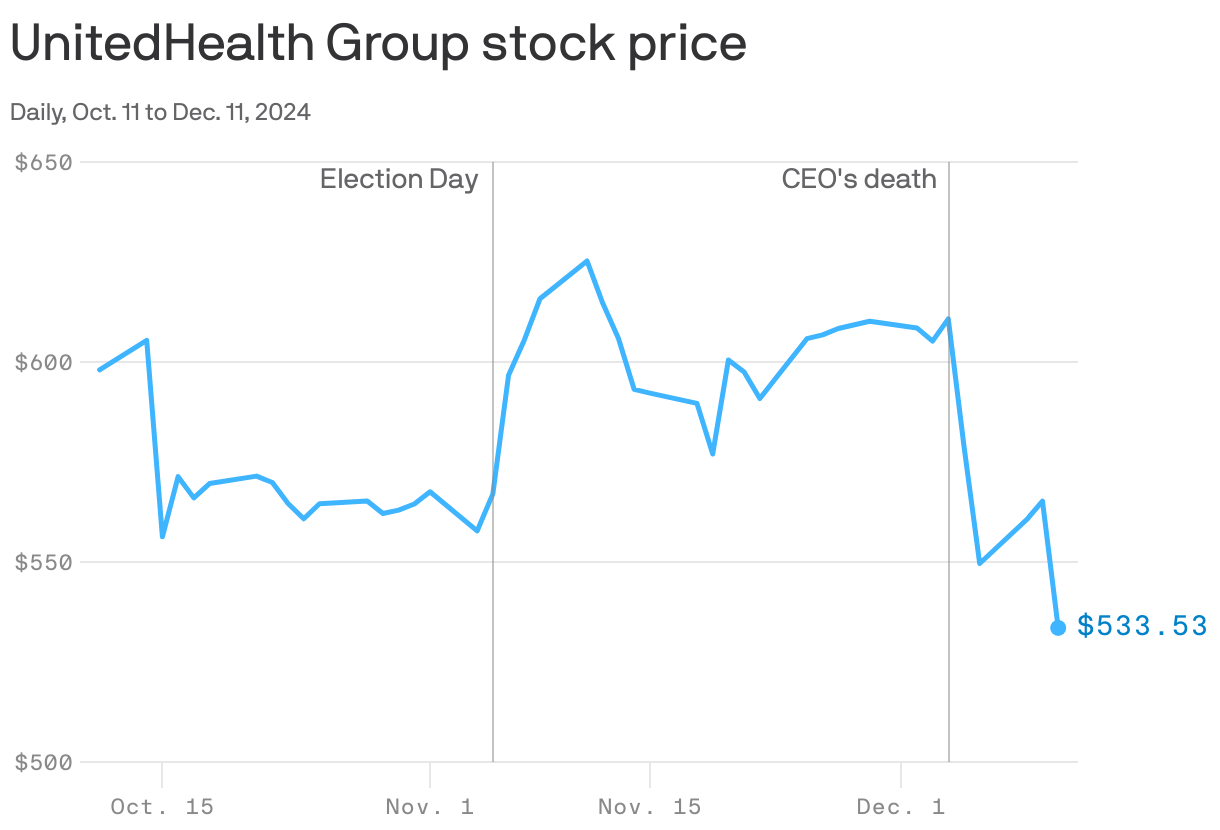
The vitriol directed at health insurers following the killing of UnitedHealthcare CEO Brian Thompson could prompt more scrutiny of an industry thought to be facing a positive regulatory outlook in the second Trump administration.
The big picture: Parent UnitedHealth Group's plummeting market value this week suggests investors fear a regulatory crackdown in response to the public outcry over coverage denials and corporate indifference.
- Lawmakers have focused recently on the prior authorization process and instances in which insurers used AI to deny coverage. But a large-scale push to change the industry's business practices seems far-fetched.
Where it stands: Shares of parent UnitedHealth Group have declined more than 12% in the last five days.
- Shares of other carriers including Cigna and Humana also fell this week.
- "[W]ith public sentiment apparently so low, it is possible that regulators may feel emboldened to make bigger changes than they would have prior to this event," Julie Utterback, senior equity analyst at Morningstar, said in an email to Axios.
Flash back: UnitedHealth Group's stock surged in the days following President-elect Trump's re-election to the White House.
- Republicans have historically favored privately run health insurance and lighter regulation, to the benefit of health insurers operating in the commercial market and Medicare Advantage.
But the public fury directed at health insurance companies in the wake of Thompson's killing, combined with a growing populist wing of the Republican party, could shift the tenor.
3. GLP-1s could test Musk-RFK Jr. relationship
Elon Musk — tapped to lead President-elect Trump's government efficiency effort — appears bullish about the way weight-loss drugs could help could help Americans live longer and better.
- But that may not pass muster with Trump's pick to lead HHS.
Why it matters: Musk's comments up the ante on how handle coverage of the wildly popular drugs.
- Last month, the Biden administration proposed requiring Medicare and Medicaid to cover anti-obesity drugs. But the incoming Trump administration could reverse course, in the belief espoused by HHS secretary-designate Robert F. Kennedy Jr. that coverage amounts to a sop to pharma.
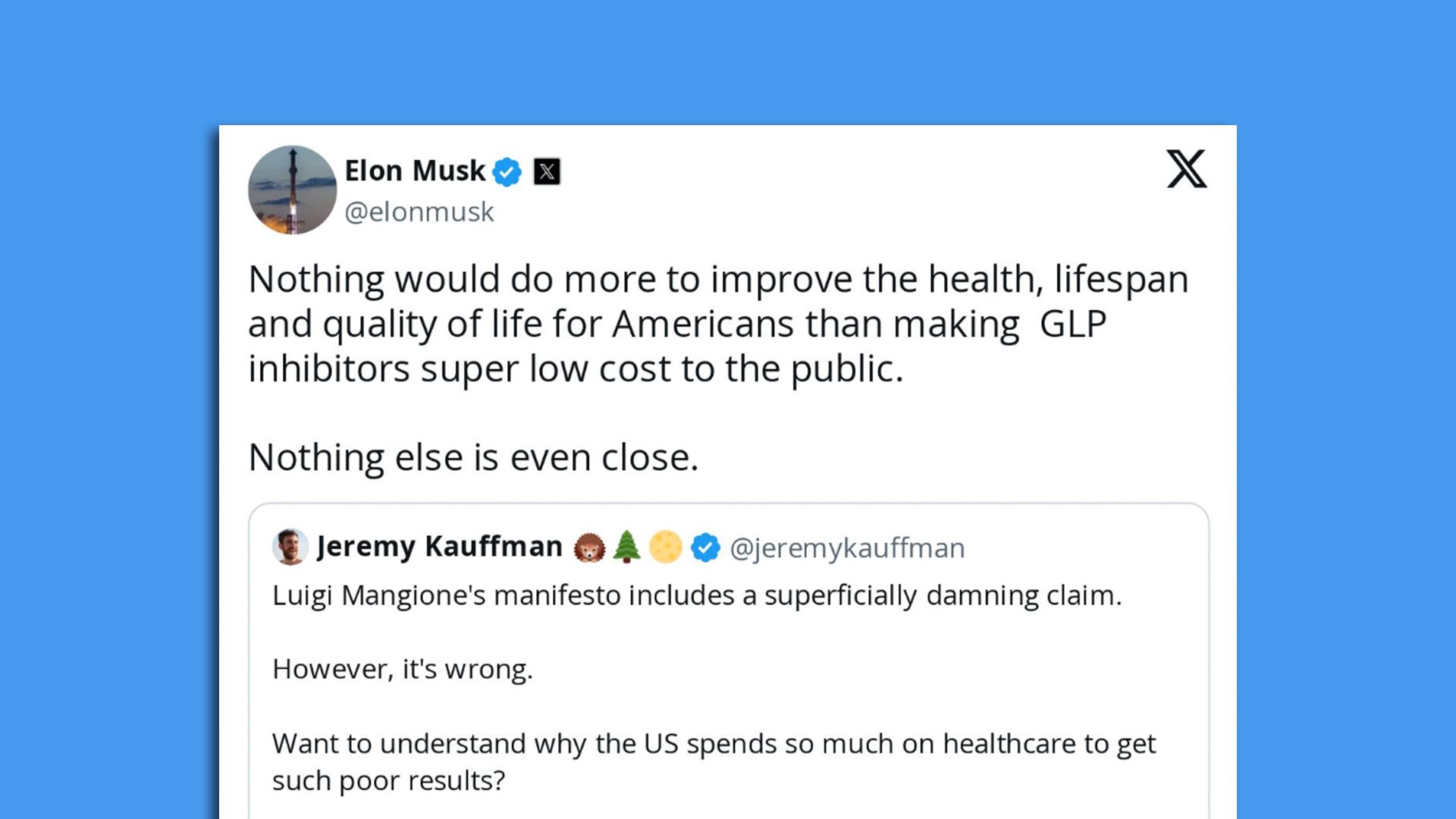
What they're saying: "Nothing would do more to improve the health, lifespan and quality of life for Americans than making GLP inhibitors super low cost to the public. Nothing else is even close," Musk posted on X on Wednesday.
- His comment was in response to another user disputing statements by the man accused of shooting UnitedHealthcare's CEO about high health care costs.
- Musk previously posted about using Novo Nordisk's GLP-1 Wegovy himself.
What we're watching: Such sentiments could set up the first potential test for Musk's relationship with Kennedy, who has said government funding would be put to better use addressing the root causes of obesity.
4. Leave the meat, eat the beans, experts urge
Americans should eat less meat and cut back on saturated fats, while upping their intake of fiber-rich legumes, fruits and vegetables, according to new recommendations by a panel of nutrition experts.
Why it matters: The fresh recommendations build on existing evidence that foods like red meat, and the overconsumption of salty and sugary foods, can be linked to health risks.
- More than half of American adults struggle with conditions like diabetes, obesity and cardiovascular disease — for which unhealthy diets are a risk factor, according to the introduction to the new Scientific Report from the 2025 Dietary Guidelines Advisory Committee.
The big picture: The recommendations will help inform HHS and the USDA as they craft the 2025-2030 Dietary Guidelines for Americans, which are set to be published late next year.
- But the new report did not take a stance on consuming ultra-processed foods, which studies have shown can be linked to adverse health effects, prompting an outcry from some health experts, the Washington Post reported.
5. Catch up quick
🚬 The Biden FDA made a last-ditch move to slash nicotine levels in cigarettes, submitting a proposal to the White House with just weeks left in the administration. (NYT)
💊 Eli Lilly CEO David Ricks offered thoughts on how the Trump administration will approach drug costs and regulation after a meeting at Mar-a-Lago. (Fierce Pharma)
📄 Using an obscure part of the tax code, billionaires avoided paying Medicare tax despite earning huge amounts from their companies. (ProPublica)
Thanks for reading Axios Vitals, and to senior health care editor Adriel Bettelheim, managing editor Alison Snyder and copy editor Matt Piper. Please ask your friends and colleagues to sign up.
Sign up for Axios Vitals


/2024/12/12/1733961644375.gif?w=3840)