Health insurer stocks tumble as customers rage

Add Axios as your preferred source to
see more of our stories on Google.
The vitriol directed at health insurers following the killing of UnitedHealthcare CEO Brian Thompson could prompt more scrutiny of an industry thought to be facing a favorable regulatory outlook in the second Trump administration.
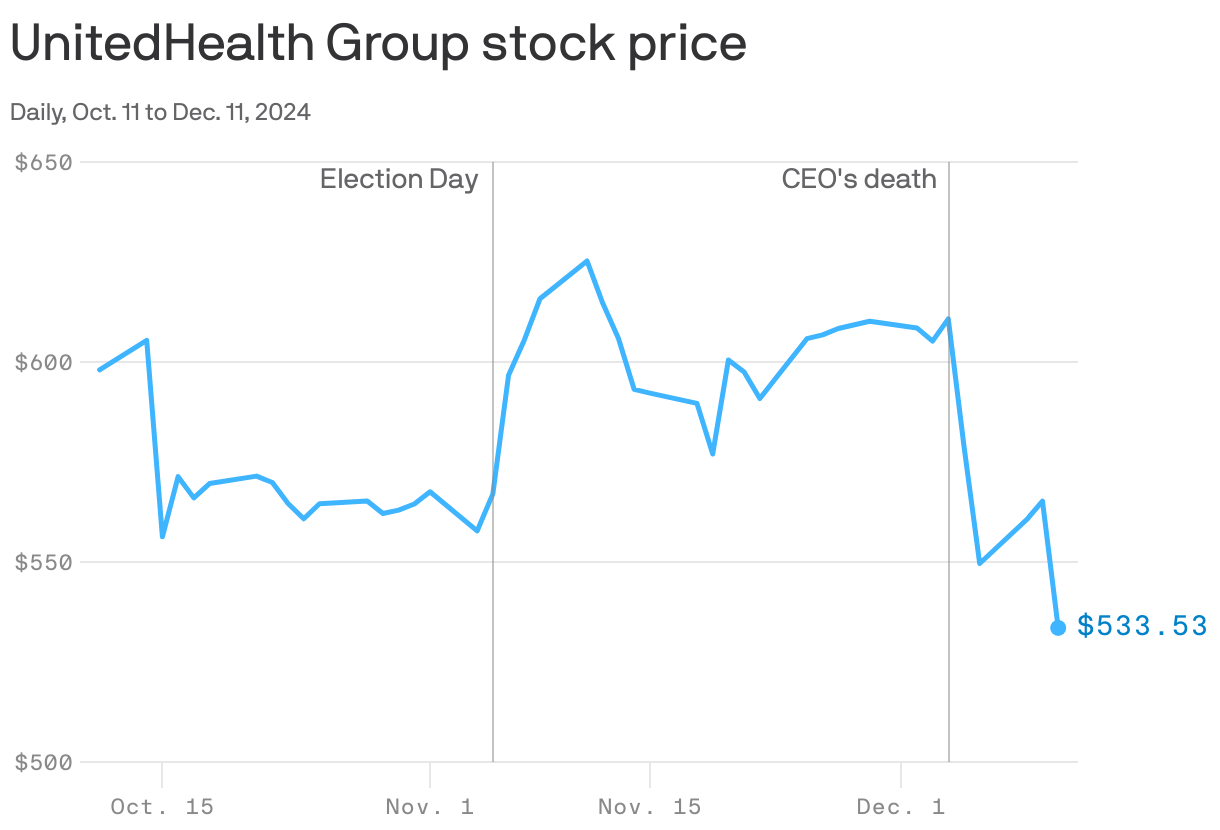
The big picture: Parent UnitedHealth Group's plummeting market value this week suggests investors fear a regulatory crackdown in response to the public outcry over coverage denials and corporate indifference.
- Lawmakers have focused recently on the prior authorization process and instances in which insurers used AI to deny coverage. But a large-scale push to change the industry's business practices seems far-fetched.
Where it stands: Shares of parent UnitedHealth Group have declined more than 12% in the last five days.
- Shares of other carriers including Cigna and Humana also fell this week.
- "[W]ith public sentiment apparently so low, it is possible that regulators may feel emboldened to make bigger changes than they would have prior to this event," Julie Utterback, senior equity analyst at Morningstar, said in an email to Axios.
- "Obviously, there's a lot of uncertainty around that, especially given the partisanship that typically rules in Washington," she added.
Flash back: UnitedHealth Group's stock surged in the days following President-elect Trump's re-election.
- Republicans have historically favored privately run health insurance and lighter regulation, to the benefit of health insurers operating in the commercial market and Medicare Advantage.
But the public fury directed at health insurance companies in the wake of Thompson's killing, combined with a growing populist wing of the Republican party, could shift the tenor.
- Members of Congress have condemned Thompson's killing and reactions valorizing Luigi Mangione, who has been charged with the murder. However, some have also acknowledged Americans' frustration with their insurers.
- Sens. Josh Hawley (R-Mo.) and Richard Blumenthal (D-Conn.) sent a letter Tuesday to Elevance, the parent company of Anthem, asking for an explanation of a widely panned and now reversed policy to place time caps on reimbursement for surgical anesthesia services.
The insurance industry has condemned the outcry against it and portrayed its mission as making coverage more affordable while helping people navigate the health system.
- And surveys have shown many Americans are satisfied with their own coverage but harbor suspicion and resentment toward the insurance industry as a whole. Satisfaction is lower among people with worse health.
Between the lines: The health insurance industry isn't the only sector contributing to the complexity and cost of the U.S. health care system, said Howard Forman, director of Yale School of Medicine's MD/MBA program.
- "There's no free lunch here," he said. "If we got rid of plan denials, costs would go up. If we really want to do anything, it requires nationalizing everything, and you can sort of guarantee the political will is not there to do that."
- Trump also knows firsthand the difficulty of changing the health care system, after a failed effort to repeal the Affordable Care Act during his first term.
- Trump continues to bash ACA coverage, but his comments suggest major reform isn't a priority. He repeated on Sunday that he has "concepts of a plan" for how to improve coverage.
The bottom line: "At the very least, it has been enlightening to see the public's view of the industry, and there may need to be a bigger focus by industry players on how end users are treated" in the U.S. health care system, Morningstar's Utterback said, adding that change could come through regulation or companies' internal initiatives.
- A 2010 book criticizing the health insurance industry has shot up to No. 2 on Amazon's nonfiction bestseller list, Axios' Sareen Habeshian reported.
