Axios Twin Cities

August 07, 2026

Welp! We know it's barely August, but back-to-school season is already underway in parts of the metro.
- Some Stillwater students start in just 10 days, and a late Labor Day has at least a dozen more Twin Cities districts breaking with tradition and starting early.
π With shopping lists and first-day pics looming, we're a special edition on trends shaping classrooms across the country.
π¦οΈ The weather remains summer-like, with a high of 84 and a chance of thunderstorms this afternoon, NWS says.
π Happy birthday to our members celebrating today through Sunday: Anna Ourada, Dawn Paulsen, Lynne Walker, Justin Ropella, David Bjork and Jonathan Wittig.
Today's newsletter is 1,091 words β a 4-minute read.
1 big thing: Surprising study on phones in class

Many Minnesota schools are joining a nationwide crackdown on student cellphone use, but a new study finds the restrictions bring mixed results.
The big picture: Schools that require students to lock away their phones during class have seen phone use decline substantially, according to the study shared by the National Bureau of Economic Research in April.
- Student well-being also appears to improve the longer the rules remain in place.
Yes, but: "For academic achievement, average effects on test scores are consistently close to zero," the researchers wrote.
- And they found "little evidence" those policies affect attendance, attention in class or perceived online bullying.
State of play: Minnesota doesn't have a statewide ban, but a recent law does require that districts develop a policy for the tech, and a growing number of schools are restricting phone use when class is in session.
Case in point: St. Paul Public Schools bars students districtwide from using phones in class β and some schools like Central High have opted to ban devices during lunch and passing periods, too.
- Some districts apply the same cellphone rules to all grade levelsΒ β like Stillwater's bell-to-bell ban, and Minnetonka's not-while-in-class policy.
- Many other districts, like Wayzata, Hopkins and Richfield, set more permissive rules for high schoolers than for younger students.
Between the lines: Stricter bans tend to be more popular with teachers, other academic surveys have found.
- "It's anecdotal evidence at the moment β¦ but teachers are not having to manage devices when they teach β they can just teach, and that leads to better instruction," Jenny Hill, a St. Cloud State University education researcher, told KSTP in June.
By the numbers: As of this year, roughly two-thirds of states have enacted legislation limiting student phone access, per the study.
- Nearly 5,000 schools use lockable phone pouches, according to the study.
The bottom line: Cellphone bans may still benefit students β even if they don't directly translate into higher test scores.
2. ποΈ Where families spend the most


Midwest families expect to spend close to $1,000 on back-to-school shopping this year, according to a PwC survey.
State of play: That figure β which includes clothes, tech, equipment for after-school activities, books, school supplies and other one-time purchases β exceeds the national average of $922.
What's happening: Prices are higher, classroom needs have changed and kids have more say over what families buy β including requests for pricier items.
The big picture: Total K-12 back-to-school spending could climb around 10% this year compared to last, hitting a record $43.3 billion, the National Retail Federation forecasts.
Reality check: As parents know, the spending doesn't stop once school starts.
- Households nationwide plan to spend $635 a month on recurring expenses like meals, snacks and tutoring, per PwC.
3. The Spoon: Learn from these headlines

π§ Federal immigration officials threatened to arrest Hennepin County Sheriff Dawanna Witt and charge her with witness tampering unless she gives federal agents more access to jail inmates. (N.Y. Times)
- Witt denies wrongdoing, and legal experts doubt any such charge would stick.
π Minneapolis Mayor Jacob Frey is pointing to a new city-generated analysis as evidence that MPD's soaring overtime costs are primarily driven by understaffed officer ranks and recent crises, not budget mismanagement. (WCCO)
πΆ Northeastern Minnesota businesses asked Gov. Tim Walz to reconsider his decision against calling a special legislative session on the wildfires, saying they're in desperate need of an economic relief package. (MPR News)
βοΈ Georgia Fort's attorneys are asking a federal judge to dismiss charges stemming from her presence at a January anti-ICE protest inside a St. Paul church. (KARE11)
π³οΈ A new KSTP/Survey USA poll shows close contests for the GOP gubernatorial and DFL U.S. Senate races heading into Tuesday's primary. (KSTP)
4. π School recess is back in play

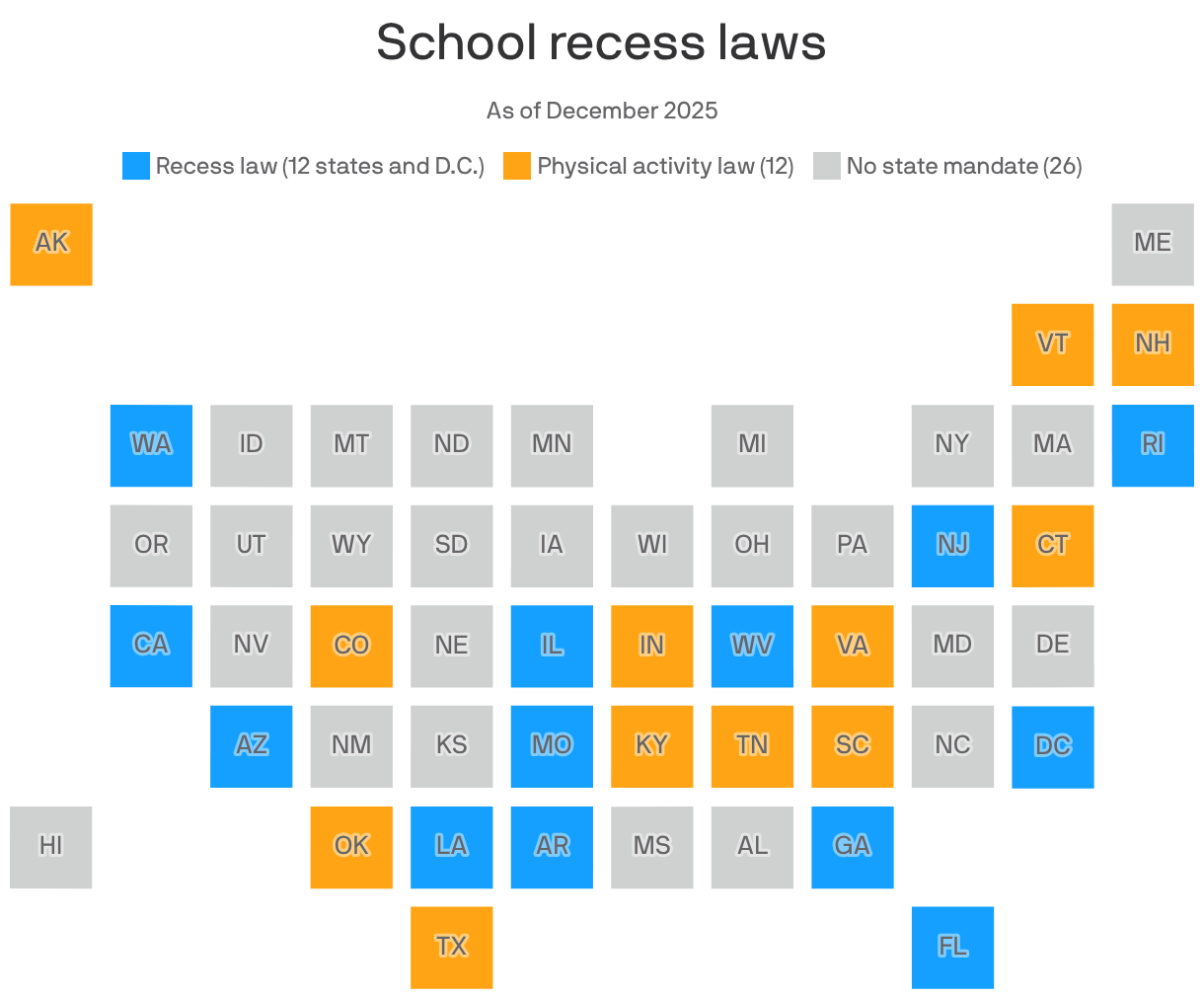
After decades of diminished recess time, nearly half of U.S. states now require it or other physical activity by law.
Why it matters: Yes, recess is literally child's play. But researchers, pediatricians and parents say it's crucial for young students' physical and mental health.
By the numbers: As of December, school recess is mandated in 12 states and D.C. Laws requiring physical activity exist in 12 states, according to Johns Hopkins research.
Zoom in: While Minnesota doesn't require recess, a 2022 "recess detention" law prohibits schools from withholding or delaying the free time as a punishment in most cases.
- Best practices for districts circulated by the Minnesota Department of Education encourage at least 20 minutes of recess for students in grades K-5.
The big picture: Unstructured play doesn't just teach social skills, but research connects it to increased classroom motivation and behavior, better school attendance, and less stress for students.
- And more physical activity could help academic performance.
What they're saying: "Recess gives you a better feeling about school. Recess refreshes you. Recess helps you feel a little bit less cynical about what's going on," psychologist Peter Gray, author of forthcoming "Restoring Childhood," tells Axios.
Catch up quick: From 2001 to 2019, weekly recess time in U.S. schools dropped by 60 minutes, education consulting company EAB found.
- One oft-cited factor for the decline: The signing of "No Child Left Behind" in 2002, which led to more time focused on reading and math testing β and less on recess.
5. π 1 short-answer question to go
As the opening bells near, we want to take a closer look at the issues impacting Minnesota schools and their students.
So we thought we'd pose a question to all the parents, teachers and administrators out there: What questions and concerns do you have about the state of K-12 education in Minnesota?
- We'd also love to hear your tips and stories about schools and educators getting things right or going above and beyond to make a difference in students' lives!
Hit reply or drop us a line at [email protected] to share your thoughts.
π΄ Torey's son is pumped for kindergarten, mostly because it means an end to "boring" preschool nap time.
π Kyle still has stress dreams about missing final exams.
π Audrey and Nick are on sabbatical.
Today's newsletter was edited by Sami Sparber, Carly Mallenbaum and Larry Graham.
Sign up for Axios Twin Cities