Axios from Tel Aviv
April 13, 2022

Welcome back to Axios from Tel Aviv.
- This week's edition (1,997 words, 7½ minutes) comes to you from Ankara, where I just attended a briefing with Turkish Foreign Minister Mevlüt Çavuşoğlu.
- It also covers the latest from the occupied West Bank city of Jenin, a U.S. request for help finding Austin Tice, and Secretary of State Tony Blinken's apology to Abu Dhabi Crown Prince Mohammed bin Zayed.
1 big thing: Turkish FM urges Israel to "respect international law"
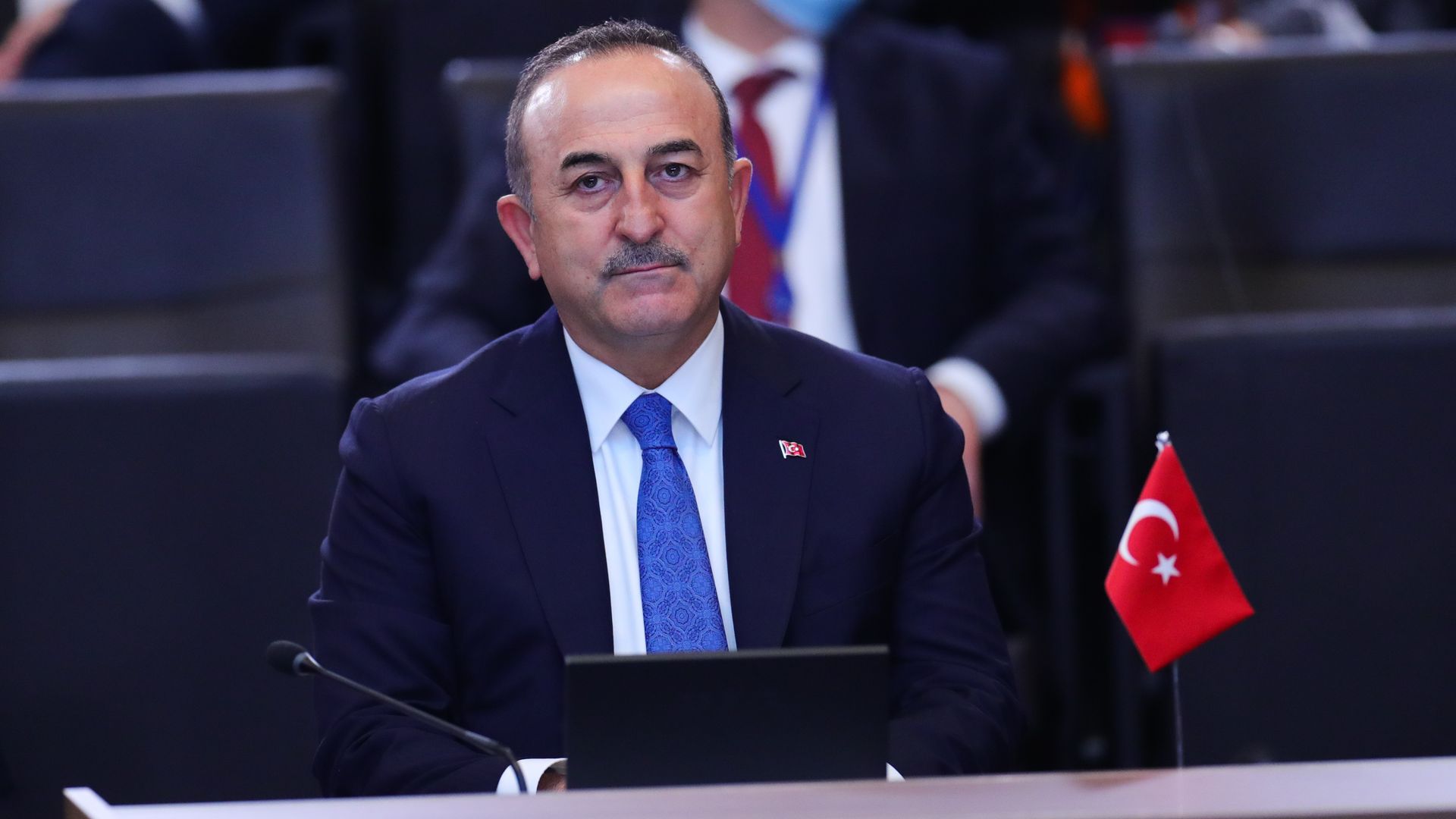
Mevlüt Çavuşoğlu. Photo: Zheng Huansong/Xinhua via Getty Images
ANKARA, Turkey — Turkish Foreign Minister Mevlüt Çavuşoğlu told Israeli reporters this morning that "sustainable relations" between Israel and Turkey will require Israel to "respect the international law on the Palestinian issue."
Why it matters: Israeli-Turkish relations were frozen for most of the past 13 years, but are now beginning to improve. Past crises in the relationship were almost all linked to the Israel-Palestinian conflict — particularly flare-ups in Gaza — and Çavuşoğlu warned that such events could also undermine the current normalization process.
The backstory: Turkish President Recep Tayyip Erdoğan's government initiated talks aimed at mending relations after Israel's new government took office last year.
- Israeli President Isaac Herzog visited Ankara last month, becoming the first Israeli president to do so in 15 years. At a summit with Erdoğan, both leaders pledged to open a new chapter in the relationship.
- They also agreed to form a "conflict resolution" mechanism to discuss differences on the Palestinian issue in private and avoid further public disputes.
In this morning's briefing with five Israeli reporters, Çavuşoğlu said the current Israel-Turkey dialogue has been constructive and momentum is growing.
- After many ups and downs, Çavuşoğlu said, Turkey now wants to build a more sustainable relationship with Israel.
- Nevertheless, he said the problems that still exist between the countries are connected to the Israeli-Palestinian conflict and what he called "violations of international law" by Israel.
- He added that Turkey wants a dialogue with Israel on regional issues like Iran and Syria and a positive agenda in areas like trade, investment, energy and tourism. (See No. 5 below.)
What to watch: Çavuşoğlu stressed that Turkey calls for restraint by Israel and the Palestinians during Ramadan and said he hopes recent terror attacks by Palestinians against Israelis and incidents in which the Israeli military has killed Palestinian civilians won't lead to further escalation.
What's next: Çavuşoğlu is likely to visit Israel in late May, according to a senior Israeli official. That would be the first visit by a Turkish foreign minister in more than a decade.
2. Scoop: Blinken's apology to MBZ
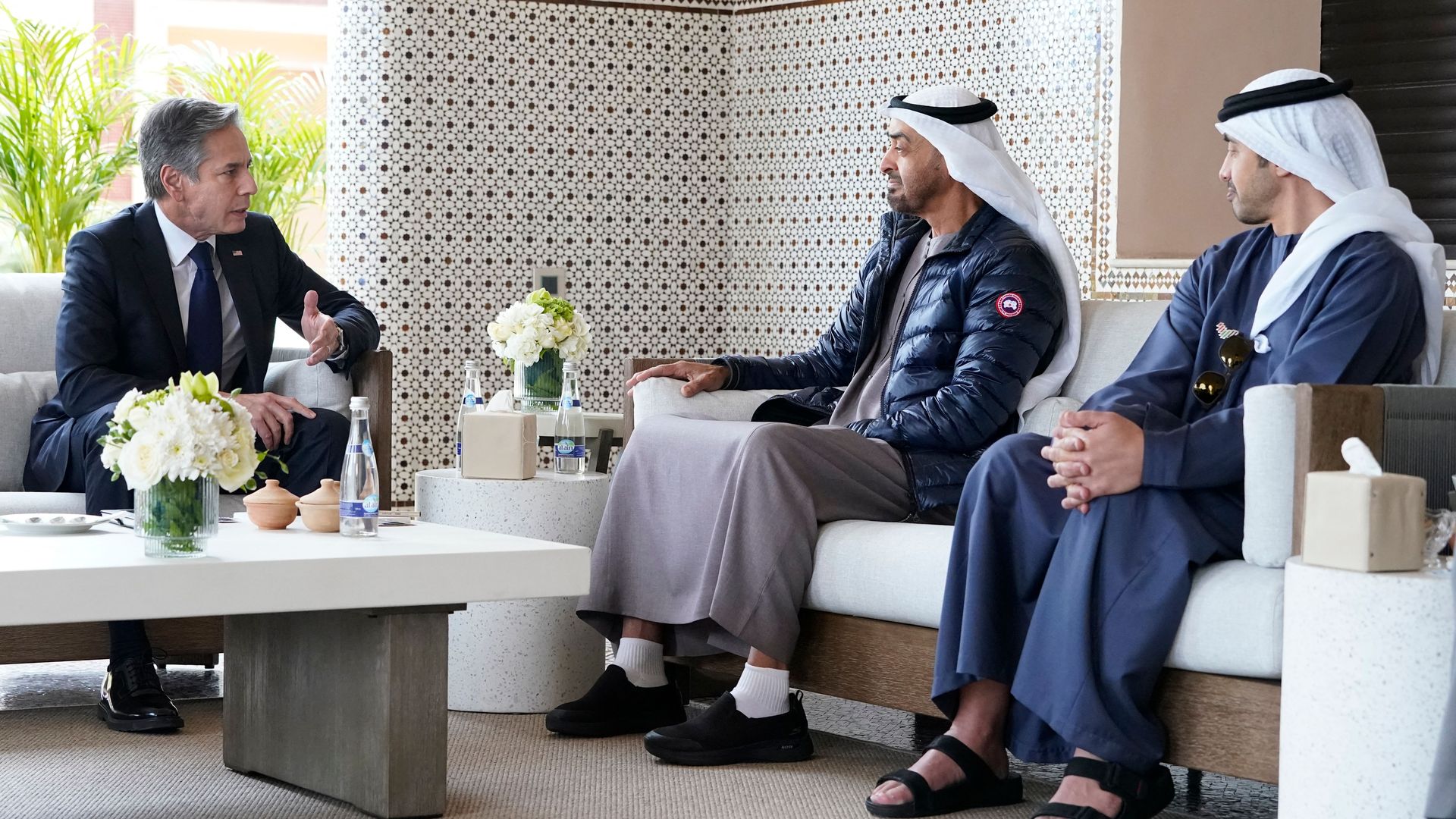
Blinken meets with Abu Dhabi Crown Prince Mohammed bin Zayed at his residence in Rabat, Morocco. Photo: Jacquelyn Martin/AFP via Getty Images
Secretary of State Tony Blinken apologized to Abu Dhabi Crown Prince Mohammed bin Zayed last month for the slow U.S. response to January's Houthi attacks against the United Arab Emirates, two sources briefed on the issue told me.
Why it matters: Blinken’s apology helped ease tensions between the UAE and the Biden administration.
Driving the news: The Emiratis were disappointed with the U.S. response to the Houthi attacks, which they saw as too weak and too slow, while the Biden administration was subsequently disappointed by the Emirati response to Russia's invasion of Ukraine.
- According to the two sources, Blinken admitted during his meeting with MBZ in Morocco that the Biden administration took too long to respond to the attacks and said he was sorry for that.
What they're saying: A senior State Department official declined to speak about Blinken’s private conversation, but didn’t deny this account.
- “The Secretary made clear that we deeply value our partnership with the UAE and that we will continue to stand by our partners in the face of common threats," the senior State Department official said.
- Yousef Al Otaiba, the UAE ambassador to Washington, told me last month that the Blinken-MBZ meeting helped “move the relationship between the UAE and the U.S. back on the right track."
3. Jenin at center of escalation in Israeli-Palestinian conflict
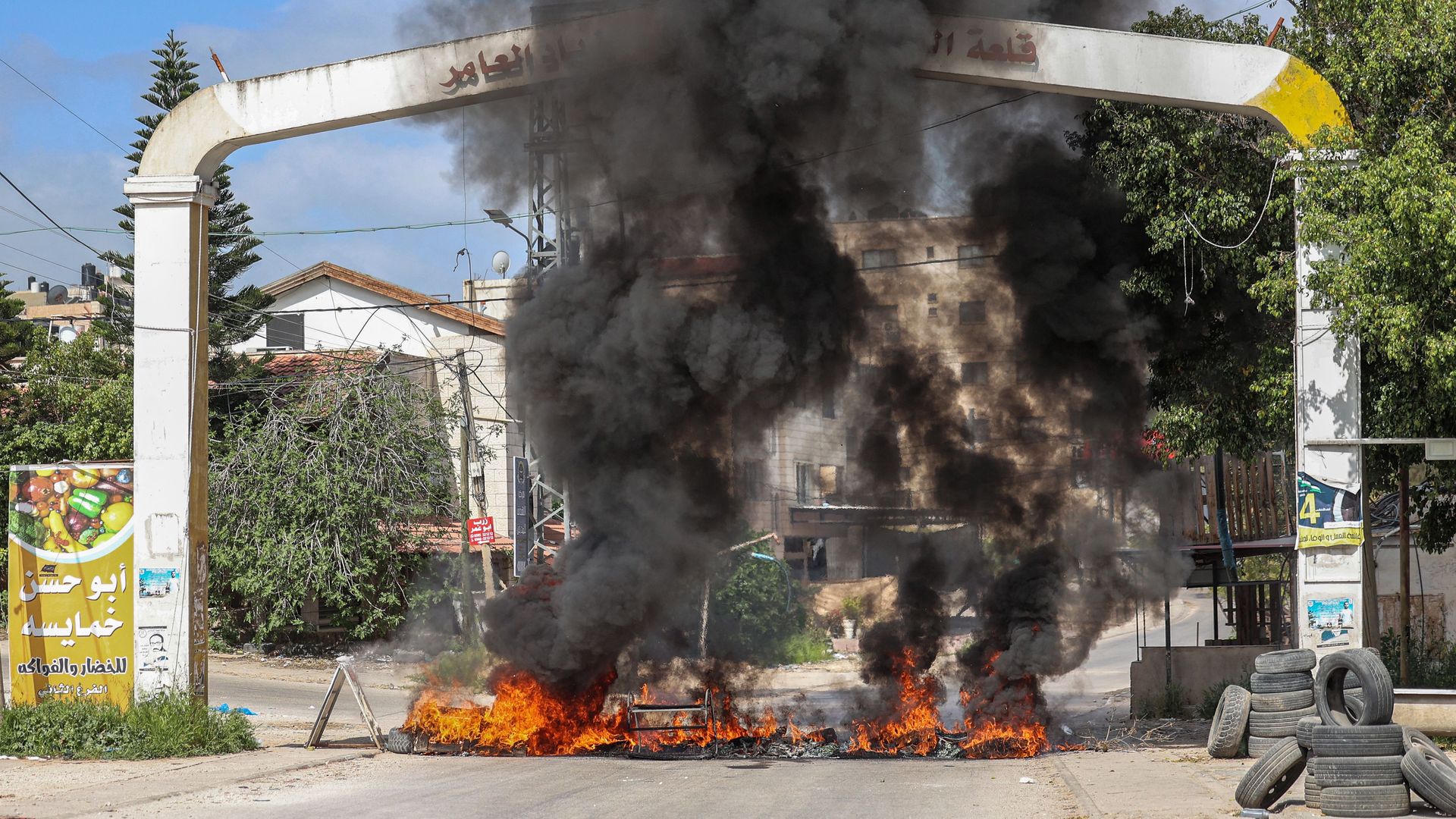
Tires are set aflame at an entrance to the Palestinian refugee camp of Jenin in the occupied West Bank on April 9. Photo: Jaafar Ashtiyeh/AFP via Getty Images
The city of Jenin in the northern occupied West Bank has become the epicenter of the latest escalation in the Israeli-Palestinian conflict.
Why it matters: Israeli and Palestinian Authority officials have expressed concerns that if the situation escalates even more in Jenin, it could spill over to the rest of the West Bank and could lead to a flare-up in Gaza.
Flashback: During the second intifada in the early 2000s, many suicide bombers who attacked places in Israel came from Jenin. Palestinians saw the city as the "capital of the resistance."
- Jenin was controlled by armed militias affiliated with Fatah, Hamas, Islamic Jihad and other Palestinian factions.
- The refugee camp was the scene of intense fighting at the time, and the Israeli military destroyed hundreds of homes.
In the years after the second intifada, the city was rebuilt and the level of violence dramatically decreased following Israeli military operations, better control and governance by the Palestinian Authority and its security forces, and a series of agreements between the PA, Israeli Shin Bet security agency and the militia affiliated with the Palestinian Fatah party.
- By 2018, Jenin became one of the most prosperous Palestinian cities in the West Bank, with much of its economy reliant on Palestinian citizens of Israel who visit the area for shopping and leisure.
Yes, but: Over the past three years, the PA was weakened and it decreased its security coordination with Israel due to policies of the Netanyahu government and Trump administration.
- The COVID-19 pandemic exacerbated the situation. Lockdowns led to an economic crisis, and Hamas and Islamic Jihad filled the vacuum created in Jenin as Palestinian security forces turned their attention to enforcing COVID restrictions and the Israeli military decreased its operations in the area.
- At the end of last year, the PA tried to regain control of the city. Palestinian President Mahmoud Abbas replaced many senior officials in the area, but the security operation wasn’t enough to restore the rule of law.
The latest: The situation has escalated in Jenin since a wave of attacks in Israel began last month. Fourteen people in Israel have been killed in four terror attacks since March 22. At least 10 Palestinians have been killed by Israeli forces in the same time period.
- Two of the attacks on Israelis — one in Bnei Brak and another in Tel Aviv — were committed by Palestinians from the Jenin area. The other two were claimed by ISIS.
- Israeli security services also killed three Palestinians in Jenin who they said intelligence suggested were planning to commit an attack on Israelis.
The Israeli military has dramatically increased its operations in Jenin in the last few months, and even more so after the attacks.
- Israeli forces have killed at least eight Palestinians in the city since early March, most of them during armed fire fights, and arrested dozens of others.
- Palestinian armed militias in Jenin have started coordinating their actions.
- PA officials in the city, including the governor and heads of the security services there, paid their respects to the family of the Palestinian who killed three civilians in Tel Aviv. The governor stressed he doesn't consider him a terrorist. “Palestinians are not terrorists. Palestinians want to free themselves from occupation,” he said.
- Abbas condemned the attacks, saying, the “killing of Palestinian and Israeli civilians only leads to a further deterioration of the situation, as we are all striving for stability.”
At the same time, Israel has also placed restrictions on Jenin.
- Palestinian workers from the city are still allowed to enter Israel, but the Israeli government on Saturday banned Palestinian citizens of Israel from entering Jenin — a move likely to harm the area's economy, especially during Ramadan. Palestinians have described the restrictions as "collective punishment."
- The Israeli Security Cabinet also decided to rebuild the separation barrier in the Jenin area to block illegal entry into Israel.
What to watch: Israeli Minister of Defense Benny Gantz said he expects the PA to take more action in Jenin.
- But many Israeli officials told me the PA’s ability to do this is very limited.
- Omer Bar Lev, the Israeli internal security minister, said this week that Israel should prepare a contingency plan for a wide-ranging military operation in Jenin if the wave of attacks doesn’t stop.
- Hamas leader in Gaza Yahya Sinwar held a meeting with other Palestinian factions to discuss a possible response to the escalation in Jenin. After the meeting, the groups said they were ready to respond if necessary, but did not issue an ultimatum to Israel.
4. U.S. asked Israel for help locating American Austin Tice
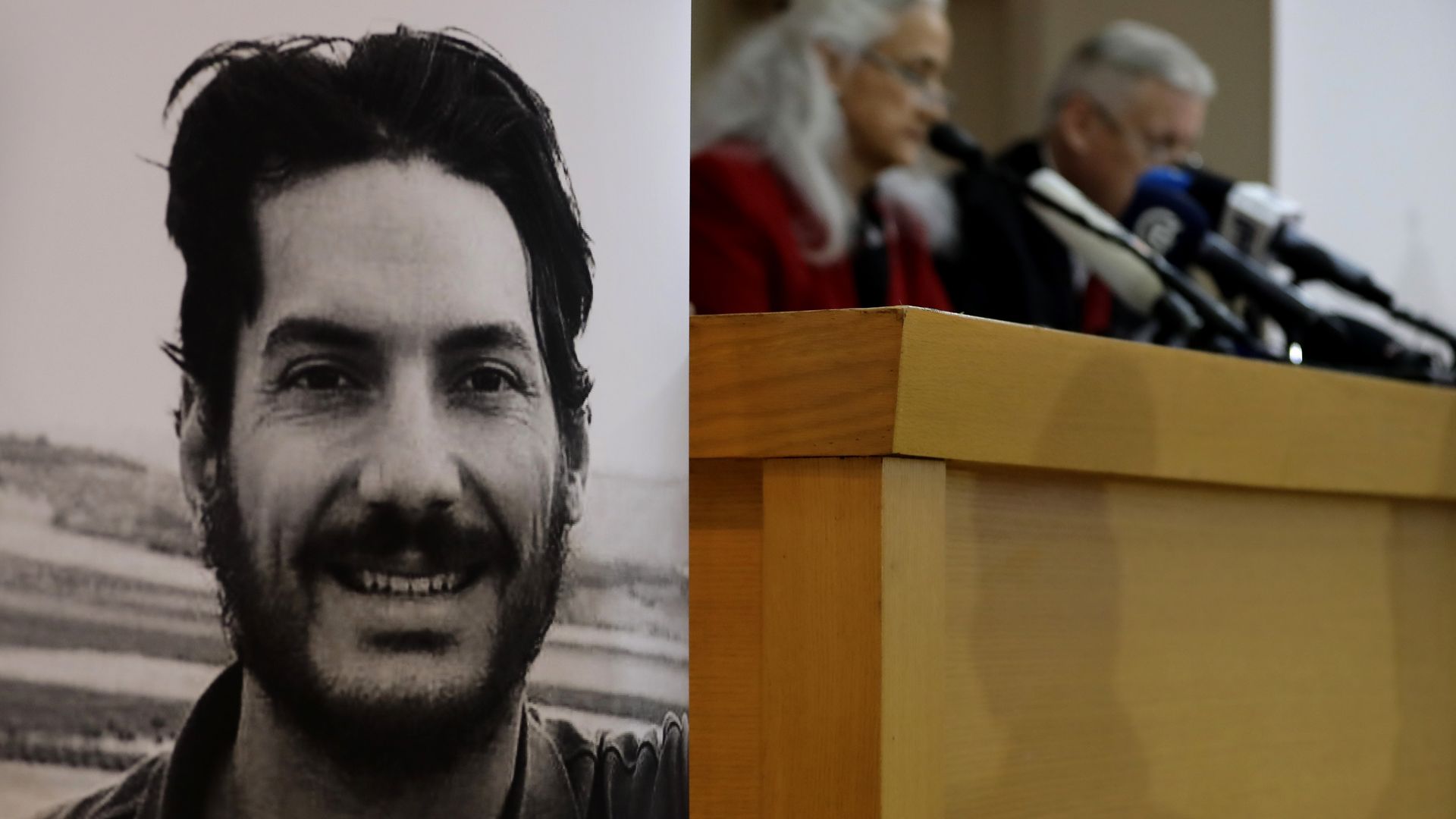
A portrait of U.S. journalist Austin Tice is seen as his parents, Marc and Debra Tice, give a press conference in Beirut on Dec. 4, 2018. Photo: Joseph Eid/AFP via Getty Images
State Department hostage envoy Roger Carstens asked Israel for help locating American journalist Austin Tice, who was kidnapped in Syria in 2012, during a recent visit to Israel, two Israeli sources tell me.
Behind the scenes: Last week, Carstens met with Israel's hostage team, which includes negotiators and experts from agencies including military intelligence and Mossad. Like the U.S, Israel does not have diplomatic relations with Syria, but Israel's intelligence services monitor the neighboring country closely.
- Carstens asked the Israeli team to assist with intelligence gathering and for new ideas on how to proceed with the case.
The backstory: Tice, a freelance journalist who worked for outlets including McClatchy, the Washington Post and CBS, is one of the longest-held and most high-profile American hostages overseas. The U.S. says the Syrian government is responsible for Tice's fate, though the Assad regime has never acknowledged holding him.
- The Trump administration also requested Israel's assistance when Robert O'Brien was hostage envoy from 2018 to 2019, the Israeli sources say, but the effort produced no progress and very little new information.
- Efforts to bring Tice home have yielded virtually no progress. This August will mark 10 years since his kidnapping, and the U.S. government has made no recent updates as to where in Syria he might be or whether he is known to be alive.
Flashback: Former President Trump made extensive efforts to free Tice and even sent a letter to Syrian President Bashar al-Assad in March 2020 offering to speak directly.
- Trump also sent CIA officials and other envoys to Damascus for meetings with Syrian intelligence chief Ali Mamlouk about Tice’s case, also without success.
What they're saying: "Austin’s release and return home are long overdue. We call on Syria to help release Austin Tice and every U.S. citizen held hostage in Syria," a State Department spokesperson told me, adding, "We will pursue all avenues to bring Austin home."
- The spokesperson said Secretary of State Tony Blinken is personally dedicated to seeking the safe release of U.S. hostages and wrongful detainees and he believes it is within Assad’s power to free Tice or persuade his captors to let him go.
- The Tice family declined to comment.
5. View from Ankara: Turkey and U.S. work to repair relations
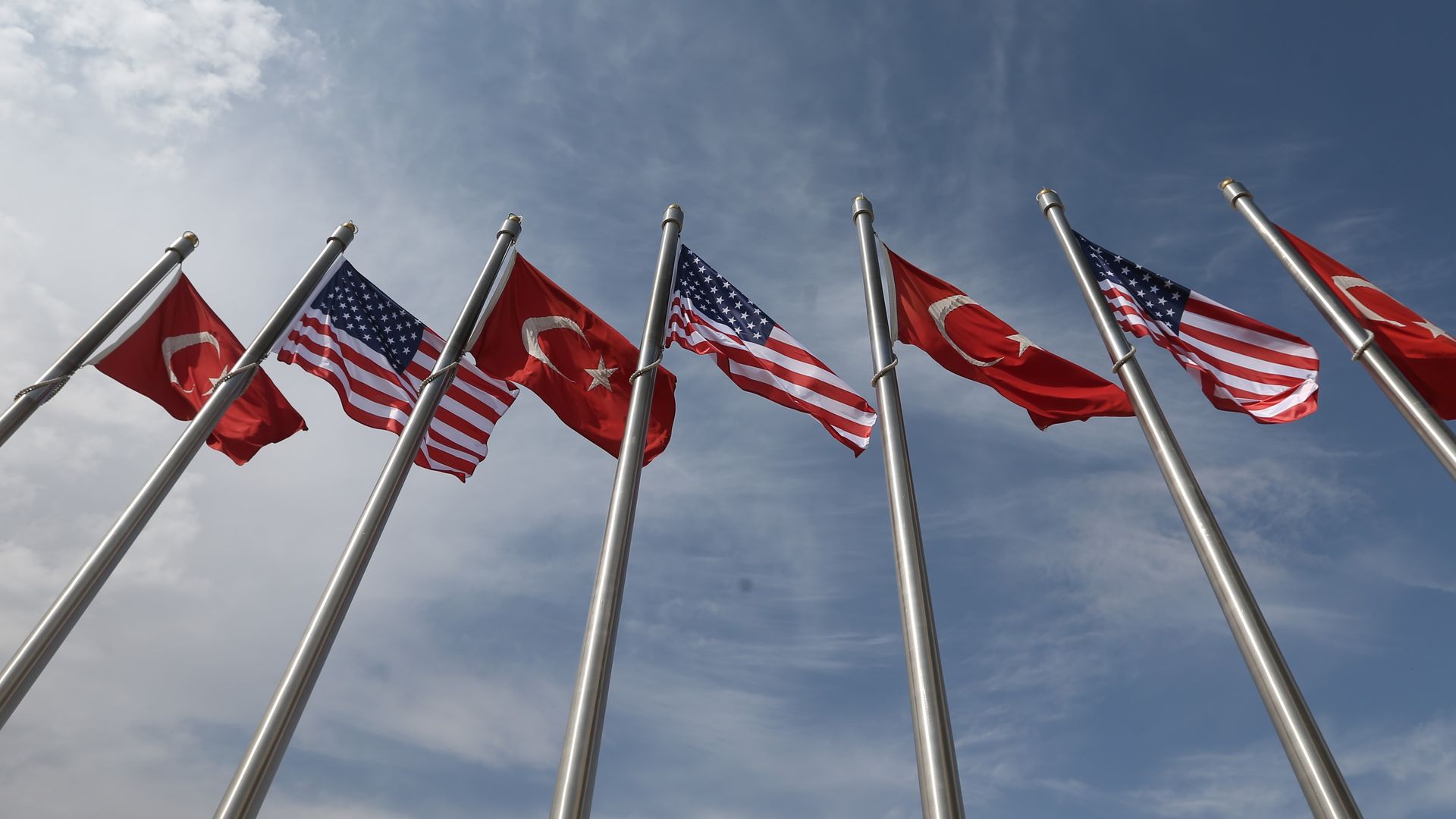
Turkey and U.S. flags in Ankara. Photo: Evrim Aydin/Anadolu Agency via Getty Images
Turkey and the U.S. recently announced the launch of a "strategic mechanism" aimed at repairing relations and unlocking potential cooperation in areas of defense, the economy and counter-terrorism, Menekse Tokyay writes for Axios from Ankara.
Why it matters: Relations between the two NATO allies have been strained in recent years over a number of issues, including Turkey’s purchase of Russia's S-400 missile defense systems, U.S. support for the Kurds in Syria and human rights issues.
Driving the news: U.S. Under Secretary of State Victoria Nuland met with Turkish Deputy Foreign Minister Sedat Önal in Ankara last week to "review topics of mutual interest." Nuland also met with President Recep Tayyip Erdoğan’s senior adviser Ibrahim Kalin.
- Nuland's visit was followed by that of U.S. Department of Commerce Under Secretary Marisa Lago, who held meetings to "advance the U.S.-Turkey commercial relationship and promote clean and secure energy alternatives in the region."
Under the rapprochement process with Washington, Ankara said it also prioritized its procurement request for new F-16 jets and modernization kits from the U.S. to upgrade its air force.
- Turkey’s top defense industry officials were sanctioned in December 2020 over the S-400 acquisition, and Turkey was also expelled from the F-35 fighter jet program.
- The State Department recently submitted a letter to Congress supporting the sale of F-16 fighter jets to Turkey.
Between the lines: The launch of the "strategic mechanism" comes as Turkey, which shares borders with Russia and Ukraine in the Black Sea, acts as a mediator between Kyiv and Moscow.
- The Ukrainian crisis helped Turkey to get closer to the West, but long-standing tensions remain over the country's foreign policy and democratic backsliding.
The big picture: Nuland also visited Cyprus, where she stressed the importance of decreasing the region's dependence on Russian oil and gas.
- She called the proposed plan to supply Europe with natural gas from the eastern Mediterranean too expensive, saying it would be better to build alternative energy resources.
- She also called for cooperation between Turkey, Greece, Israel, Egypt and Cyprus on the transfer of liquid natural gas to Europe.