Axios Tampa Bay

February 27, 2026

π Happy FriYAY!
- Today, we bring you a special newsletter from Axios transportation correspondent Joann Muller, who breaks down why you're likely to find yourself in a Waymo robotaxi sometime soon.
π§οΈ Today's weather: Patchy fog then chance of rain showers, with a high of 80 and a low of 63.
Today's newsletter is 1,121 words β a 4-minute read.
1 big thing: Waymo speeds across America
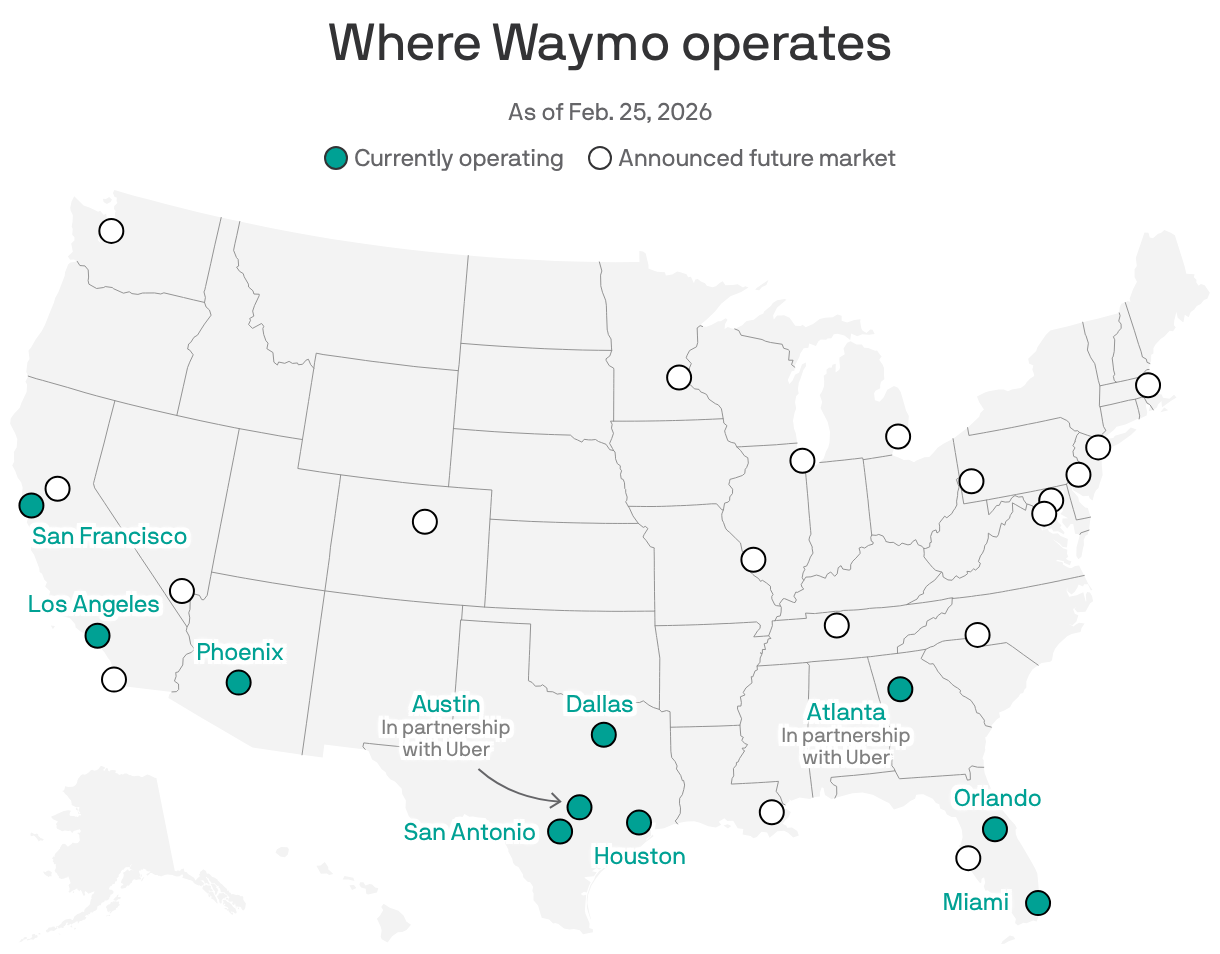
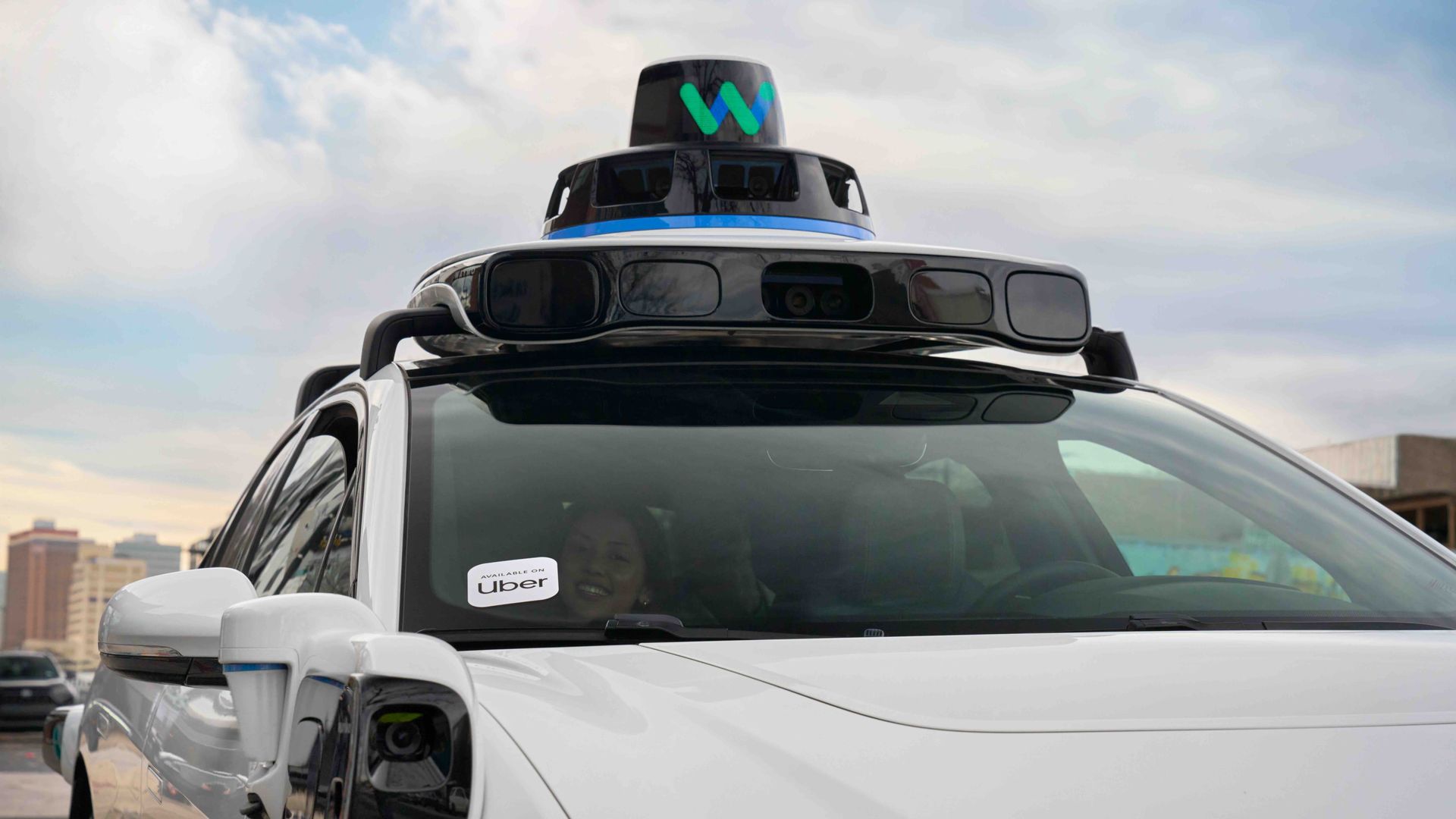
Waymo is accelerating its rollout of robotaxis in the U.S., adding four new cities in Texas and Florida as self-driving technology begins to penetrate mainstream America.
Why it matters: Armed with $16 billion in fresh capital from parent Alphabet and others, Waymo is quickly extending its lead over other players like Tesla and Amazon-owned Zoox, which are still mostly in testing mode.
The newest markets are Dallas, Houston, San Antonio and Orlando.
- The service will start slowly, with riders invited on a rolling basis until Waymo adds more cars to its fleet and scales up necessary operations like vehicle charging, service and maintenance.
Zoom in: The service is also eyeing several more markets for expansion down the line β including Tampa.
- Waymo began mapping the city last year with human-operated cars. This month, the company held a training with Tampa and Hillsborough first responders.
- A spokesperson told Axios yesterday there were no updates regarding when the service will become available to the public.
The big picture: Now in 10 cities, Waymo has doubled the number of markets it serves in a matter of months.
- It's laying the groundwork for service in at least 20 cities, and is on track to provide more than one million driverless rides per week by the end of the year.
2. Robot vs. human
A Waymo robotaxi incident outside a California elementary school in January suggests an AI brain would react faster than a human, but it's not that simple.
The big picture: This incident fits into a much larger debate about whether autonomous vehicles can match β or exceed β the safety of human drivers.
- People fear self-driving cars, yet nearly 40,000 people are killed each year in traffic accidents involving human drivers.
Catch up quick: The National Highway Traffic Safety Administration is investigating after a Waymo robotaxi struck a child who ran across the street from behind a double-parked SUV.
- Police said first responders evaluated the student, with her parent present, and did not report any injuries.
The intrigue: Waymo claims its driverless vehicle behaved as expected, slamming the brakes as soon as it detected the child, slowing from 17 mph to under 6 mph before making contact.
- A "fully attentive human driver" in the same situation would have hit the child at approximately 14 mph, according to Waymo's computer modeling.
Reality check: Reacting quickly isn't the only way to avoid crashes, safety experts tell Axios. Context, judgment and driving experience matter, too.
- Young drivers have quicker reflexes, for example β but old drivers have much better safety records, notes AV safety expert Philip Koopman, emeritus professor at Carnegie Mellon University.
- A careful, competent human driver would have avoided a panic stop in the first place by adjusting their driving behavior amid the chaos of school drop-off β or taking a different route altogether, he argued.
3. What it's like to ride
Axios Miami's Martin Vassolo tested one of the company's self-driving cars earlier this year in Little Havana.
His experience: The Waymo team set him up on a preplanned ride starting near Macondo Coffee Roasters on Calle Ocho and ending up at Coral Gate Park, taking about 30 minutes round-trip.
His review: It was a smooth and surprisingly human-like ride.
- He sat in the back seat as the electric Jaguar SUV (Waymo's standard car for Miami) navigated around intersections, pedestrians and stopped vehicles.
- What most surprised him β other than the sight of a steering wheel moving on its own β was how the car's AI brain reacted to obstacles in the road with assertive fluidity.
At another tricky intersection β one without a traffic light β the Waymo slowly eased forward to check for cars before taking a left turn across four lanes of traffic.
β Do's:
- Tap the tablet: The in-car screen allows passengers to control music, climate and ride functions.
- Wear your seatbelt. It's the right call in every ride ... but the Waymo won't start moving until you do buckle up.
- Try out the back right seat. You get a good view of the steering wheel spinning to make turns (if that sight doesn't freak you out).
β Don'ts
- Sit in the driver's seat. Feel free to sit shotgun, however.
- Touch the steering wheel or other driving controls. "Somebody from rider support will get on and say, 'Please don't do that,'" Waymo's Ethan Teicher told Axios.
- Smoke or vape in the car. You wouldn't do that with a human behind the wheel, would you?
- Expect the vehicle to speed. The vehicle follows the rules of the road and does not mimic other drivers' behaviors.
4. Why Waymo could face roadblocks
Misreading local politics could foil Waymo's ambitious growth plans, erasing the giant lead it has over competitors.
State of play: While self-driving cars are permitted in about half the country, the laws would have to be changed in places like Washington, D.C., and New York, where a human operator is still required behind the wheel.
- In other states, the law is silent on driverless cars, which means it's open to interpretation β and debate.
- More worrisome for Waymo, potentially: City leaders in some places, including Boston and Seattle, are proposing new ordinances that would prohibit autonomous vehicles.
Between the lines: It doesn't appear likely that the rollout in Tampa will hit any of these roadblocks.
- Mayor Jane Castor welcomed the expansion, and state law has for more than a decade allowed autonomous vehicles on Florida roads.
5. The Pulp: Stetson Law alums criticize Bondi

βοΈ Nearly 400 Stetson University College of Law graduates signed a letter urging their alma mater to denounce Attorney General Pam Bondi, who graduated from the Gulfport campus in 1990. (Tampa Bay Times)
- The letter came after reporting indicating the Justice Department withheld Epstein files related to allegations against President Trump.
π¨ Hillsborough County school district officials are installing vaping detection sensors at high schools across the county in an effort to curb the practice. (WTSP)
Two local men were aboard a Florida-registered speed boat involved in a shootout with Cuban soldiers this week. (Tampa Bay Times)
- Michael Ortega Casanova, who was killed, and Leo Enrique Cruz GΓ³mez attended meetings at Casa Cuba de Tampa, an anti-communist Cuban group, per the Times.
- "Both were always very firm in their convictions and believed that to bring down the Cuban government, you had to fight with weapons," the group's vice president told the newspaper.
Thanks for reading! If you enjoyed this dispatch, be sure to sign up for Joann's weekly Future of Mobility newsletter.
This newsletter was edited by Shane Savitsky.
Sign up for Axios Tampa Bay