The potential roadblocks to Waymo's national rollout

Add Axios as your preferred source to
see more of our stories on Google.
Illustration: Lindsey Bailey/Axios
Waymo boasts that deploying robotaxis to new cities has become "routine." But in at least a half dozen of the markets it's targeting for expansion, it may have underestimated the policy roadblocks and political headwinds it faces.
Why it matters: Misreading local politics could foil Waymo's ambitious growth plans, erasing the giant lead the Alphabet-owned company has over competitors.
Driving the news: Waymo is in the midst of a head-spinning robotaxi expansion.
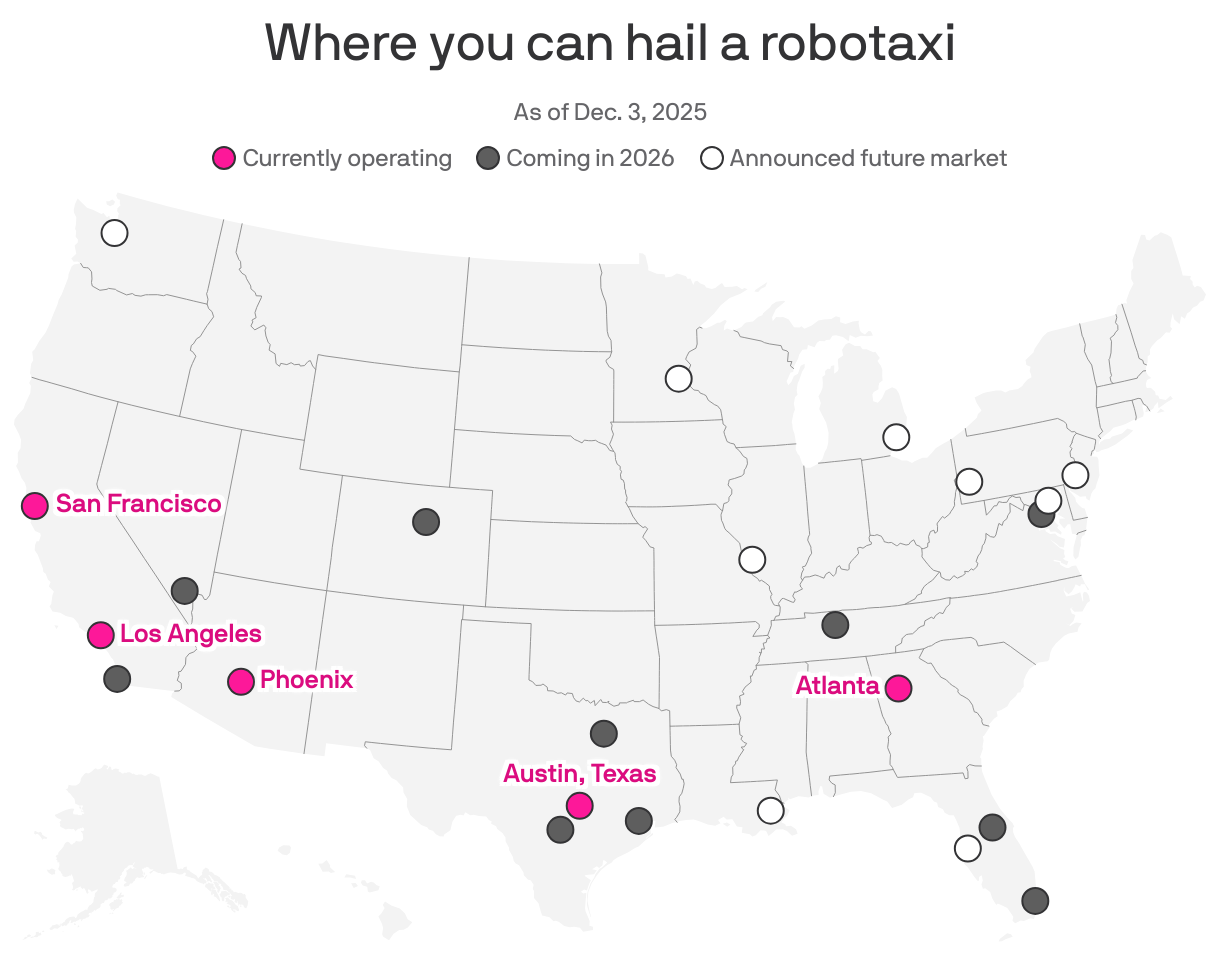
- It's currently operating in five cities — Los Angeles, Phoenix, San Francisco, Atlanta and Austin (the latter two in partnership with Uber, plus a relationship in Phoenix as well).
- 19 additional U.S. cities are coming in the next year or two, including four announced just this morning — Baltimore, Philadelphia, Pittsburgh and St. Louis.
- It's even hoping to take on Manhattan someday.
Yes, but: While self-driving cars are permitted in about half the country, the laws would have to be changed in places like Washington, D.C., and New York, where a human operator is still required behind the wheel.
- In other states, the law is silent on driverless cars, which means it's open to interpretation — and debate.
- More worrisome for Waymo, potentially: City leaders in some places, including Boston and Seattle, are proposing new ordinances that would prohibit autonomous vehicles.
The intrigue: Waymo replaced its global head of public policy in September to deal with the mounting headwinds.
- Justin Kintz previously led the policy team at Uber during its early growth period, when the ride-hailing network was unwelcome just about everywhere.
- At Waymo, he will likely draw on that experience to try to push local legislation that is more favorable toward robotaxis.
- That will require navigating opposition from labor unions and progressive Democrats, like Boston Mayor Michelle Wu, New York Mayor-elect Zohran Mamdani and Seattle Mayor-elect Katie Wilson, who built her reputation as a proponent of public transit.
What they're saying: "The biggest hurdle Waymo faces is not understanding local politics," says AV policy expert Grayson Brulte, founder and CEO of The Road to Autonomy, a strategic advisory firm.
- "They're going into markets where the policy is not ready yet," he said.
- It can take years to pass new legislation in many states, which could delay Waymo's plans.
For the record: Waymo acknowledges the work ahead.
- "Expanding our footprint will require expansive attention on the development of AV policies that enable fully autonomous operations, including in many places that currently have none," the company said when it hired Kintz in September.
- A spokesperson tells Axios this week the company is "feeling more hopeful" about its prospects in D.C., where a more favorable law is currently being drafted. "We'll be ready in 2026," he said.
- In other states, including Washington, Minnesota and Illinois, Waymo is seeking "legal clarity" before its planned deployment, he says.
Zoom in: In Minneapolis, Waymo recently hired lobbyists to navigate complicated state and local dynamics, where opposition from Democrats and labor unions aligned with rideshare drivers could threaten its expansion plans.
- Multiple members of the Minneapolis City Council have signaled interest in passing a citywide ordinance requiring that a human driver remain in the vehicle.
- "Bringing autonomous fleets into Minneapolis without protections for workers puts jobs at risk, destabilizes communities & shifts wealth out of our city," Council Member Jamal Osman, a key swing vote, wrote on X after Waymo's November announcement.
- Efforts to pass a statewide regulatory framework for AVs could also face pushback from some Democrats in the narrowly divided Legislature, as a recent battle over rideshare driver pay and protections illustrated.
The bottom line: With 2,500 robotaxis on the road and more than 100 million fully autonomous miles driven, Waymo is by far the industry's 800-pound gorilla.
- But that early success isn't guaranteed to continue if it keeps running into the same obstacles.
Axios Twin Cities' Torey Van Oot contributed.
