Axios Tampa Bay

June 24, 2026

🐫 It's Hump Day!
🌧️ Today's weather: Chance of showers and thunderstorms, with a high of 93 and a low of 78.
Sounds like: "Say You Do" Sigala ft. Imani Williams & DJ Fresh.
🎂 Happy birthday to our Axios Tampa Bay member, Mark Braunsdorf!
🌍 Support local journalism that covers your world by becoming a member.
Today's newsletter is 1,123 words, a 4-minute read.
1 big thing: 🩺 Hillsborough DOGE targets health plan

Hillsborough County's version of DOGE has published findings from its "limited" review of the county's finances, identifying more than $670 million in what it deems "potential waste."
Why it matters: The report, which isn't a forensic or financial audit, arrives a week after the county discussed how to offset the potential revenue loss from a constitutional amendment to overhaul Florida's property tax system.
Driving the news: Commissioner Christine Miller (R) proposed creating the DOGE committee in April 2025; its five members were appointed by the Board of County Commissioners and met monthly for a year.
- The committee's chair, Jake Hoffman — who is also the executive director of Tampa Bay Young Republicans — praised Gov. Ron DeSantis and state CFO Blaise Ingoglia on X for "putting pressure on local elected officials."
- The report examined the state DOGE findings and included the committee's own observations about county spending.
Zoom in: The committee took particular issue with the county's health care plan, which covers residents who earn less than $30,000 as individuals or less than $60,000 for a family of four but do not qualify for Medicaid.
- The plan helps close a health insurance gap created by stagnant wages and the state Legislature's refusal to expand Medicaid.
The county's committee, however, argued that because its health care plan was created in 1991, before "Medicaid modernization and the Affordable Care Act marketplace," it is no longer needed.
- The committee recommends phasing out the plan, which saw enrollment increase last year after Affordable Care Act subsidies expired, causing premiums to triple.
- In doing so, it says, Hillsborough County could save over $452 million.
Zoom out: The committee also flagged $89 million intended to purchase and repair county vehicles, $12 million in grants for nonprofits and $1.5 million in subsidies for the Film Commission program.
Between the lines: Ingolia said the aim of the state DOGE, from which the local effort is derived, is to lay "a predicate to reducing property taxes."
What's next: County staff did not respond to specific questions about the items flagged by the committee, telling Axios it is still reviewing the report.
2. 🏫 Undocumented students' shrinking higher ed options
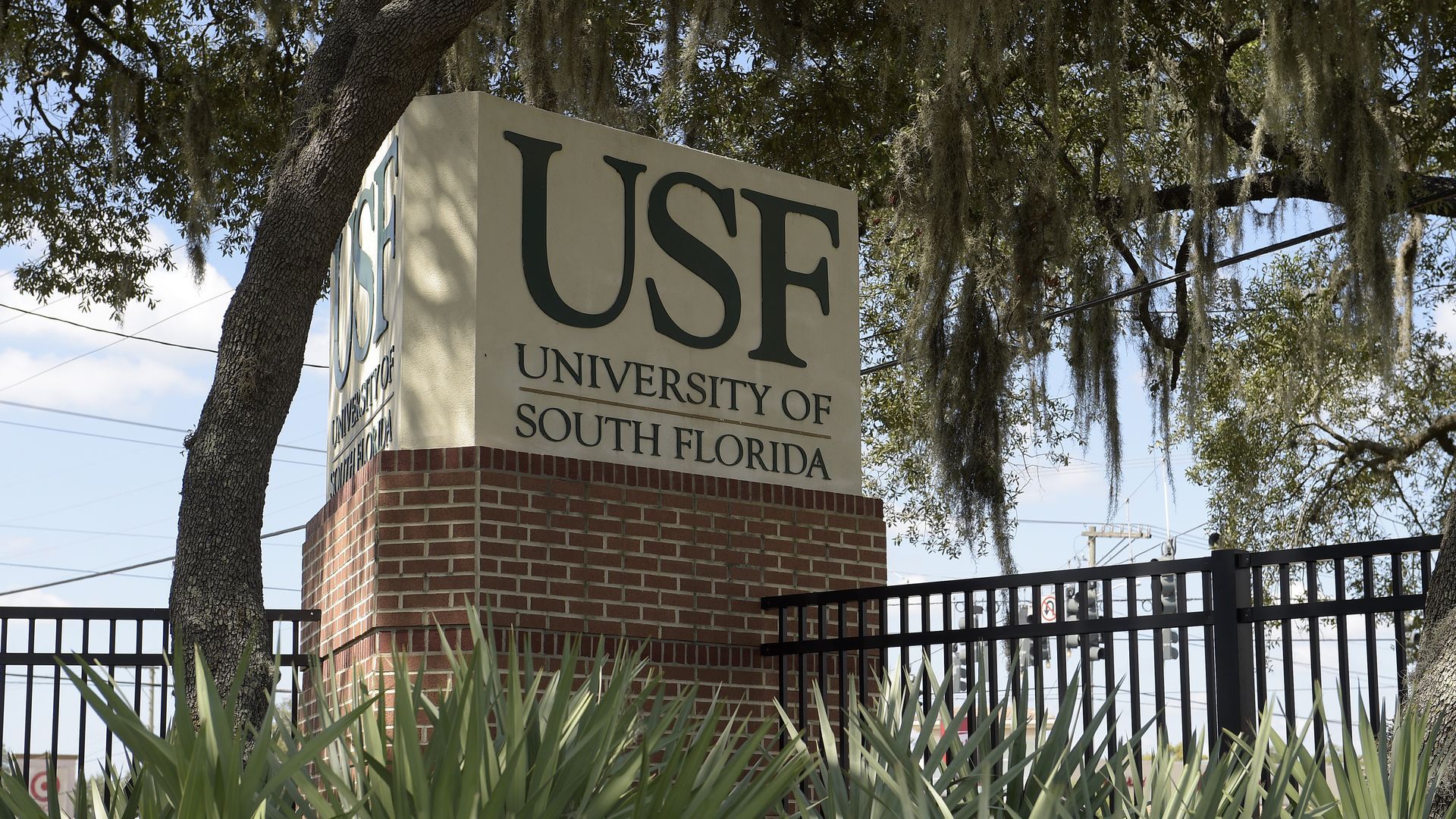
The Florida Board of Governors will take up a proposal today that would bar undocumented students from enrolling in state universities that don't accept all "academically qualified" students.
Why it matters: It is the latest effort by the state to make higher education inaccessible to undocumented immigrants, many of whom were brought to Florida as children through no choice of their own.
- An estimated 8,000 undocumented students graduate from the state's high schools each year, per the Higher Ed Immigration Portal.
Driving the news: The proposal would take effect in the 2027-28 academic year and would affect universities that, for the past two years, have not admitted all eligible and qualified applicants.
- Among those schools is the University of South Florida, which, on its admissions page, describes itself as "very competitive" and acknowledges that even those who meet its criteria may be denied admission.
- The proposal comes just a week before the state Board of Education is set to consider a new rule that would prohibit undocumented immigrants from attending public colleges in Florida.
The big picture: DeSantis signed a bill last year eliminating in-state tuition for undocumented immigrants, closing off a key path to higher education for students who cannot receive federal financial aid or legally work.
- Since then, USF has raised out-of-state tuition twice, meaning undocumented students would now have to pay at least $8,000 per semester, a 317% increase from what they had been paying.
- Now, even those able to afford the higher cost may soon be barred from admission. And should the state Board of Education follow, Hillsborough College and St. Petersburg College would also be off-limits.
3. The Pulp: Water restrictions extended

💦 The Southwest Florida Water Management District voted to extend watering restrictions through Oct. 1 across Tampa Bay, due to the region-wide drought. (Tampa Bay Times)
- How it works: Residents can water one day per week between 12:01am and 4am or between 8pm and 11:59pm.
👷 Modern Tampa Bay Homes plans to build a 4,000-square-foot mixed-use building at 2250 Central Ave. in St. Petersburg's Grand Central district. The space is currently a parking lot. (Tampa Bay Business Journal)
🛫 St. Pete-Clearwater International Airport is warning travelers that finding parking can be difficult during June and July, PIE's busiest months. Officials say flyers should consider getting a ride. (WFLA)
🥇Hillsborough County Parks & Recreation was named a finalist for the 2026 National Gold Medal Award for Excellence in Park and Recreation Management, its fourth nomination in five years. (WTSP)
4. Data centers face AI backlash


Only a small fraction of data center opponents actually live near one, according to new polling by a consulting firm that counsels leading AI labs and tech startups.
Why it matters: The findings by Milltown Partners, shared first with Axios, highlight how data centers have become a stand-in for broader anger at an AI future many Americans don't want but fear they'll have to pay for.
By the numbers: The public is still divided on data centers, with direct opposition not yet a majority view. But nearly half of respondents support a temporary construction ban, according to Milltown's findings.
- 38% of respondents said they would support a data center being built near their home, while 34% would oppose it.
- Meanwhile, 49% say they support a moratorium on construction of new data centers, while only 16% oppose a moratorium.
- Most opposition to data centers isn't coming from neighbors. Only 8% of the respondents who oppose data centers say they know of one or more data centers near their home, the poll found.
Zoom in: Governments across Tampa Bay have had to reckon with residents' concerns about data center plans.
- Citrus County residents deluged a town hall meeting in opposition to a data center proposed in Holder, per the Tampa Bay Times.
- In Hernando County, commissioners voted to advance a one-year moratorium on data centers, with a final vote expected in July. Pasco is weighing a similar measure.
- A Pinellas County commissioner floated a similar pause earlier this year.
The bottom line: The massive windowless warehouses for computing infrastructure have become a physical symbol of wider AI anxiety.
📺 Kathryn almost gave up on Love Island USA season 8 but is fully invested again for Casa Amor.
🤞🏽 Yacob wants Sincere and Melanie to survive Casa Amor.
This newsletter was edited by Jeff Weiner.
Sign up for Axios Tampa Bay
