Trump squeezes states on college tuition for undocumented students

Add Axios as your preferred source to
see more of our stories on Google.
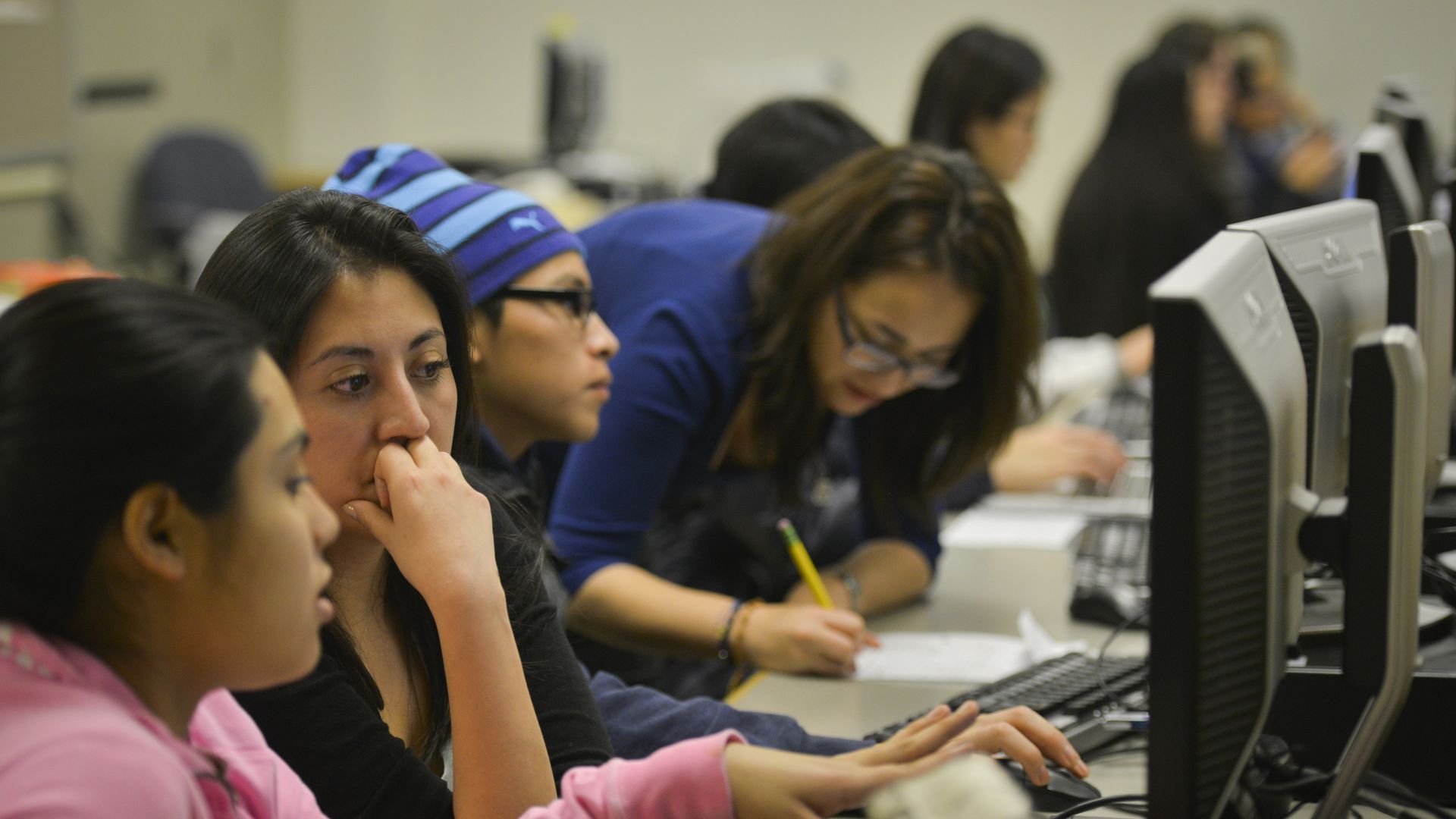
A volunteer closely reads a college essay of high school students at a program that helps undocumented immigrants write college essays and scholarship applications in Arlington, Va., in 2014. Photo: Jahi Chikwendiu/The Washington Post via Getty Images
Republican-leaning states, once at the forefront of laws helping undocumented students pay in-state college tuition, are trying to roll back that access thanks to pressure from President Trump.
Why it matters: Around 8% of the nation's estimated 11 million undocumented immigrants are under 18, and the ending of in-state tuition would make college unaffordable if those laws are reversed.
- Without in-state tuition, undocumented immigrants who have gone through the state's public school system would still have to pay out-of-state or international rates to attend public colleges and universities.
Catch up quick: The repeal efforts follow a Trump administration federal lawsuit filed in June to block the enforcement of Texas laws that grant in-state tuition rates to undocumented immigrants.
- The complaint states that federal policy bars undocumented immigrants from receiving "tuition benefits denied to out-of-state U.S. citizens," citing Trump's executive orders that instructed agencies to block such practices.
- The Department of Justice and Texas then reached an agreement to end the two-decades-old law.
Zoom out: According to the Higher Ed Immigration Portal, 24 states and the District of Columbia offer in-state tuition to undocumented students — though Florida repealed its policy earlier this year.
- Republicans in many of those states are pushing for their legislatures to repeal their laws.
State of play: The Trump administration's move against in-state tuition for undocumented students is one of many to make life difficult for immigrants amid a mass deportation plan.
- The IRS has agreed to share the personal information of undocumented taxpayers with immigration authorities, for example.
What they're saying: "No state can be allowed to treat Americans like second-class citizens in their own country by offering financial benefits to illegal aliens," said Attorney General Pamela Bondi in a statement.
- The Trump administration says federal law prohibits public institutions of higher education from providing benefits to undocumented immigrants that are not offered to U.S. citizens.
Yes, but: Many of the laws are designed to aid undocumented students who've attended high school for several years to qualify for in-state tuition, just like other state residents.
- Any student who has not lived in the state for a specified number of years prior must pay out-of-state tuition, regardless of their status.
- However, some states participate in a consortium that allows in-state tuition to be applied across state lines at certain universities for all state residents who meet the qualifications.
The other side: "Ending in-state tuition is a deliberate and wicked effort to keep predominantly Black and brown immigrant students in a permanent caste in society where they are underpaid and exploited," Juan Martinez-Guevara of the advocacy group United We Dream told reporters last week.
- Advocates argue that states will lose revenue and talent by forcing college-potential students into menial jobs.
- The rollbacks are "putting in jeopardy the dreams and aspirations of our students," said Gladys Fatima Marquez, an executive committee member at the National Education Association.
Between the lines: The push to repeal is a shift from Republicans of the President George W. Bush era, who championed in-state tuition for undocumented students and pathways for citizenship through military service.
- Bush and his brother, former Florida Gov. Jeb Bush, had long preached that such policy goals were economically beneficial to the country.
- Texas was the first state to pass a "tuition equity" law, or local Dream Act, when lawmakers approved legislation in 2001.
- Following Texas, other states like New Mexico, Kansas and Nebraska began allowing immigrants access to in-state tuition.
The intrigue: Some left-leaning states, such as California and Massachusetts, were slower to pass similar measures.
- Back in 2000, former California Gov. Gray Davis vetoed a bill extending in-state tuition to undocumented students, citing cost. The state later enacted a measure.
- Massachusetts lawmakers resisted for years, finally passing their version in 2023.
What we're watching: Democratic attorneys general could put up a fight against the Trump administration's rollback.
- That fight could ultimately end in the Supreme Court.
