Axios Seattle

December 10, 2024

It's Tuesday!
☁️ Today's weather: Mostly cloudy High near 44.
🧩 Become a core piece of our newsroom when you become a member today.
🎂 Happy birthday to our Axios Seattle member Mark Olson!
Today's newsletter is 779 words, a 3-minute read.
1 big thing: Promising to pay for college
Washington state plans to let low-income kids know by the 10th grade that they automatically qualify for free college, rather than making them wait on the outcome of financial aid applications in their senior year.
Why it matters: The new system will make it so students whose families are on food stamps can start thinking about college or career training earlier, while eliminating the barrier that the Free Application for Federal Student Aid (FAFSA) can pose for some.
The big picture: Washington has long struggled with low FAFSA completion rates among high school seniors — a rate that dipped even further this year, as a new FAFSA form rolled out amid technical difficulties and delays.
- That's a problem because for most students, if they don't fill out the FAFSA, they can't qualify for financial aid, including Washington state's program that pays full public school tuition for many students.
- Right now, that program covers full in-state tuition for students whose families make up to 65% of the state's median income, which comes out to about $78,500 per year for a family of four.
Zoom in: A new law the Washington Legislature passed this spring will make it so students in 10th through 12th grade automatically qualify for those state aid programs if their families receive state or federal food assistance benefits (such as from the Supplemental Nutrition Assistance Program).
- The new eligibility rules will take effect Jan. 1, 2026, affecting low-income students in this year's junior class and below.
What they're saying: The idea is to give those kids a guarantee that they'll be able to afford college or career training when they graduate, so that they don't give up on those pathways prematurely, Michael Meotti, executive director of the Washington Student Achievement Council, told Axios.
Zoom out: Meotti said Washington state's law is based on an experiment in Michigan, where officials promised low-income students four years of free tuition at the University of Michigan, regardless of whether they filled out financial aid applications, and encouraged them to apply.
- Students who received those notices were twice as likely to apply to the university and twice as likely to enroll, the researchers found.
2. Charted: Christmas tree havens


Nearly a million Christmas trees were grown and cut in Washington in 2022, making the Evergreen State the nation's fourth-highest producer of Christmas trees that year, according to the most recent federal data available.
By the numbers: We're far behind Oregon, where 4.8 million Christmas trees were grown and cut down in 2022, and North Carolina, which produced 3.2 million trees that year, per data from the U.S. Department of Agriculture.
- Michigan also outpaced Washington, cultivating and cutting down 1.8 million Christmas trees in 2022.
The big picture: Extreme weather affects the Christmas tree industry, with drought conditions in 2021 hurting tree harvests in the Western U.S. and floods from Hurricane Helene damaging trees in North Carolina this year, per the National Oceanic and Atmospheric Administration.
Between the lines: While cutting down trees may not seem like an environmentally friendly choice, "real Christmas trees are recyclable, making them a zero-waste product," says NOAA's National Centers for Environmental Information.
- The Nature Conservancy writes that Christmas tree sales support farms that grow 10 times more Christmas trees than the number cut down each year, making the industry a net positive for fighting climate change.
- Plus, "real trees don't require the intensive carbon emissions that it takes to produce and ship artificial trees," the environmental nonprofit says.
3. Morning Buzz: World-class whiskey
🥃 Seattle's Westland Distillery has once again nabbed worldwide honors: its wine-cask finished single malt whiskey was named the 20th most exciting release of the year by a prominent whiskey magazine. (Seattle Times)
🗳️ Seattle Mayor Bruce Harrell plans to run for a second term next year. He registered his reelection campaign yesterday. (KING 5)
✈️ Alaska Air Group plans to start offering nonstop flights from Seattle to Tokyo and from Seattle to Seoul next year. (CNBC)
4. Mapped: Washington's Heisman drought
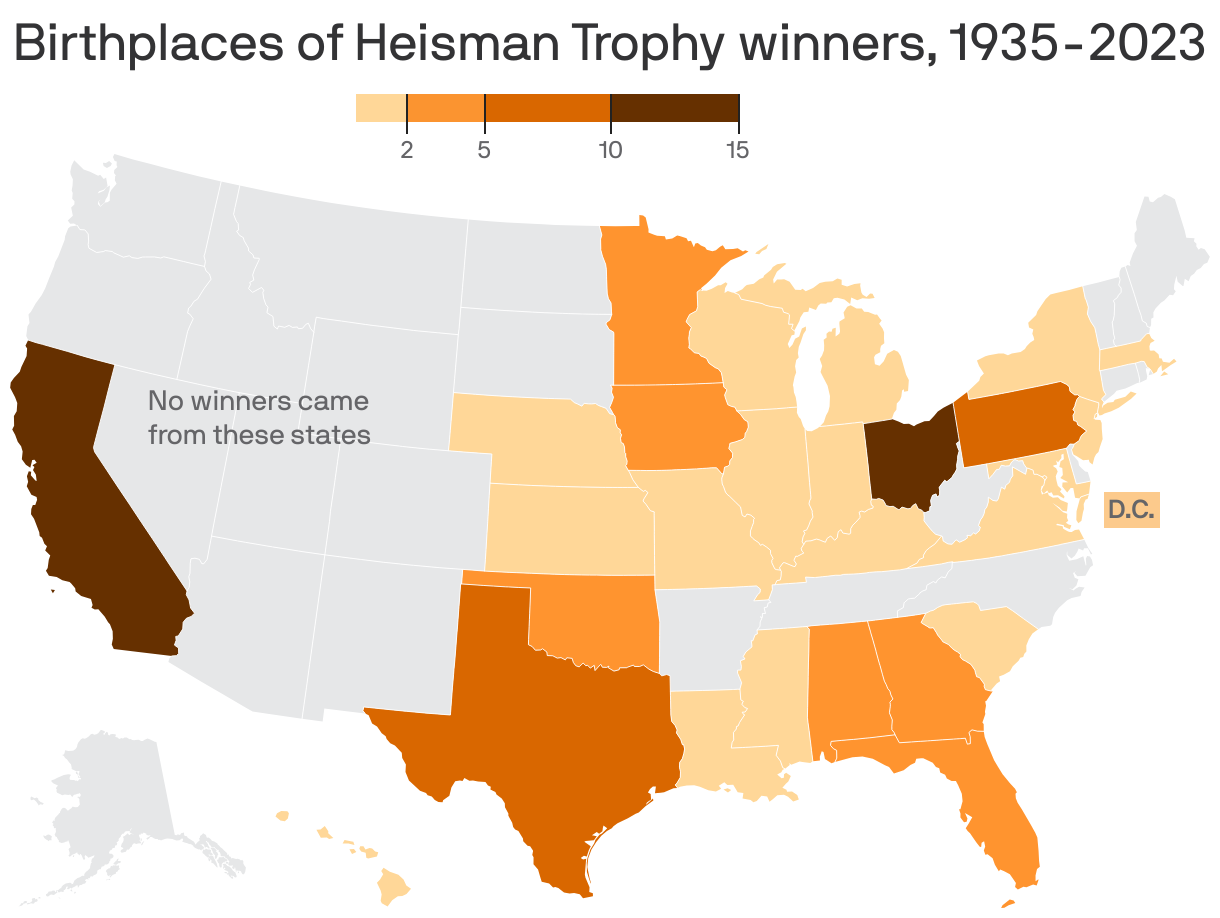
No football players from Washington state made this year's shortlist for the Heisman Trophy, the biggest award in college football, when the list of finalists was announced yesterday. But we're used to it.
Catch up quick: A player born in Washington has never brought home the trophy since it was first awarded 90 years ago.
- Nor has a player from a school in Washington won the trophy (although former UW quarterback Michael Penix Jr. came in second last year).
This year's finalists are University of Oregon quarterback Dillon Gabriel; Boise State University running back Ashton Jeanty; Travis Hunter, cornerback and wide receiver at the University of Colorado Boulder; and University of Miami quarterback Cam Ward.
- The winner will be announced Saturday.
🍪 Melissa is getting ready to bake cookies.
🕶️ Clarridge is finishing up a long weekend.
This newsletter was edited by Rachel La Corte.
Sign up for Axios Seattle