Axios San Francisco

July 30, 2025


1 big thing: Non-criminal ICE arrests rise




Immigration and Customs Enforcement (ICE) arrests of people without criminal charges surged last month in California, driven by the Trump administration tripling ICE's arrest quota, newly obtained data shows.
Why it matters: The spike is fueling fear in immigrant communities and testing how local police interact with federal agents, who are often in masks or plainclothes.
By the numbers: In California, people without criminal charges or convictions made up an average of 60% of daily ICE arrests in June, up from about 38% in May and 22% in April.
- That's according to agency data obtained by the UC Berkeley School of Law's Deportation Data Project.
- The upward trend was also reflected in arrests in the ICE San Francisco field office region, which covers Northern California, Hawai'i, Guam and Saipan.
The big picture: In late May, the Trump administration told ICE to arrest at least 3,000 people daily, up from 1,000, despite previously claiming to focus on criminals who live in the country illegally.
Many people "who have been community pillars" in SF have expressed fear of even going outside to the grocery store, District 9 Supervisor Jackie Fielder told Axios.
State of play: San Francisco is not adequately prepared to respond to the increase in ICE activity, said Fielder, who represents the Mission and its large Latino population.
- The city needs clearer protocols, she noted, pointing to the Los Angeles Police Department's recently enacted policy requiring officers to verify ICE agents' credentials on body-worn cameras.
- "At the local level, we are the last line of defense against authoritarianism, and I think SFPD and the sheriffs should consider the same directive," she added.
Zoom in: City law prevents SFPD from assisting ICE in federal immigration law enforcement unless required by federal or state law, but Deputy Police Chief Derrick Lew's comments after a violent clash with protesters raised concern among immigration advocates.
- While Lew emphasized that they don't want the community to get hurt, he also said "we can't just sit by and watch our fellow law enforcement agent or officer get hurt," Mission Local reports.

3. The Wiggle: 🏗️ Displacement concerns
4. 🏋 We go hard at the gym
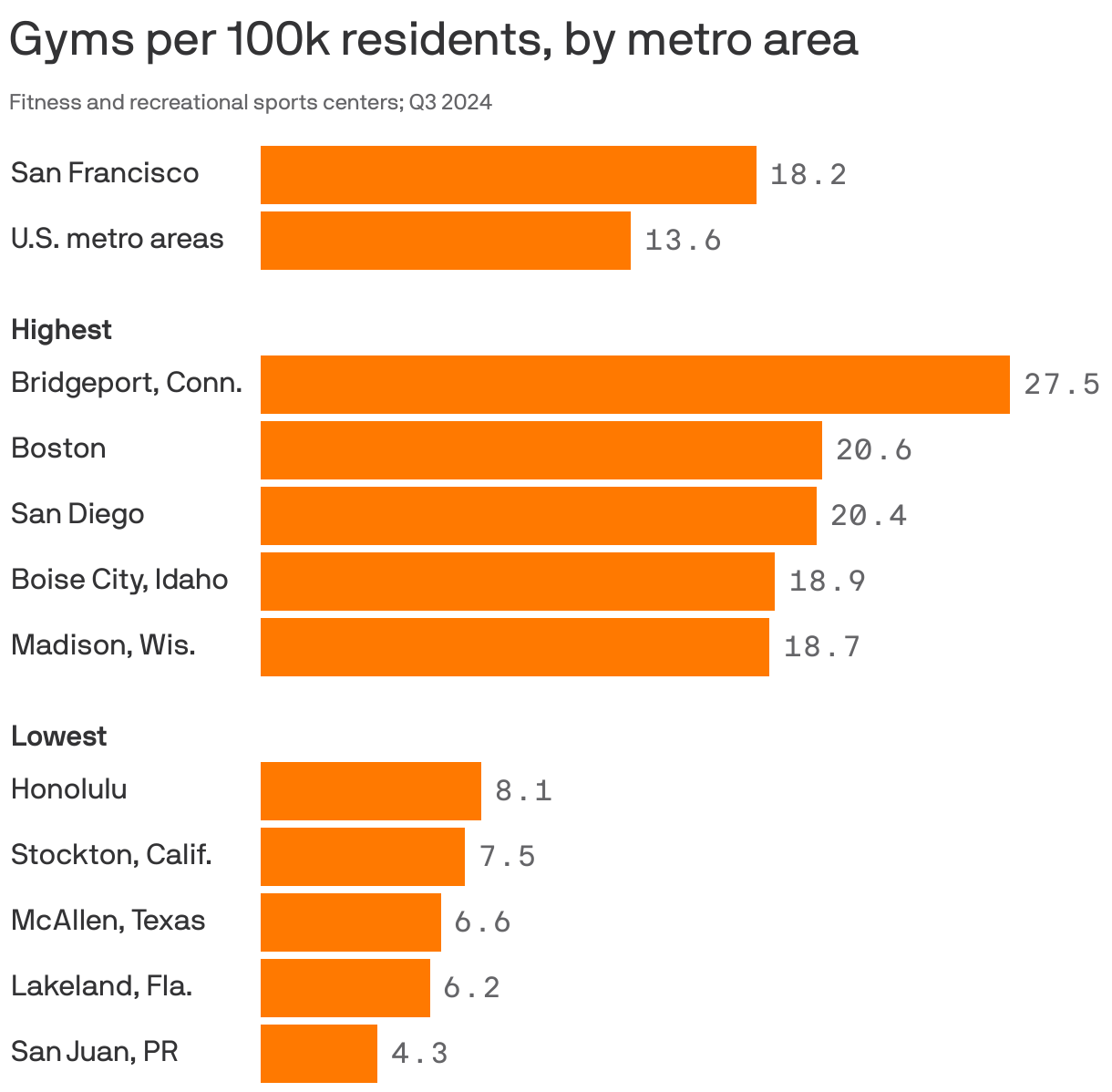
San Francisco is among the largest U.S. metro areas with the most gyms per 100,000 residents, government data shows.
Why it matters: Gyms offer city dwellers a way to get and stay healthy, and can serve as excellent "third places" — a spot to hang out and connect outside home or work.
State of play: San Francisco has 18.2 gyms per 100,000 residents, higher than the U.S. average of 13.6.
- That includes everything from chains like 24 Hour Fitness to local brands like Fitness SF, Live Fit and The Yard.
Zoom out: Bridgeport, Connecticut (27.5); Boston (20.6); and San Diego (20.4) have the most gyms, while San Juan (4.3); Lakeland, Florida (6.2); and McAllen, Texas (6.6) have the fewest.
How it works: These figures represent "fitness and recreational sports centers" in the Bureau of Labor Statistics' Quarterly Census of Employment and Wages data for Q3 2024.
- Axios looked at metro areas with at least 500,000 residents.
What we're watching: High-end gyms are branding themselves as both a place to pump iron and take work meetings — though hopefully not at the same time.
- Other popular chains, like Planet Fitness and Crunch Fitness, are swapping out cardio equipment for more weights — reflecting our "increasingly muscle-obsessed population," per Bloomberg.
Axios San Francisco
