Axios San Diego

March 09, 2026

Good morning! Today, we're bringing you a special edition from our colleagues exploring how play can make us better.
☀️ Today's weather: Coast — Mostly sunny, high of 67; Inland — Mostly sunny, 76
🎂 Happy (belated) birthday to our Axios San Diego members Jack Hawblitzel and Cecily Geyelin!
Today's newsletter is 951 words — a 3.5-minute read.
1 big thing: The key to better problem-solving
Tell a workaholic: Play isn't just good for your health — it could improve your work output.
Why it matters: Taking play breaks can reduce stress, strengthen teamwork, and boost creativity and problem-solving, research suggests.
The big picture: Play enables better work.
- Being in a high-pressure, serious state can put your brain into a fear mode that shuts down cognitive functioning, says Piera Gelardi, Refinery29 co-founder and author of the forthcoming book "The Playful Way" (out in April).
- "Whereas when we're in a playful state, we're in a more exploratory, open-minded, experimental place, and that's usually where solutions come from," she says.
Zoom out: Meanwhile, "play deprivation" could be linked to negative mental health outcomes, according to Stuart Brown, clinical researcher and founder of the National Institute for Play.
Adding some play to your workday can look like:
- Stepping away to doodle for a few minutes.
- Listening to your favorite song — without scrolling on your phone.
- Going for a walk to seek awe in the outdoors.
To find more opportunities to play, identify the grown-up version of the thing you loved as a kid, Gelardi says.
- If you spent hours dressing up dolls, explore your personal style now.
- If playing house made you lose track of time, people-watch and imagine their backstories.
- If you thrived on sports teams, build more movement into your day.
Carly's thought bubble: My two favorite play activities are...
- Going to movement class or another kind of sober dance party.
- Running around the house with my curious, energetic toddler.
2. Work hard, play hard
If play helps us think better at work, the next question is: How can you have a playful mindset on the job?
In her book, Gelardi lays out distinct play-at-work styles:
1. The curious quester
- Strength: Asks great questions.
- One way to "play" at work: Turn projects into experiments and treat setbacks as data, rather than failure.
2. The mundane alchemist
- Strength: Makes boring work engaging.
- One way to "play" at work: Give meetings a clever name and gamify tedious tasks.
3. The visionary dreamer
- Strength: Has a big-picture imagination.
- One way to "play" at work: Ask "What would need to be true for this to happen?" and lead bold brainstorms.
The bottom line: Playful strengths aren't distractions from serious work — they make you better at it, Gelardi says.
3. Mapped: The most (and least) active states

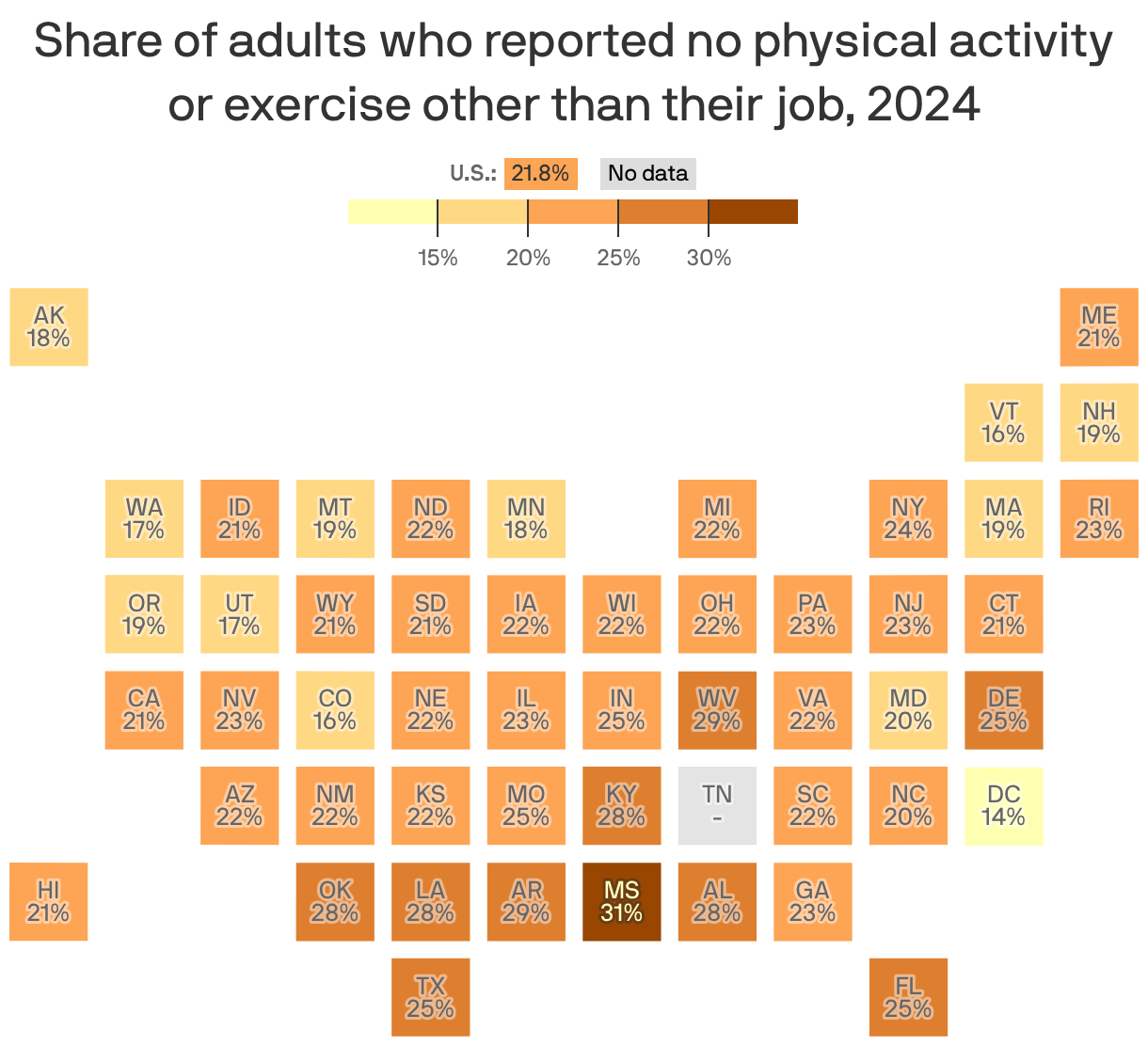
About one in five Californians report doing no physical activity or exercise outside their job, per a new report. That's on par with the national average.
Why it matters: Even just moderate exercise can have tremendous benefits for your physical and mental well-being, research has found.
Driving the news: The findings, from 2024 U.S. Department of Health and Human Services data, are highlighted in the United Health Foundation's new "America Health Rankings" report.
Between the lines: While the states with the least active adults tend to rank poorly in other health metrics, other factors could be at play here.
- People who work physically demanding jobs, for example, may be less likely to exercise for fun than desk jockeys.
🎉 Celebrating 5 years of Axios Local
🎈1 big thing: For five years, Axios has delivered smart, trustworthy local news to communities like yours — and we're just getting started.
Why it matters: Memberships sustain the journalism you rely on and help us keep delivering strong, independent reporting focused on what matters most.
Your newsletter helps you stay informed and connected. Help us power the next five years of Axios San Diego by becoming a member today.
4. Parkour goes fitness
Parkour — the sport that went from an outlaw, fence-hopping subculture to a joke on "The Office"— became one of the fastest-growing fitness class categories in the U.S. last year, according to ClassPass.
Why it matters: The sport is all about moving freely through space and has gone mainstream, which means even this reporter tried it out.
- And it is thrilling.
Zoom in: Kids and adults can try parkour at San Diego Gymnastics & Parkour, Rogue Parkour Gym and Legacy Gymnastics Academy.
What they're saying: Parkour is "everything I used to do as a kid that I was told not to do," says Christian Elijah Mayo, owner and operator of parkour gym Fr3running Society in Los Angeles.
How it works: At Fr3running Society, you wipe your shoes on a sticky mat, then step into a vast, industrial space — a maze of wood platforms, metal pipes, black mats and rock-climbing walls.
- For my class, the equipment was arranged into stations for drilling specific movements.
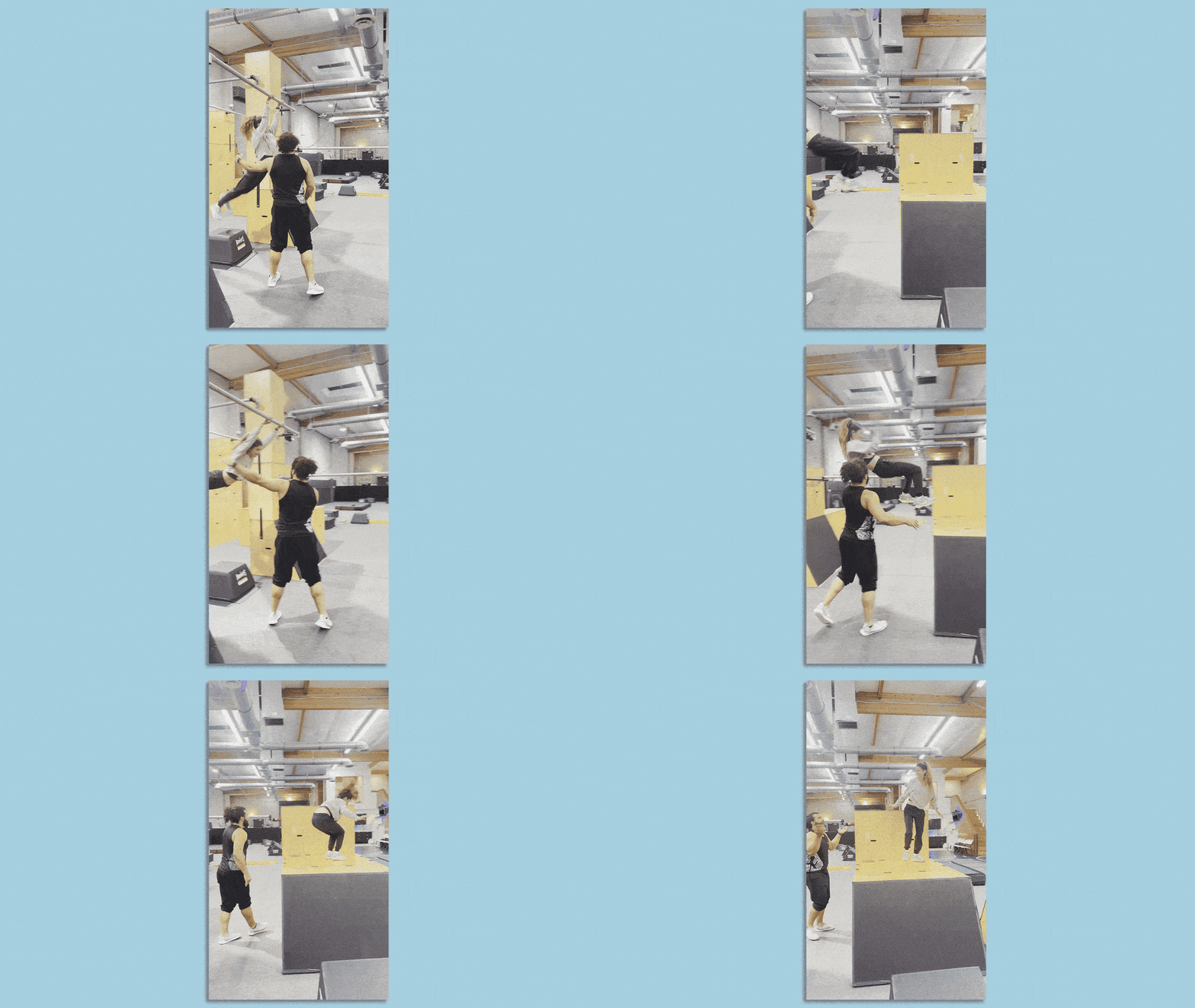
- The section that made my eyes widen: You had to leap from a block to catch a bar, then swing your body through the air, and finally release and land on a raised platform that looked very, very far away.
I was scared. And said as much. But Mayo brushed it off.
- He recommended breathing through it, and continuing to expose myself to more challenging scenarios — like higher jumps and swings — in a controlled environment. That helps "sharpen the blade in your brain" and expand your comfort zone, he said.
- My nerves didn't go away, but after swinging and not jumping, I finally did let go. I barely made it.
I was euphoric. Sure, it feels good to do any kind of workout, but this was different.
- I felt myself pushing physical limits — and tapping into a kind of play I hadn't experienced in years. It ended in a game of tag, for goodness' sake.
Yes, but: Writing this days later, my palms are blistered, my shins bruised, I can barely put my hair in a ponytail because my arms are so sore, and I think I tweaked my ankle. At 36, I'm feeling especially old today.
- Mayo says that done over the long-term, though, parkour functions as an injury-prevention class because it strengthens smaller muscles and tendons. I'll see how I feel next week.
🧘♀️ Carly is foam rolling.
Thanks to editor Ashley May.
Sign up for Axios San Diego