Axios Richmond

November 01, 2026
Good morning. It's Sunday.
- Sorry to wake you, but we're back with a special higher-ed-themed edition.
π§ Sounds like: "Easy" by The Commodores.
Todayβs newsletter is 985 words β a 3.5-minute read.
1 big thing: π£ Bigfoot is on the syllabus
In Virginia, college students can earn credit studying Bigfoot, witchcraft, Dungeons & Dragons, hip-hop beats and the ethics of colonizing Mars.
Why it matters: College is about broadening your horizons. Sometimes, apparently, all the way to Mars.
State of play: With spooky season still lingering on the lawn, we went in search of some of the weird, witchy and wonderful classes available at Virginia's four-year universities.
What we found: Colleges in the Old Dominion are packed with magnificently specific courses that prove there's academic credit for just about every curiosity.
Zoom in: Here are a few of our faves:
π½ Radford: Bigfoot Stole My UFO!: Critically Engaging with Science, Pseudoscience, and the Paranormal β three credits on Bigfoot, UFOs, Chupacabra, psychic powers, ancient aliens and how to evaluate paranormal claims scientifically.
π§ University of Richmond: Occult America and Witchcraft and Its Interpreters β two religious studies courses exploring witchcraft, hauntings, spirit possession, magic and the Salem witch trials.
π§ University of Richmond: Vampires in Literature and Film β the lit course you didn't know you needed explores vampires from the 16th century through modern TV and film.
Zoom out: Not every wonderfully weird course involves the paranormal or occult.
π UVA: The Ethics of Dungeons & Dragons β a fall 2026 course using D&D to examine race, power, colonialism and ethics.
π UVA: Decolonize Mars β an ethics course built around colonization and space exploration, focused on Mars as humanity's "natural next step," per the course description.
π Virginia Tech: Bees and Beekeeping, plus a separate lab, introduces students to honey bee biology β complete with actual beekeeping.
π§ VCU: Code Beats With Python β a one-credit course that teaches Python by having students create hip-hop beats.
πΆ VCU: Footprints on the James β students paddle, camp and study their way down the James River watershed for six credits in this summertime course.
The bottom line: You can go to college in Virginia to study accounting, engineering or biology.
- Or you can go looking for Bigfoot.
2. π A shrinking college pipeline

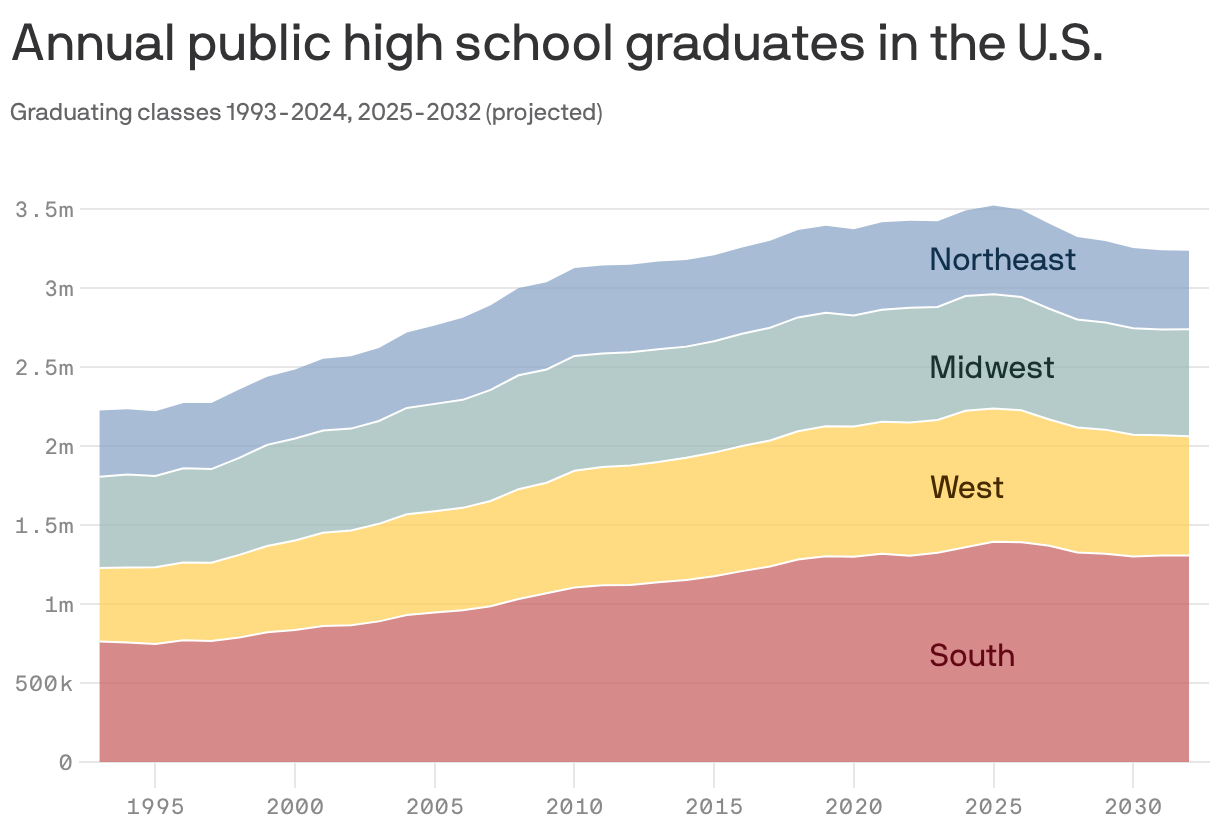
America's future college pipeline is growing in the South, but Virginia is bucking the trend.
Why it matters: Colleges in shrinking markets will face a fierce fight for students, while those in growing regions will have to adapt to serve an expanding, more diverse student body.
- The nation's student pipeline is also becoming less white, more Latino, more first-generation and more cost-conscious.
By the numbers: The number of U.S. high school graduates is projected to peak in 2025 and then fall 13% by 2041, per the Western Interstate Commission for Higher Education (WICHE).
- The decline is especially steep in major college markets: California is projected to lose 29% of its high school graduates, New York 27% and Pennsylvania 17%.
- The South is projected to grow 3%.
Zoom in: Virginia, however, is projected to lose 6% of its high school graduates over that same period.
- In its most recent enrollment projections, state higher-ed officials noted that Virginia's high school graduate count is projected to decline through 2033, tick back up in 2034, then continue falling.
What we're watching: Colleges in declining markets may cut jobs, humanities programs and low-enrollment majors to stay afloat.
3. π JMU's new graduation promise
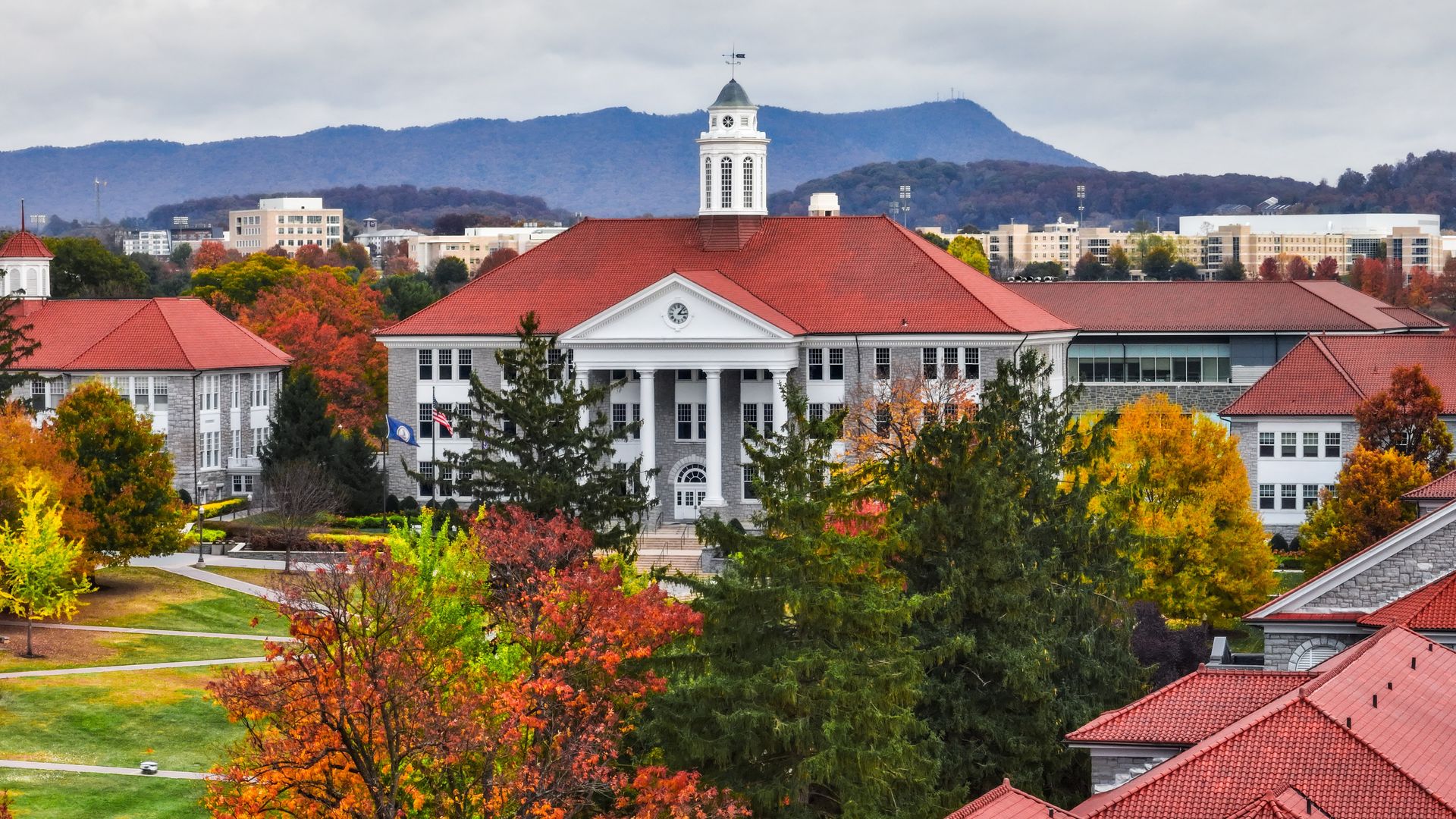
JMU recently made a bold promise to its students: if they haven't landed a job or meaningful next career move within a year of graduation, the university will keep helping them β for free.
Why it matters: JMU is joining a small but growing group of colleges willing to put a guarantee behind graduates' career outcomes at a time when confidence in higher education is slipping.
State of play: Last month, the Harrisonburg university announced its new Employment Guarantee β the school's promise to continue to support its bachelor's degree graduates who haven't reached what the university calls a "positive career outcome" within 12 months.
- That means a job, graduate or professional school, military service or a service or volunteer year.
- Dukes who haven't reached one of those milestones can get continued career coaching, resume and interview help, employer connections, work-based learning and additional undergraduate coursework, as space allows.
- It starts with the Class of 2027 and it's available at no additional cost for students.
The intrigue: JMU's guarantee goes beyond students. The school is also promising employers who hire its grads that it will provide additional training if a company identifies gaps in a former student's workplace skills.
- That promise lasts for up to three years after graduation β and comes at no cost to the employer.
The bottom line: JMU isn't guaranteeing every grad a job or every employer a perfect worker. It's putting some institutional skin in the game by promising its responsibility to students doesn't end when they get a diploma.
4. π° 1 chart to go: College grads' pay advantage

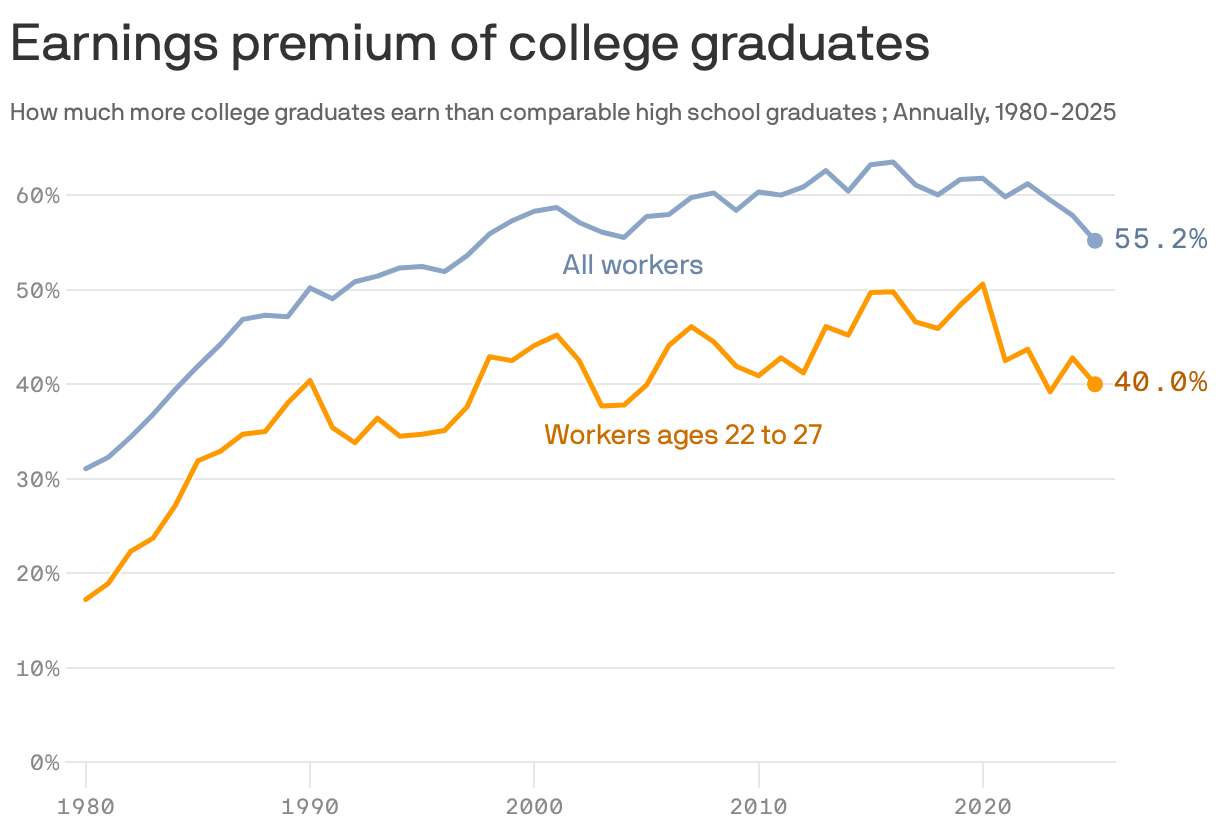
The boost college graduates get in pay over those who don't go to college is massive β but it's been declining a bit in recent years.
Why it matters: College is a big financial investment, and a lot of graduates are banking on it paying off.
By the numbers: Last year, the average college graduate earned 55.2% more than the typical high school grad, per Labor Department data analyzed by the progressive Economic Policy Institute.
- That's down from a peak of more than 60% a decade ago.
Zoom in: The payoff is striking in metro Richmond, where bachelor's degree-holders earn nearly twice as much as high school gradsβ around $69,000 a year vs. $40,000, according to 2024 Census data previously analyzed by Axios.
The bottom line: The college pay premium may be shrinking nationally, but in Richmond, a degree still comes with a pretty hefty paycheck boost.
Tell someone trying to decide about college
π€ Karri is considering going back to school just to study Bigfoot.
Thanks to Alexa Mencia Orozco for editing today's edition
Sign up for Axios Richmond