Axios Richmond

May 16, 2024

Welcome to Thursday.
โ๏ธ Today's weather: Mostly sunny with a high near 81.
๐ง Sounds like: "A Change is Gonna Come" by Sam Cooke.
๐ Situational awareness: Tomorrow is the 70th anniversary of the Brown v. Board of Education ruling. Today's newsletter is dedicated to looking at the past and present of school segregation in Virginia.
Today's newsletter is 915 words โ a 3.5-minute read.
1 big thing: Virginia's enduring legacy of school segregation
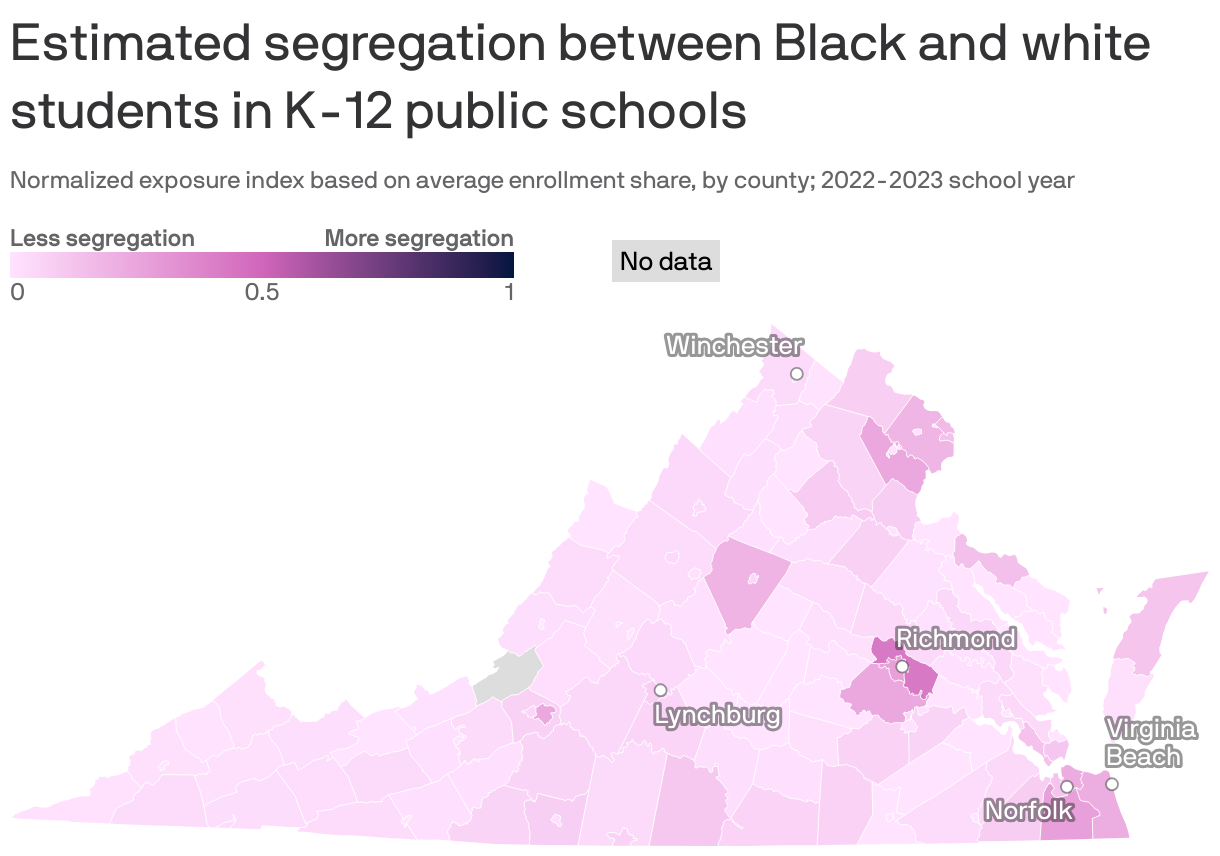
Racial segregation in Virginia's public schools has increased over the last three decades, according to an Axios review of federal data.
Why it matters: Segregated schools disproportionately hurt Black and Latino students because the schools where they're the majority often have fewer resources, more teacher shortages, higher student-to-school counselor ratios and greater suspension rates.
The big picture: Seventy years after the Brown v. Board of Education ruling, which declared racially divided schools unconstitutional, Virginia's population is the most diverse it's ever been.
- But the state continues to reel from decades of policies that further isolated Black and Latino students by race and poverty.
Some linger from the era of the Brown decision:
- 1930s housing policies that declared Black neighborhoods as "hazardous" and blocked Black families from buying homes.
- Massive Resistance (more on that below) led to some schools not integrating until the early 1970s.
- White flight, when white families fled to the suburbs to avoid integration.
- Limited federal oversight for school desegregation.
Others are more recent:
- Explosion of school choice without civil rights protections.
- The growing affordable housing crisis limiting neighborhood and schooling options for non-wealthy families.
The impact is seen in the Richmond-area: the second-most segregated region in Virginia behind the DMV, per a Stanford University analysis of demographic changes between 1991 and 2022.
Examples in RPS:
Mary Munford Elementary:
- 1991: 37% white, 62% Black, 0.5% Hispanic, 63% nonwhite.
- 2022: 76% white, 9% Black, 6% Hispanic, 16% nonwhite.
Elizabeth Redd Elementary (five miles from Mary Munford in Southside):
- 1991: 10% white, 88% Black, 0.4% Hispanic, 90% nonwhite.
- 2022: 6% white, 57% Black, 34% Hispanic, 91% nonwhite.
The bottom line: "A lot of people say desegregation didn't work," said Janel George, an associate professor at Georgetown Law focused on education inequality. "We didn't give it a chance to work."
Keep reading for segregated school examples in Henrico and Chesterfield
2. How we got here: Massive Resistance
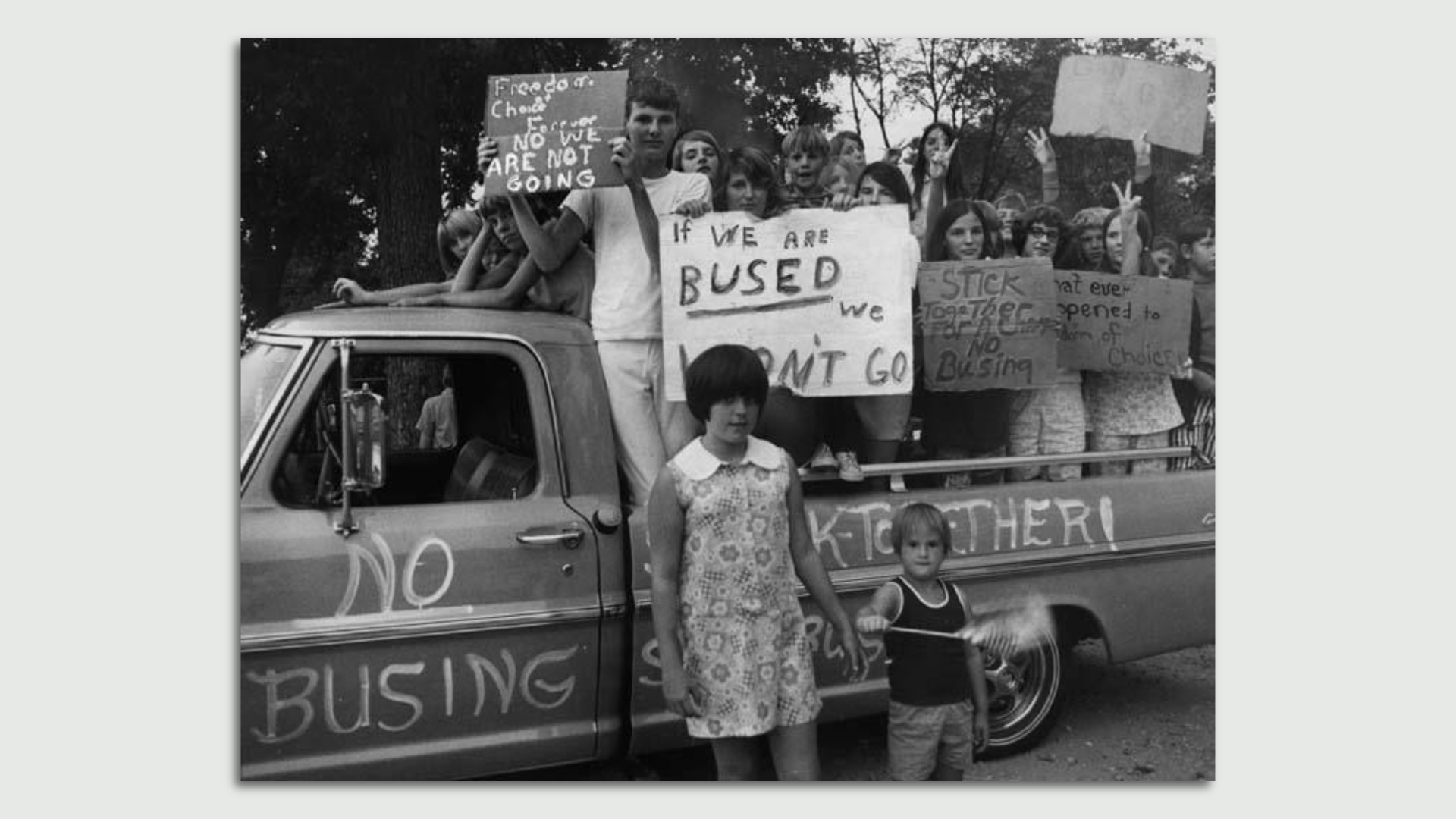
Friday may mark 70 years since the Supreme Court's landmark 1954 Brown v. Board decision, but Virginia schools wouldn't see desegregation in any meaningful sense for nearly two decades.
Why it matters: The architect of Massive Resistance โ the concerted political effort to thwart racial integration of schools by any means necessary โ was Sen. Harry Byrd Sr., the powerful Virginia politician whose influence stretched into state and local governments.
The big picture: A former state senator and Virginia governor, Byrd and his family essentially controlled state and local politics for more than half of the 20th century through what was dubbed the "Byrd Machine."
- His sway helped usher in sweeping policies throughout Virginia immediately after Brown v. Board that had one shared goal: to preserve racial segregation in schools.
Zoom in: Those policies in Virginia included:
- A statewide policy that made school attendance optional.
- A law allowing parents who opposed integration to receive public funds via tuition grants to use in private schools.
- The denial of state funding to any public school that attempted to integrate. This resulted in the governor closing still white-serving schools in Warren County, Charlottesville and Norfolk in 1958 after a federal court ordered them to integrate.
Yes, but: The 1958 school closures in Norfolk and beyond left 13,000 Virginia students without a school to attend, which turned public opinion and marked the beginning of the end of Massive Resistance in Virginia โ at least formally.
3. ๐ The Current: Historic hospital deemed endangered

๐ฅ Richmond Community Hospital, Richmond's first Black-owned hospital, was added to this year's state-wide endangered historic sites list, which could help protect it from future demolition. (Style Weekly)
๐ซ VCU suspended fraternity Delta Epsilon Mu for two years for "psychological hazing" and sorority Phi Mu for four years for buying and selling prescription pills. (Times-Dispatch)
โ๏ธ The city finalized three-year labor contracts with the unions representing police, firefighters and other emergency workers, solidifying pay raises and worker protections. (WRIC)
4. The growing triple segregation of Latino students
Richmond Public Schools had the highest levels of school segregation between white and Latino students in Virginia in 2022, according to the Stanford University analysis of federal data.
Why it matters: The combination of ethnicity, poverty and language creates a "triple segregation" among Latino students that's been overlooked for decades.
Now, Latino students in RPS are the most segregated of any racial or ethnic group, with segregation nearly quadrupling since 1991, per federal data.
- This coincides with a boom in RPS' Latino population. In 2022, Latinos were 26% of the district โย about 29 times greater than they were in 1991 (0.9%).
- Meanwhile, the percentage of Black or white students in RPS has dropped since 1991.
The intrigue: Some RPS schools, like Cardinal Elementary in Southside, have traded one predominant demographic for another.
- In 1991, Cardinal was 86% Black, 12% white and 2% Hispanic.
- By 2022, it was 84% Hispanic, 13% Black and 2% white.
Keep reading for when Latinos got the federal right to desegregation
5. 1 hopeful stat to go: The state's most diverse school

There are some positive signs when it comes to diversity in Richmond-area schools: Tucker High School in Henrico has the most racially diverse population of all Virginia public high schools, according to education data website Niche.
- Henrico County Public Schools also boasts the most diverse student population in the Richmond region โ and one of the most diverse in the state.
Zoom in: While Henrico County's population is 50% white, per census data, the district serves a majority-minority student population with only around 32% of white students.
The student body at Tucker, per state data:
- 28% - Hispanic.
- 27% - White.
- 22% โ Black.
- 18% โ Asian.
- 6% โ Multiple races.
Go deeper for what Henrico is doing right
๐ช Karri is proud to say that her Army brat mom, who was randomly a student at George Wythe the year they tried to integrate, told her this week she could not understand what all the Southerners were freaking out about.
- As an Army brat, she'd only ever attended fully integrated schools.
๐ฒ๐ฝ Sabrina is reading about the 1940s Mendez v. Westminster lawsuit, which ended Latino segregation in California school districts nearly a decade before the Brown v. Board ruling.
Thanks to Fadel Allassan for editing and Carlin Becker for copy editing today's edition.
Sign up for Axios Richmond