Axios Pro Rata

May 11, 2024

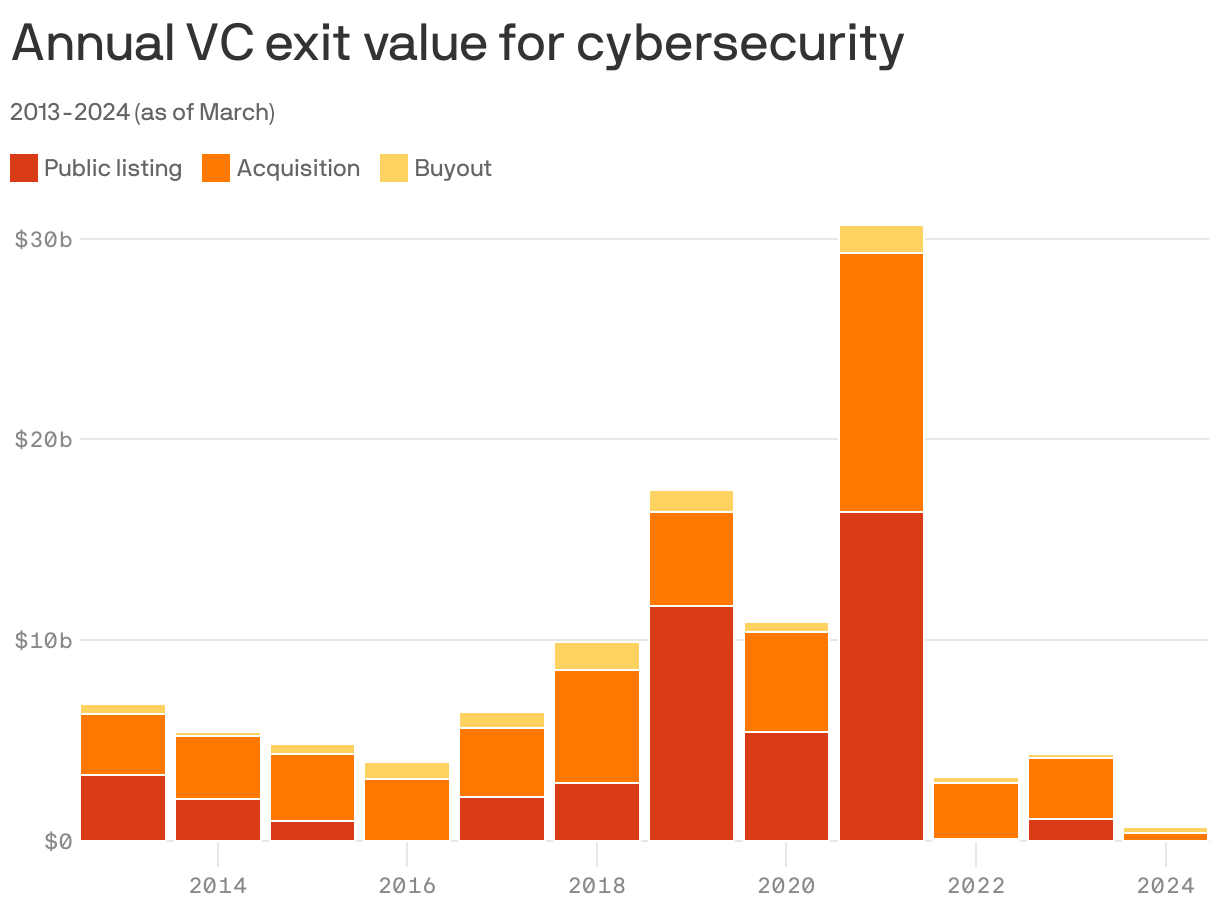
Happy Saturday! In honor of RSA Conference week, we're looking at dealmaking in cybersecurity.
- ☎️ Reminder: Feel free to send me tips or comments by replying to this email or on X: @imkialikethecar. (Or ask me for my Telegram or Signal number.)
Today's Smart Brevity™ count is 883 words — a 3½-minute read.
1 big thing: Wiz gears up for cybersecurity M&A

Illustration: Tiffany Herring/Axios
Wiz, a New York cybersecurity company that's seemingly become a large player overnight, is not shy about acquiring its way to success.
Why it matters: Few venture-backed companies openly raise merger and acquisition war chests.
Driving the news: This week Wiz announced $1 billion in new venture funding at a $12 billion valuation, which included a small secondary transaction for early employees and investors.
Catch up quick: The company was founded in 2020 by Assaf Rappaport, Yinon Costica, Ami Luttwak and Roy Reznik after leaving Microsoft. The four had landed at the tech giant in 2015 after it acquired their prior startup, Adallom, for $320 million.
- Wiz quickly set about winning over large enterprises as customers, achieving $100 million in annual recurring revenue in 18 months (it hit $350 million this year).
- It previously raised $900 million in funding from blue chip investors like Index Ventures, Sequoia Capital and Insight Partners.
The big picture: Although Rappaport says he doesn't feel pressure from his investors to make any further acquisitions, M&A is a big reason for the large pile of cash his company just raised.
- It's already acquired two companies — Rafft and Gem — spending about $400 million, per reports.
What they're saying: "I saw in my previous work, and we see it in the market … some companies who cannot innovate, you know, outsource their innovation through acquisitions," Rappaport tells Axios.
- "That's the PE approach … take an existing technology, put it in an existing machine, and like the 'one plus one equals three' ... we'll try to squeeze the lemon as much as we can.
- "When you're acquiring a company, you're not looking for a good deal, you're looking for a great company.… And it typically comes with a premium price. So that's one thing that is not very PE, because they're much more sensitive about the pricing."
Inside the room: Wiz is also very intentional about its post-acquisition approach. "What we're doing is we're almost sunsetting the existing product in order to rebuild it into the Wiz technology stack to make sure that everything is coherent," Rappaport says.
Yes, but: Inevitably, some prospective deals have not come to fruition, notably Sutter Hill-backed Lacework and publicly traded SentinelOne.
- Lacework has raised $1.8 billion in funding and was last valued at $8.3 billion. Wiz ultimately made an initial offer of about $160 million before revising it down to less than $100 million, following a few weeks of diligence, according to a source familiar with the discussions.
As for SentinelOne, which had hired bankers to explore a potential sale last summer, Wiz considered a bid but walked away after details leaked to the press, according to the source. SentinelOne told Axios there was never a deal between the parties.
What's next: The company wants to build out an actual corporate development team to focus on M&A and investments, and start checking things off the list for an eventual IPO, like hiring a CFO — and hitting $1 billion in ARR.
- "We're a 4-year-old toddler as an organization," says Rappaport.
The bottom line: An M&A market that's still rebounding, a stable of companies with pandemic-era valuations, and venture capitalists eager to see some portfolio exits could create some opportunities for Wiz.
Editor's note: This story has been corrected to state that Wiz's consideration of a bid for SentinelOne ended after details were reported by the press, not that a deal fell apart.
2. Zoom in: cybersecurity dealmaking

Illustration: Shoshana Gordon/Axios
I caught up with Thoma Bravo managing partner Seth Boro, who helps run the firm's cybersecurity investment efforts, to chat about the sector.
The big picture: Like other areas of software, venture-backed cybersecurity startups that raised funding at inflated valuations during the pandemic are now great acquisition targets, Boro says.
- "We're seeing a massive opportunity in those companies that are overvalued but have great tech," he explains. "It's just that there's broken business models."
Yes, but: The industry isn't consolidated the same way it once was.
- You're not seeing big multiplatform companies emerging and growing through acquisitions, as Symantec and McAfee once did, says Boro. "Today it's more focused.… It's much more strategic and much more thoughtful. We're staying in our lanes."
Zoom in: It's become much harder for cybersecurity software vendors that aren't at the top of their category.
- That's largely because the interest rate hikes that began two years ago elongated sales cycles from customers, which still persist today.
- "It was much harder for people to forecast their spend. There were many more steps that got introduced into the process, and companies had to adapt to that," says Boro.
Meanwhile, the generative AI factor has added a layer of complexity to existing problems. "Bad actors who are incredibly well funded now have a new tool to use," he adds.
- Still, it's also a tool for cybersecurity companies, primarily in two ways, he says. It makes their software "more usable," helping summarize threats and making them more understandable.
- It also helps companies and their customers detect cybersecurity threats more efficiently.
- Of course, "everyone has a generative AI strategy today," he adds.
🧩 Trivia
In lieu of trivia, I leave you with this fun vignette from my colleague Sam Sabin's RSA Conference adventures this week:

This was one of the most star-studded conference weeks I've seen in San Francisco — Meghan Trainor, Duran Duran and Alicia Keys were among the stars that made appearances.
🧮 Final Numbers
🙏 Thanks for reading! And to Javier David and Brad Bonhall for editing. See you Monday for Pro Rata's weekday programming, and please ask your friends, colleagues and hackers to sign up.
Sign up for Axios Pro Rata

Dan Primack’s briefing on VC, PE & M&A for dealmakers.