
Axios Portland

February 10, 2026

It's Tuesday, and National Flannel Day. Throw on something cozy.
⛅ Today's weather: Partly sunny, with a high of 53 and a low of 35.
Situational awareness: Portland local and Olympic alpine skier Jackie Wiles secured a bronze medal in the women's team combined event this morning with partner Paula Moltzan.
📈 Take your support to the next level by becoming an Axios Portland member today.
Today's newsletter is 1,146 words — a 4.5-minute read.
1 big thing: ☎️ A call for connection

Most people will pass these weathered Portland phone booths without a second thought. But for those who stop, it's the difference between being cut off and connected.
Why it matters: Payphones are basically extinct, but a volunteer-led project called Futel is putting them back to work, turning obsolete technology into public infrastructure, as well as a place to engage with interactive art.
Catch up quick: Software engineer Karl Anderson began Futel in 2014 when he installed a payphone booth in his front yard near the Springwater Corridor. He noticed some of his neighbors and unhoused people nearby couldn't consistently keep a cellphone due to cost.
- Anderson sourced a salvaged payphone booth from a former installer and connected it to his home internet instead of a traditional landline.
- Within weeks, dozens of people were regularly stopping by, even though the phone wasn't labeled or advertised.
The initial response convinced Anderson to expand.
- "When I started the project, people would say, 'Everyone has a cellphone; even homeless people have cell phones," he told Axios. "But it's just been shown to be very useful."
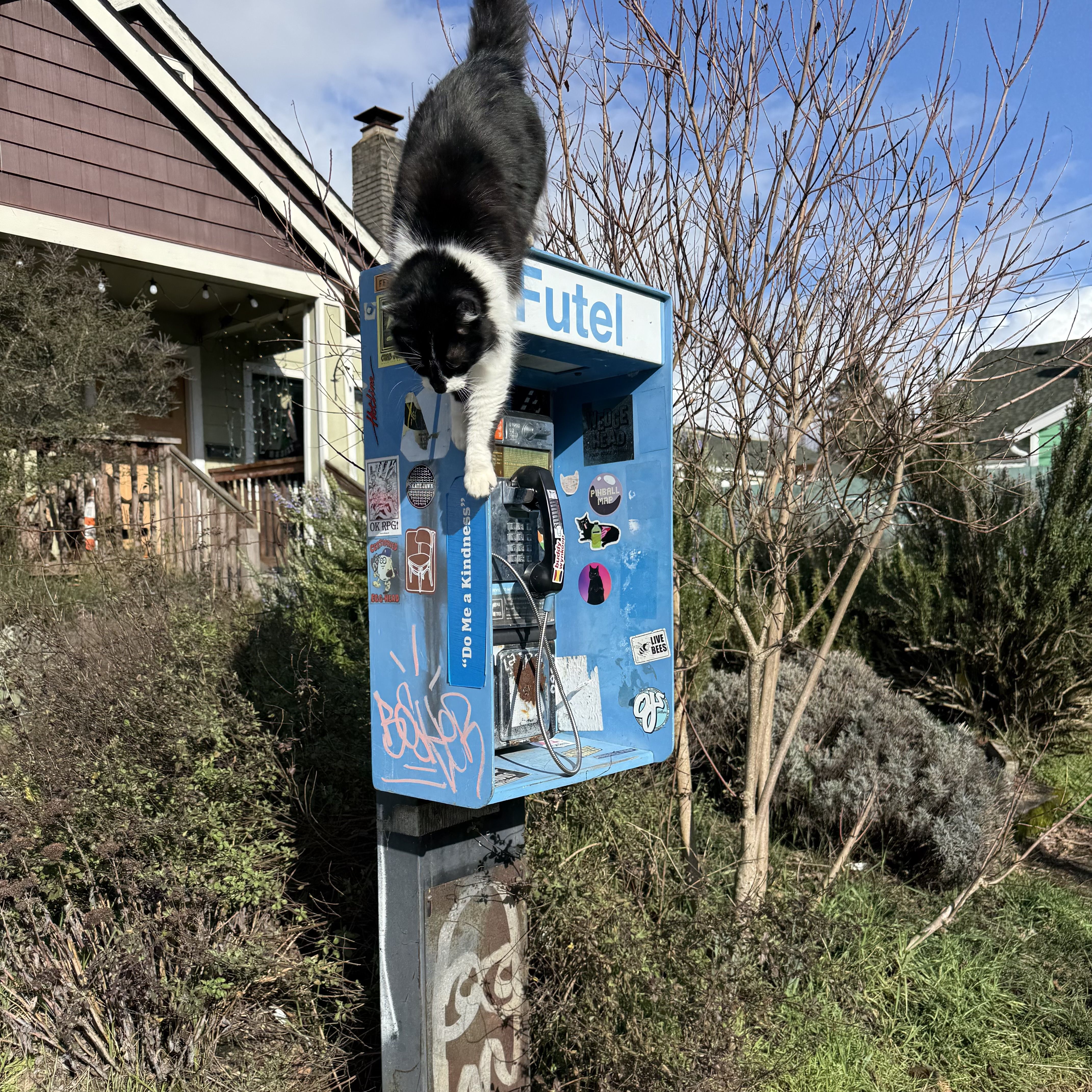
By the numbers: Over the last decade-plus, Futel has installed roughly 20 phones in Portland and a few others in Washington and Michigan. Anderson has partnered with nonprofit organizations like Sunnyside Shower Project and Street Roots, as well as private property owners who donate space, electricity and internet access.
- Last year, more than 35,000 phone calls were made using Futel phones, Anderson said.
- The project is funded by grants and donations and supported by a group of two dozen-ish volunteers.
Zoom in: Futel gives users more than just the option of making an outgoing call. Anyone can set up a voicemail box and access directories for social services like 211, the mental health crisis line and Ride to Care.
- Yes, but: There are also numbers you can call to hear spoken-word poetry, play "choose your own adventure"-style phone tag games and leave an anonymous apology (inspired by a 1980s New York project).
The bottom line: "Everyone needs to use whatever power they have for good," Anderson said. "This is something I can do."

2. ⏰ Court sets defender deadlines
Criminal defendants must receive a court-appointed lawyer within a set time or their charges will be dismissed, the Oregon Supreme Court ruled last week.
Why it matters: The ruling pressures Oregon to resolve its public defender shortage by forcing faster appointments or risking dismissed cases.
Zoom in: People facing misdemeanor cases will have two months to have an attorney appointed before their charges are dropped, per the Oregonian.
- Felony cases will have a three-month deadline.
By the numbers: The ruling could affect some 1,400 cases statewide, with roughly 900 of those in Multnomah County.
- Despite the shortage, the Oregon Public Defense Commission has made progress on the backlog, reducing the number of defendants without attorneys from more than 3,700 in late 2024 to just under 2,500 as of last month, the Oregonian reported.
- In a statement to the paper, the commission said it would "continue to address the crisis with urgency and transparency."
The other side: John Wentworth, Clackamas County's top prosecutor, called the ruling "an immense waste of taxpayers' money."
- "Our indigent defense system must deliver the service they are paid to provide," said Wentworth, who is also the president of the Oregon District Attorneys Association.
Between the lines: The ruling did leave prosecutors the option of refiling cases that have been dismissed, though legal experts said that could lead to charges being filed repeatedly while people wait for a lawyer.
3. Rose City Rundown
🏀 Oregon lawmakers introduced a bill this week to establish a joint city-state ownership of Moda Center and create an arena fund as concerns over a potential departure of the Blazers mount. (Portland Business Journal)
📚 Did your favorite Oregon author land on the finalists list for Literary Arts' 2026 Book Award? It should come as no surprise that Lidia Yuknavitch, Leah Sottile, Rebecca Grant and Karen Thompson Walker did. (Portland Mercury)
💍 The couple that got married during Bad Bunny's Super Bowl half time performance got engaged on the Oregon coast. (The Oregonian)
🎨 New day, new found money down at Portland City Hall: There's roughly $9 million sitting in reserves generated from the city's arts tax. (OPB)
⛷️ Olympic skier Hunter Hess, who hails from Bend, spoke out about his mixed emotions representing the U.S. in the games, leading President Trump to call him "a real loser" in a post on Truth Social. (Axios)
4. 🏡 Homeowners staying put


Portland homeowners are staying in their houses for the longest time in at least 25 years, largely thanks to their low mortgage rates, according to a report from ATTOM, an industry data provider.
Why it matters: That — along with still-high home prices and tight inventory — is keeping the housing market on ice.
Zoom in: Rose City sellers at the end of 2025 had owned their homes for an average of nearly 11 years — a record in data going back to early 2000, when the average was 4.7 years.
What we're hearing: Homeowner tenure has increased steadily in almost every major metro area over the past two decades, according to ATTOM.
- The "trend is especially pronounced in coastal and Northeast metros, where tenure often exceeds a decade," CEO Rob Barber tells Axios.
What we're watching: Some golden handcuffs are starting to come loose.
- For the first time since 2020, the share of U.S. homeowners with mortgage rates of 6% or higher exceeds those with rates below 3%, a new Realtor.com analysis finds.

5. 💰1 number to go: $106 million
When Portland officials unearthed $21 million in unspent housing funds last year, amid budget cuts and layoffs, it was a shock to say the least.
- When another $15 million in unused money was discovered last week, City Council president Jamie Dunphy told the Oregonian it was "no way to run a city."
The latest: On Friday, city administrator Raymond Lee revealed the total sum of unspent money now sits at $106 million, dwarfing the anticipated budget shortfall that city leaders will have to grapple with later this year.
Yes, but: That money comes from a variety of sources, per OPB, many of which have legal requirements on how the funds can be spent.
🕯️ Kale sometimes lights a little candle while he watches the Olympics and it makes him feel, in a small way, like he too is carrying the torch.
🫨 Meira is glad to know she's strobe-tolerant after seeing "The Moment."
This newsletter was edited by Geoff Ziezulewicz.
Sign up for Axios Portland