Axios Portland

February 26, 2026

💦 It's Thirstday. Stay hydrated, friends!
🌤️ Today's weather: Areas of frost then mostly sunny, with a high of 52 and a low of 36.
Today's newsletter is 793 words — a 3-minute read.
1 big thing: 🏘️ Money for that extra room
Portland is launching a pilot program aimed at persuading homeowners to rent out their spare rooms for cash.
Why it matters: The city is grappling with a severe shortage of affordable housing and rising rents, prompting leaders to try tapping underused space in existing homes.
State of play: The one-year program, beginning this month and run by the Portland Housing Bureau, offers a $1,000 one-time grant to homeowners who rent a room to low-income tenants through one of two approved home-share providers.
- To qualify, the room must be in the owner's primary residence, rented to the same tenant for at least one month and not leased to a relative.
- Homeowners can receive another $500 for each additional room they rent.
- Mayor Keith Wilson pushed for the pilot program during budget negotiations last year, securing $500,000 to get it up and running as city leaders worked to fill a sizable budget gap, per the Oregonian.
Homeowners must use either PadSplit or the Ecumenical Ministries of Oregon as their home-share provider.
Yes, but: Homeowners cannot require a security deposit and cannot charge more than $200 a week or $800 a month, including utilities and fees.
- A full list of the stipulations and requirements is available here.
Between the lines: The idea isn't new. Several private initiatives have tested home sharing in Portland in recent years.
- Most recently, the nonprofit Home Share Oregon suspended operations in December amid financial struggles.
What they're saying: "As we work together to solve our housing crisis, the City of Portland is exploring creative solutions to activate existing housing that may be underutilized," Wilson said in a statement.
- "For many Portlanders, home sharing is a win-win solution, helping homeowners to supplement their incomes while providing low-income tenants with affordable housing options," Wilson said.
What's next: The city plans to offer classes on local rental codes and how to navigate interpersonal issues with roommates starting next month.
2. Rose City Rundown
🍎 Gov. Tina Kotek has begun exploring a plan to offer universal preschool access to all Oregonians after she sharply criticized Multnomah County's Preschool for All program last year. (Oregon Capital Chronicle)
👀 An armed ICE officer in Portland called police last year to report a young person following him on a motorbike and told the dispatcher to send help "or else I'm going to have to shoot this kid," according to 911 recordings. (OPB)
📺 The foundation of modern cable television was laid in Astoria, where one man used a system of antennas, coaxial cable and signal boosters to capture broadcasts from Seattle in 1948, four years before Portland got its first TV station. (The Oregonian)
🎬 A new Netflix documentary will explore the impact of the "Jail Blazers" — the dominant early 2000s Trail Blazers team that was beset by controversy and legal trouble — and how culture, race and media shaped the public's perception of the team. (KOIN)
3. 🥶 Shorter winters elsewhere

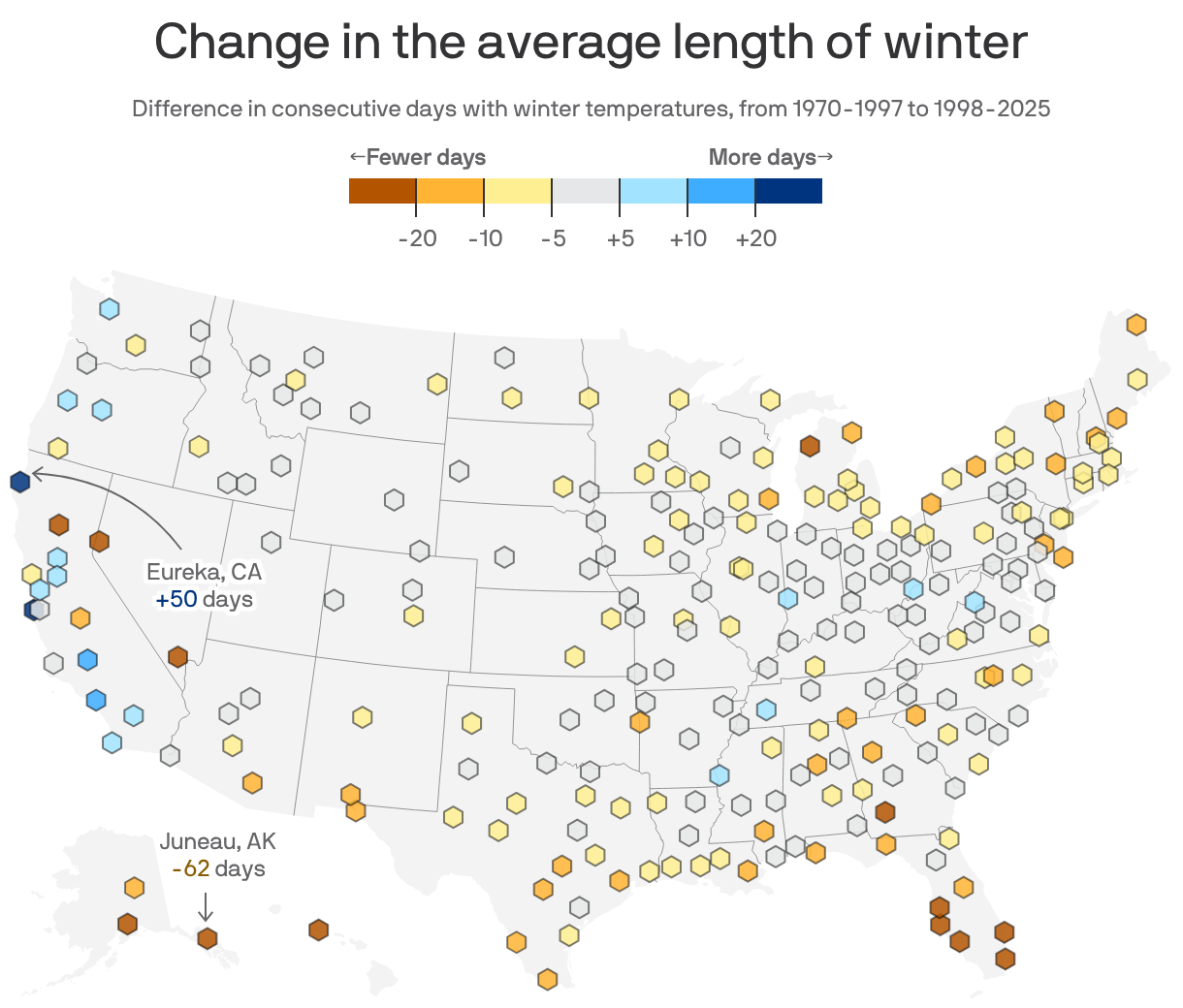
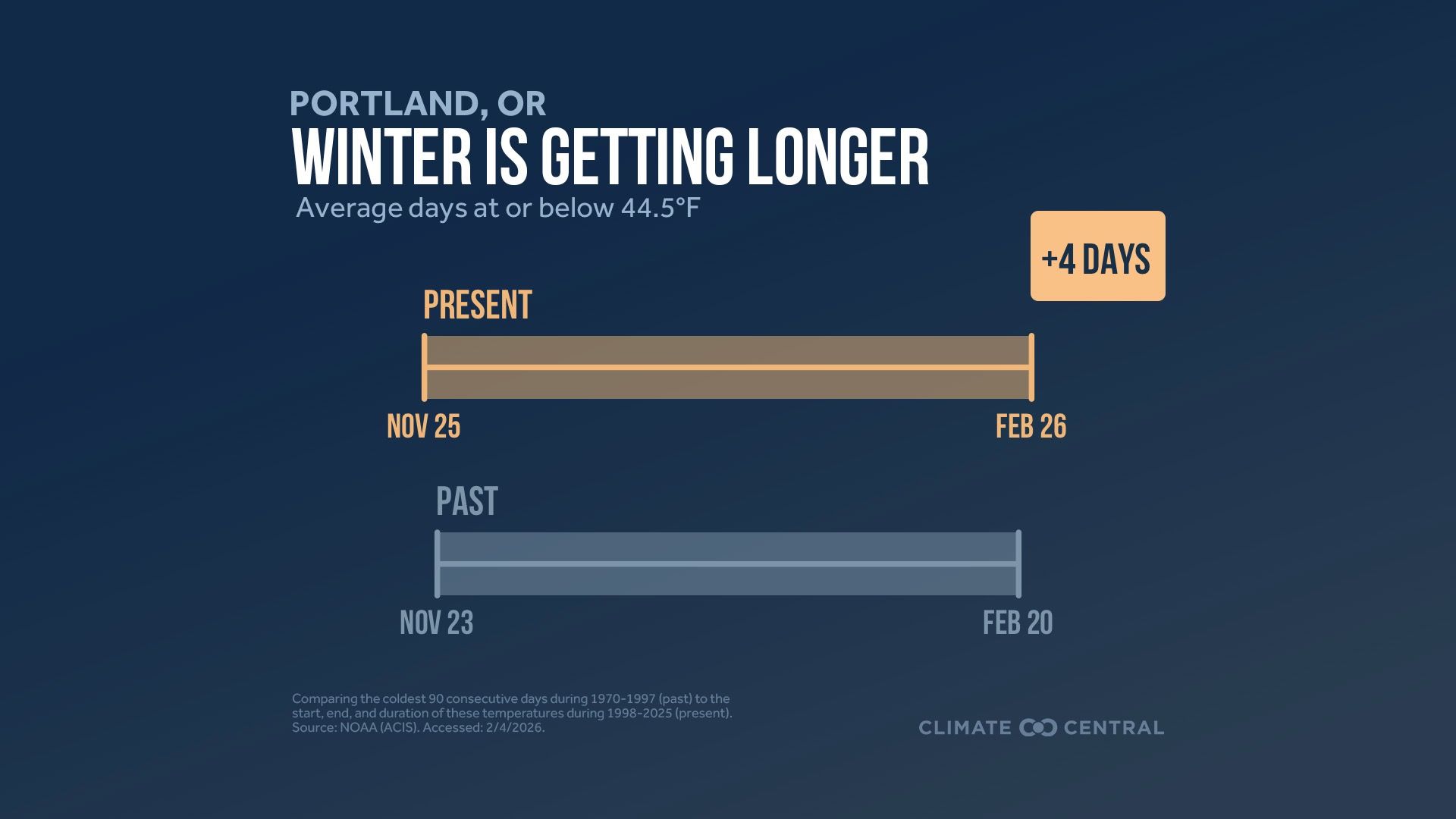
Winters are getting shorter across most U.S. cities amid climate change, but not in Portland.
- That's per a new analysis based on temperatures rather than calendar dates from Climate Central, a climate research group.
Driving the news: Compared to the 1970-1997 period, winters are now shorter in 80% of the 245 U.S. cities analyzed in the report.
- Among those 195 cities, winter lasts for nine fewer days on average.
Yes, but: Portland has bucked the trend, with four more days of temperature-defined winter, per the analysis.
- And we're not the only ones: On the California coast, Eureka's winters are now 50 days longer, while those in Monterey are 46 days longer.
Context: Winter has shortened the most in Juneau (62 days) and Anchorage (49 days), "consistent with exceptionally rapid warming in Alaska and other high-latitude locations," per the report.
- Among continental U.S. cities, Miami's winters have shortened the most (38 days).
How it works: Climate Central defined "winter" as the coldest 90 days of the year in a row during the 1970-1997 period, then compared the frequency of those temperatures during the 1998-2025 period.
- That temperature-based approach is different from the way seasons are traditionally defined by calendar dates.
The big picture: The report comes as millions of Americans in other parts of the country are enduring a frigid, icy winter.
- Meanwhile, those of us in the West are staring down a snow drought that has hampered winter recreation and could have big implications for summer wildfires and water supplies.
🤔 Kale is reminding himself of the difference between current weather and long term climate trends after writing that last story.
🤒 Meira is taking a rest day.
This newsletter was edited by Geoff Ziezulewicz.
Sign up for Axios Portland