
Axios Portland

April 25, 2024

It's Thursday, or 80:20 Rule Day.
☔️ Today's weather: Rain. High 54, low 49.
Sounds like: "Grow Old" by Body Orchestra
🍎 Situational awareness: Parents and caregivers of kids turning 3 or 4 on or before Sept. 1 have until Tuesday to apply for Multnomah County's Preschool for All for the upcoming school year.
Today's newsletter is 910 words — a 3.5-minute read.
1 big thing: Village and motel shelters show success
Tiny-home and motel-converted shelters across the metro area appear to be better at connecting those experiencing homelessness to permanent housing than larger traditional sites, according to recent report from Portland State University.
Why it matters: The findings detail what's working and what's not in how the region addresses — and allocates funding to — its worsening homelessness crisis.
By the numbers: While congregate shelters — where many people stay in one big room for up to a few days — are cheaper to build and operate, motels and villages have been more successful at placing people into housing.
- Motels and village sites operated by the Joint Office of Homeless Services (JOHS) saw the highest number of people going on to permanent and temporary housing — 34% and 42%, respectively.
What they're saying: There's no record of where nearly half of the people who exited congregate shelters went, while "a large number" returned to unsheltered homelessness.
- That's according to Jacen Greene, assistant director of PSU's Homelessness Research and Action Collaborative, which conducted the study.
Context: The city's Safe Rest Villages program opened in 2022, while several motel shelters that opened during the pandemic have been expanded to serve those with medical problems.
What they did: PSU researchers were asked by JOHS to conduct interviews and review data and budgets from several government agencies to determine operating costs and exit outcomes.
What they found: Greene said smaller shelters award residents with close-knit communities — several village sites focus on serving members of the BIPOC and LGBTQ+ communities — and allow them to form relationships with social service staff.
- "The findings support our work on building out a range of shelter options that match the diverse needs of people experiencing homelessness — all while being cost-effective," Julia Comnes, a JOHS spokesperson, told Axios via email.
Follow the money: It costs $20,400 on average per unit to operate a congregate shelter yearly, according to the report — the cheapest shelter option.
- Motel shelters cost on average $104,000 to acquire and $43,400 to run annually per unit.
- Safe Rest Villages built on city-owned land don't have expensive leases, but the short lifespan of the 8-by-8-foot pods and third-party contracts drive up costs. (The report found it costs $55,000 per unit to run these sites annually, the most expensive of shelter types.)
2. Portland traffic deaths reach record high
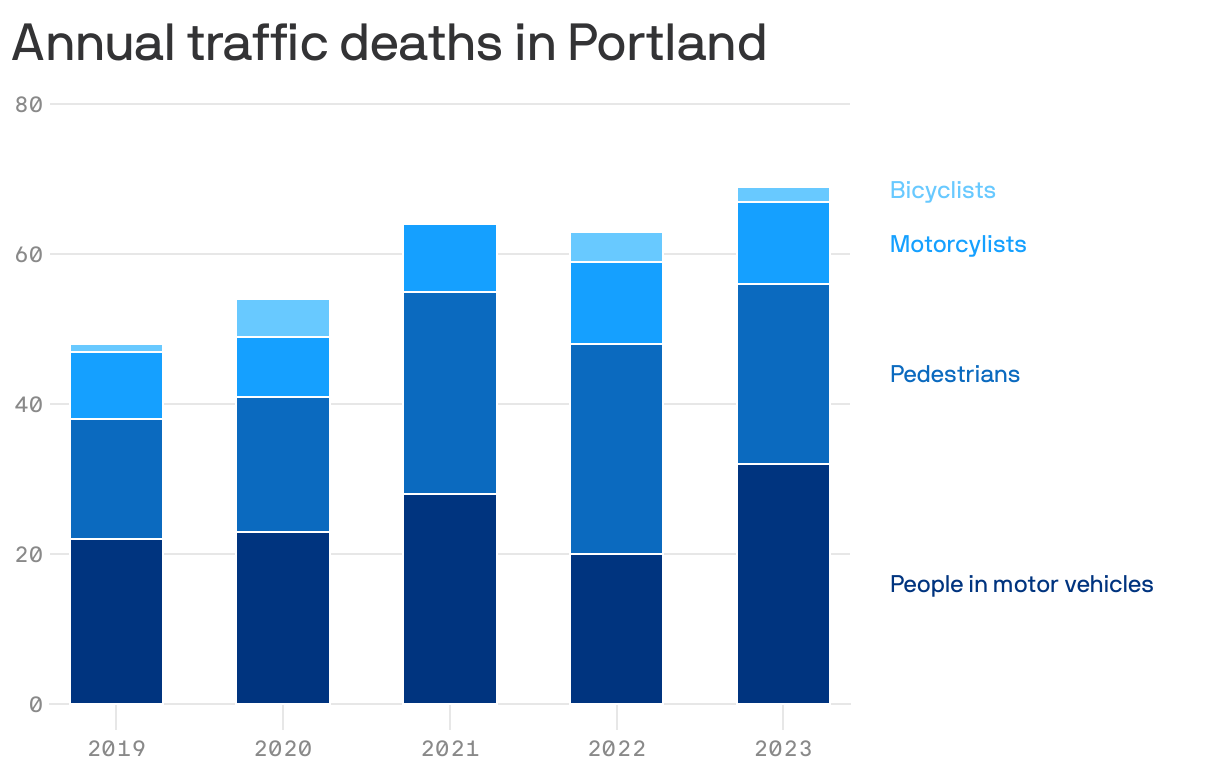
The city saw a record-high number of deaths on Portland roads last year, despite efforts to make them safer.
Why it matters: In 2015, Portland committed to eliminating traffic-related deaths within 10 years as part of its Vision Zero plan, but fatalities have increased since.
- Last week, the Portland Bureau of Transportation presented two reports on traffic safety to the Portland City Council and called for more collaboration to reduce traffic deaths and serious injuries.
By the numbers: Of 69 people killed last year on city roads, 32 were in cars and 24 were pedestrians (including those on scooters). That's an increase from 2019 when 22 people in cars and 16 pedestrians died.
What they're saying: Vision Zero reduces fatal crashes where money has been invested in street improvements, a transportation spokesperson said.
- In areas like parts of Beaverton Hillsdale Highway where speed cameras were installed in 2016, "we've seen a dramatic reduction in speeding on that corridor," Dylan Rivera told Axios.
How it works: The city is focusing on "high crash corridors" where 74% of traffic deaths occurred — lowering speed limits, installing cameras and adding crosswalks that make it easier to see pedestrians crossing.
What we're watching: The $55 million 82nd Avenue Critical Fixes project begins this summer, which aims to make one of the city's most dangerous streets safer with medians, trees, better lighting and more crossings.
- Nineteen people died on 82nd Avenue from 2007 to 2022.

3. Rose City Rundown
👷 The Working Families Party of Oregon received one of the largest political donations in Oregon so far this year.
- The party received a $340,000 check from the Working Families Party National PAC of Brooklyn, N.Y. — what the group will do with its windfall is sure to show up in the state's campaign filing system soon. (Willamette Week)
🚔 Multnomah County Central Library downtown will get more external lights to deter drug dealing, as surrounding streets have become the latest hot spot for fentanyl use. (The Oregonian)
🍷 Former Trail Blazer Channing Frye's Chosen Family Wines received high praise from New York Times wine writer Eric Asimov in "The Pour" column. (NYT)
4. 📑 Verselandia drops tonight
Verselandia is a youth poetry slam for students from Portland and east Multnomah County public high schools. And they're amazing!
What to expect: No doggerel here, no winsome, sub-Taylor torture, no Multnomah Club mumble rap...
- These teens put their hearts into their poems.
- They get up on stage, in front of thousands of peers and parents, and speak their truth. Out loud.
If you go: 7pm tonight, Arlene Schnitzer Concert Hall, $10-$70.
5. 🌙 1 photo to go: Moonshot Tavern opens
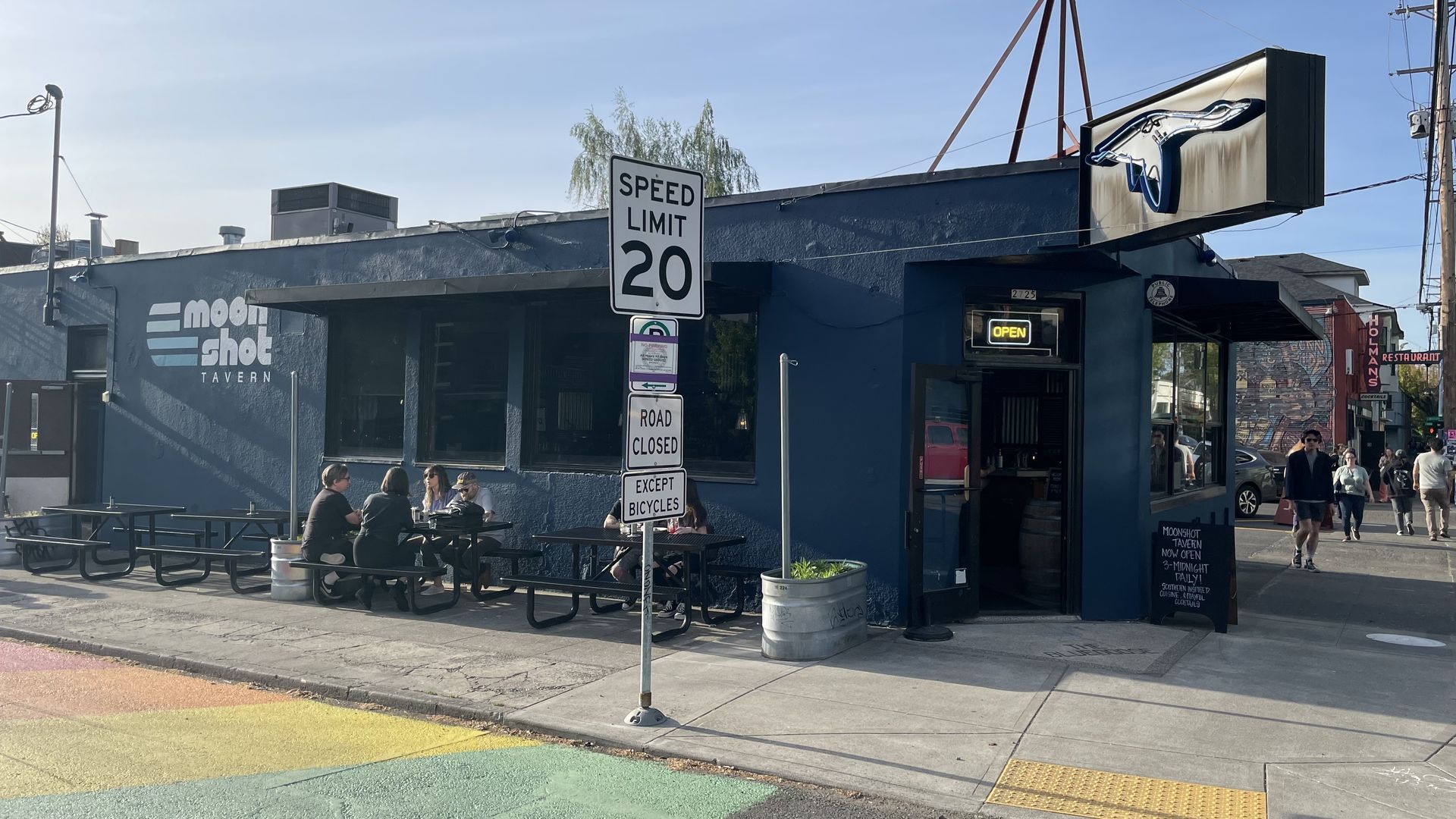
Moonshot Tavern has taken over the space on SE Ankeny and 28th Avenue once home to The Goose, a neighborhood favorite for spicy margaritas and Tex-Mex, which closed during the pandemic and never reopened.
Zoom in: Moonshot opened earlier this month, and offers Southern-style fare — hush puppies, rockfish, Creole cream pastas and pot roast with grits — from chef Kevin Jones, previously of the now shuttered Yonder.
- It also has a robust cocktail (and mocktail) program from bartenders Sean McGurn and Josh Love.
If you go: The bar is open daily 3pm-midnight.
💰 Joseph is dropping off six green bags of La Croix cans.
📕 Meira is proud of herself for finishing at least one book this year, even if it sat on her nightstand for the last nine months.
This newsletter was edited by Rachel La Corte and copy edited by Steven Patrick and Anjelica Tan.
Sign up for Axios Portland


/2024/04/24/1713998596783.gif?w=3840)