Axios Portland

August 24, 2026


1 big thing: 🛝 School recess is back in play
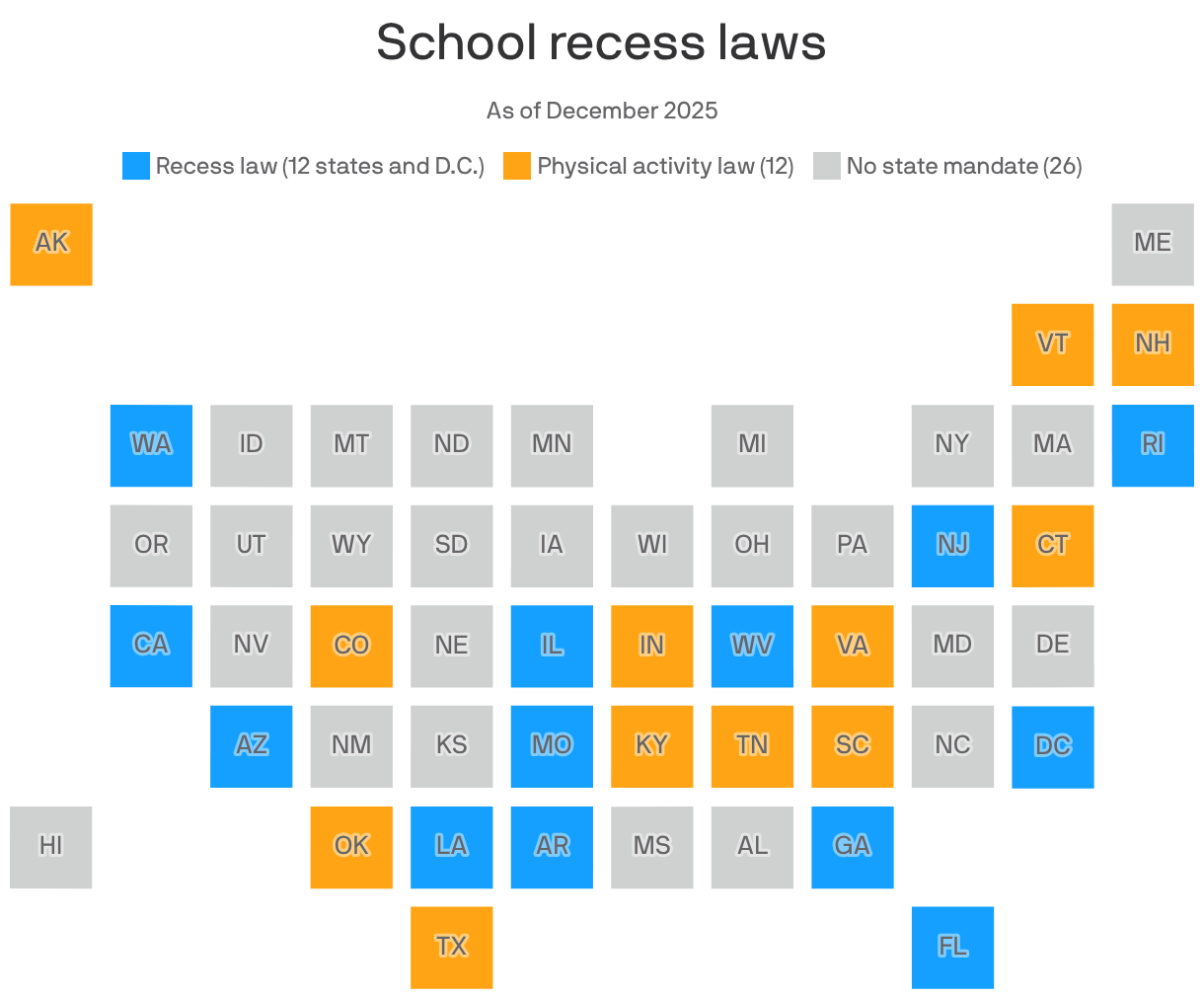
After decades of diminished recess time, nearly half of U.S. states now require it or other physical activity by law.
Why it matters: Yes, recess is literally child's play. But researchers, pediatricians and parents say it's crucial for young students' physical and mental health.
By the numbers: As of December, school recess is mandated in 12 states and D.C., and laws requiring physical activity exist in 12 states, according to Johns Hopkins research.
Zoom in: Lawmakers in Oregon attempted to pass a law mandating recess last year, but the bill never made it out of committee.
Between the lines: "Physical activity" laws are broader than "recess" ones.
- They could include after-school sports and gym class. And, separately, nearly every state has P.E. legislation.
- But physical activity and P.E. laws don't necessarily require free play, which advocates say is a daily necessity for kids.
The big picture: Unstructured play doesn't just teach social skills, but research connects it to increased classroom motivation and behavior, better school attendance, and less stress for students.
- And more physical activity could help academic performance.
What they're saying: "Recess gives you a better feeling about school. Recess refreshes you. Recess helps you feel a little bit less cynical about what's going on," psychologist Peter Gray, author of forthcoming "Restoring Childhood," tells Axios.
- "Anyone who's ever spent even a day with a kid can recognize that if you kept them sitting all day, they'd go insane, they'd drive everybody else insane," says Hannah Thompson, a physical activity epidemiologist with UC Berkeley's Nutrition Policy Institute.
- Although schools don't tend to fight the idea of recess itself, Thompson says it can be a challenge for administrators to carve out more time for it and ensure it's not withheld as punishment.
Catch up quick: From 2001 to 2019, weekly recess time in U.S. schools dropped by 60 minutes, education consulting company EAB found.
- One oft-cited factor for the decline: The signing of "No Child Left Behind" in 2002, which led to more time focused on reading, math and school testing — and less on recess.
2. 📓 Back to school spending


U.S. families expect to spend nearly $1,000 on average on back-to-school shopping this year, according to a PwC survey.
- Nearly half expect to spend more than they did last year.
State of play: Families in the Northeast, West and Midwest plan to outspend the national average of $922 — which includes clothes, tech, equipment for after-school activities, books, school supplies and other one-time purchases.
What's happening: Prices are higher, classroom needs have changed and kids have more say over what families buy — including requests for pricier items.
- They're seeing more ads on screens and often using digital wallets to buy things without parental interference, PwC's Kelly Pedersen tells Axios.
The big picture: Total K-12 back-to-school spending could climb around 10% this year compared to last, hitting a record $43.3 billion, the National Retail Federation forecasts.
Reality check: The spending doesn't stop once school starts.
- Households nationwide plan to spend $635 a month on recurring expenses like meals, snacks and tutoring, per PwC.
3. Rose City Rundown


Axios Portland
